Fibre Rollout Bochum 2026: GELSEN-NET and Ruhr Valley Infrastructure
The fibre rollout in Bochum by GELSEN-NET marks a turning point for FTTH infrastructure in the Ruhr Valley: by end of 2026, over 50,000 households in Bochum will have direct access to fibre optic connections, while backbone networks are simultaneously being expanded with high-density splice systems for up to 288 fibres. Technical implementation requires precisely coordinated components from the main distribution point to the building connection, with modular splice boxes accommodating 96 fibres in 1RU forming the critical infrastructure.
As a municipal network operator, GELSEN-NET is deploying future-proof system solutions for fibre rollout that meet rising bandwidth demands for decades to come. The challenge lies not only in laying fibre optic cables, but above all in efficient distribution and management of fibres within network distribution frames.
Technical Requirements for FTTH Rollout in Bochum
Fibre rollout in Bochum presents special demands on splice technology in use. At main distribution stations, up to 1,728 fibres must be terminated in minimal space. This requires high-density splice systems that are simultaneously service-friendly and standards-compliant to IEC 61754.
GELSEN-NET’s technical planning provides for a three-tier network architecture: from central backbone through local exchange points to building termination points. Each tier requires specific splice solutions with different packing densities and connector types.
- Backbone tier: MPO/MTP connectors for 12 to 72 fibres
- Distribution network: LC-APC duplex with attenuation < 0.25 dB
- Building connection: SC-APC simplex for individual fibre connections
- Redundant links: E2000-APC with enhanced return loss
GELSEN-NET Network Strategy for FTTH in the Ruhr Valley
GELSEN-NET’s strategy for fibre rollout in Bochum is based on systematic densification of the existing network. Previously installed empty ducts are being equipped with modern micro-cables capable of accommodating up to 288 individual fibres. This high fibre density requires correspondingly powerful splice systems in distribution cabinets.
| Expansion Phase | Timeline | Households | Fibre Density | Splice System |
|---|---|---|---|---|
| Phase 1 | Q1–Q2 2026 | 15,000 | 96 fibres | 1RU module |
| Phase 2 | Q3–Q4 2026 | 20,000 | 144 fibres | 2RU module |
| Phase 3 | Q1 2027 | 15,000 | 288 fibres | 3RU/4RU systems |
The modular design of the splice boxes used enables staged expansion without service interruption. This is particularly important for continuous supply to already-connected customers during the expansion phase.
Splice Technology and Distribution Systems in Municipal Fibre Networks
For municipal network operators like GELSEN-NET, selecting the right splice technology is critical to the economic success of FTTH rollout. Investment in high-quality splice modules with 5-year warranty reduces operational costs in the long term through lower failure rates and simplified maintenance.
Modern splice systems must meet diverse requirements: they must achieve high packing density of 96 fibres in 1RU while remaining service-friendly. Accessibility to individual fibres without compromising adjacent connections is essential.
Fiber Products Quality Promise: As an official Diamond Partner and manufacturer, we produce modular splice systems in Europe. Benefit from Swiss precision and in-house manufacturing.
- Front-side access to all connectors
- Colour-coded cassettes to DIN VDE 0888
- Integrated cable management with bend radii > 30 mm
- Interchangeable front plates for different connector types
- Documentation system with QR codes per cassette
Standards Compliance and Quality Assurance in Bochum Fibre Rollout
GELSEN-NET maintains strict compliance with international standards for FTTH Ruhr Valley rollout. All components must meet standards IEC 61300 for optical connectors and IEC 61754 for connector faces. Attenuation values must not exceed 0.25 dB for LC connectors.
Return loss for APC connectors must be at least 60 dB to prevent signal interference in high-speed transmission links. These strict requirements guarantee future-proof infrastructure for upcoming transmission standards up to 400 Gigabit.
Additionally, GELSEN-NET requires compliance with fire safety standard EN 50575 for all in-building components. Splice boxes must meet fire classification Dca-s2,d2,a1 to minimise fire and smoke spread in emergencies.
Challenges of Urban Fibre Installation in the Ruhr Valley
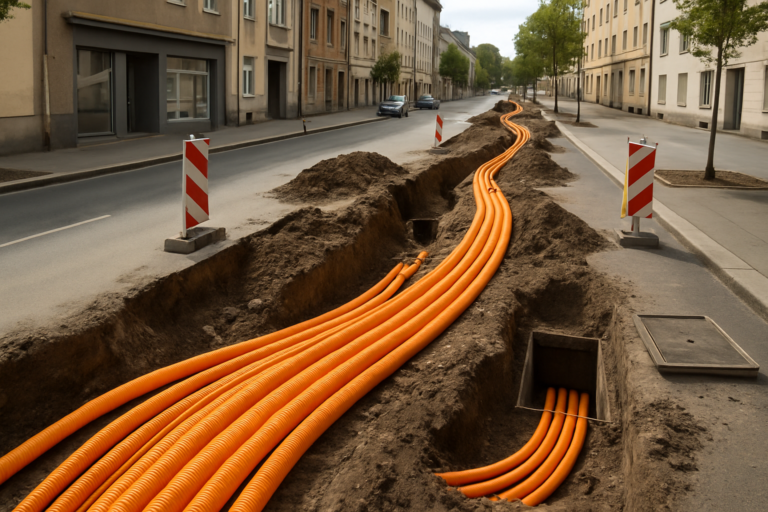
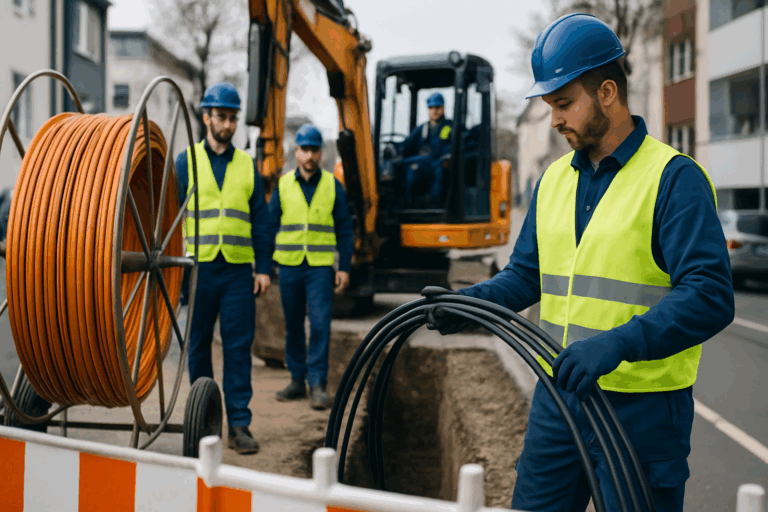
Fibre rollout in Bochum faces specific challenges of the densely populated Ruhr Valley region. Existing underground infrastructure of gas, water and electricity lines complicates route planning. GELSEN-NET therefore employs minimally invasive installation techniques such as trenching with just 10 cm slot width.
- Micro-cable blowing-in technique through existing empty ducts
- Horizontal directional drilling beneath main traffic roads
- Building entry via existing utility shafts
- Coordination with other utilities for joint use of routes
High building density requires compact distribution cabinets with maximum fibre density. Here modular splice systems come into use, enabling termination of up to 288 fibres in minimal space. Cabinets are preferably integrated into existing equipment rooms or basement areas.
Investment Volume and Economic Viability of FTTH Rollout
GELSEN-NET is investing an estimated total of €75 million in fibre rollout for Bochum. Approximately 20 percent is allocated to passive network infrastructure including splice technology and distribution systems. Choosing high-quality components with extended warranty periods significantly reduces lifecycle costs.
| Cost Item | Share | Investment | Amortisation |
|---|---|---|---|
| Civil works | 60% | €45m | 25 years |
| Fibre cable | 15% | €11.25m | 30 years |
| Splice technology | 10% | €7.5m | 20 years |
| Active equipment | 10% | €7.5m | 7 years |
| Planning/documentation | 5% | €3.75m | – |
Refinancing occurs through monthly connection fees averaging €40 to €60 per customer. At an anticipated uptake rate of 40 percent, the investment amortises within 12 to 15 years.
Technical Specifications of Splice Modules in Use
For fibre rollout in Bochum, GELSEN-NET uses standardised splice modules combining high packing density with ease of handling. Modules must integrate into 19-inch cabinets to IEC 60297 and have a maximum depth of 300 mm.
Splice cassettes within modules accommodate 24 individual fibre splices or 12 ribbon cable splices each. Excess lengths are managed at defined radii of at least 30 mm to avoid attenuation losses from macrobending. Each cassette is individually removable and uniquely identified.
- Capacity: 96 fibres in 1RU or 288 fibres in 3RU
- Connector types: LC, SC, E2000, ST, FC in PC and APC versions
- Insertion loss: < 0.25 dB for LC, < 0.3 dB for SC
- Return loss: > 50 dB for PC, > 60 dB for APC
- Operating temperature: −20°C to +70°C
- Protection class: IP20 for indoor environments
Quality Assurance and Documentation in FTTH Networks
GELSEN-NET implements comprehensive quality management during FTTH Ruhr Valley rollout. Every splice connection is verified with an OTDR instrument at 1310 nm and 1550 nm and documented. Measurement records are digitally archived and accessible via QR codes on splice cassettes.
Documentation includes attenuation values as well as geographic location, installation depths and crossing points with other infrastructure. This data flows into a central GIS system serving as the foundation for future expansions and fault resolution.
As a manufacturer of modular fibre optic solutions, Fiber Products supports network operators with pre-configured splice modules tested and documented at the factory. The 5-year warranty on all system components provides additional investment security.
Future Prospects for Fibre Rollout in the Ruhr Valley
Fibre rollout in Bochum by GELSEN-NET is part of a comprehensive digitalisation strategy for the entire Ruhr Valley region. By 2030, over 2 million households across the region should have access to fibre optic connections. This requires coordinated collaboration among all municipal network operators.
Technical standardisation plays a key role here. Unified splice systems and connector standards enable economic operation of regional networks. System modularity allows flexible adaptation to future transmission technologies such as WDM-PON or 50G-PON.
- Preparation for 5G mobile networks through fibre connectivity of transmission masts
- Integration of edge computing sites into network architecture
- Expansion of redundant routes for critical infrastructure
- Implementation of AI-supported network management systems
- Preparation for quantum communication through polarisation-maintaining fibres
Funding and Regulatory Framework
Fibre rollout in Bochum benefits from various funding programmes at state and federal levels. The federal Gigabit funding programme supports rollout in underserved areas with up to 50 percent of eligible costs. GELSEN-NET strategically uses these programmes for economically challenging rural areas.
The German Federal Network Agency has created a framework for open-access models through amendments to the Telecommunications Act. GELSEN-NET opens its network to other providers, creating additional refinancing opportunities. Technical implementation requires neutral handover points with standardised interfaces.
DigiNetz legislation also simplifies joint installation of fibre cables during other civil works. This reduces deployment costs by up to 30 percent in already-developed areas.
FAQ on Fibre Rollout in Bochum and FTTH Technology
What transmission speeds are possible with the GELSEN-NET fibre network?
GELSEN-NET’s FTTH network supports symmetric bandwidth of 1 Gigabit to 10 Gigabit per connection. The PON technology used enables future upgrades to 50 Gigabit without replacing passive infrastructure.
How long does building installation of a fibre connection take?
Pure installation time is short where building entry exists. This includes mounting the fibre subscriber connection, splicing fibres and commissioning the ONT device.
What splice methods are used in FTTH rollout?
GELSEN-NET primarily uses fusion splice connections with attenuation values below 0.05 dB. Pre-terminated connectors are deployed in distribution frames for fast reconfiguration.
How is network reliability ensured in the fibre network?
Critical network segments are redundantly configured with automatic switchover within 50 milliseconds. The 20 percent spare fibre reserve enables rapid repairs without redeployment.
What role do modular splice systems play in network expansion?
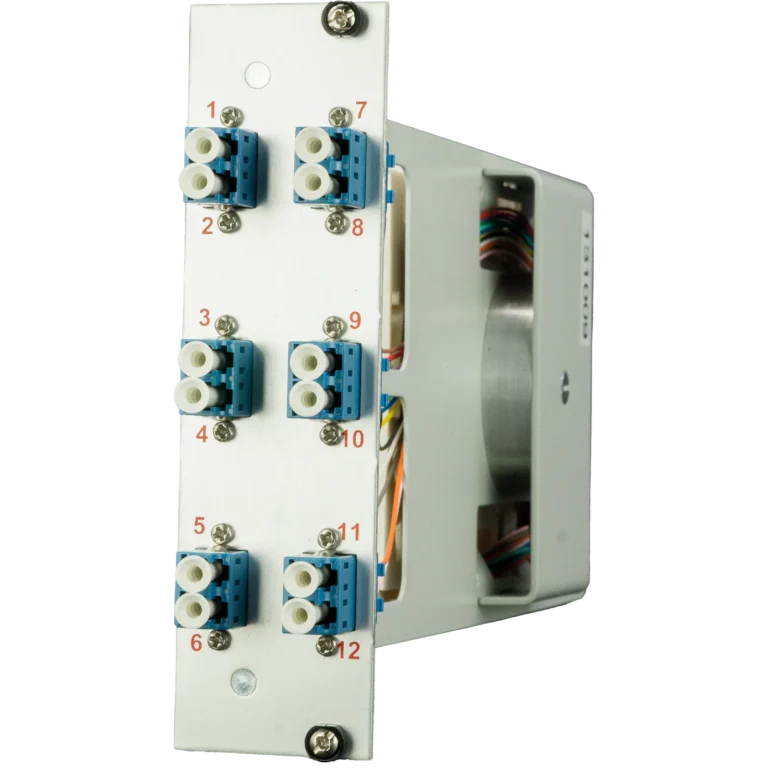
Modular systems like the SlimConnect 1RU splice boxes enable staged network expansion without service interruption. High packing density of 96 fibres in 1RU greatly reduces space requirements in equipment rooms.
How are fibre cables protected from mechanical damage?
Cables are installed at a minimum depth of 60 cm and marked with warning tape. In critical areas, additional PE-HD cable protection tubes with 3 mm wall thickness are used.
Conclusion: GELSEN-NET as Leader in Fibre Infrastructure
Fibre rollout in Bochum by GELSEN-NET exemplifies how municipal network operators advance digital transformation. With an investment volume of €75 million and deployment of state-of-the-art splice technology, future-proof infrastructure is being created for the coming decades.
Consistent use of modular splice systems with high packing density enables economic rollout while maintaining flexibility for future expansion. For utilities and municipal network operators, this approach provides a proven model for their own FTTH projects.
As a partner for professional fibre optic solutions, Fiber Products supports network operators with a comprehensive portfolio of splice modules and distribution systems in guaranteed Diamond quality—engineered and manufactured in Europe for maximum reliability in FTTH rollout.
Order directly from the shop: fiber-products.com
Request a Quote Today
Free consultation – personalised quote within 24 hours