Fiber optic expansion for municipal utilities 2025: The complete strategy guide for successful FTTH projects

The roll-out of fiber optics to municipal utilities in Germany will gain increasing momentum in 2025, with municipal utilities playing a key role in the digital transformation of their municipalities. As municipal companies, they are faced with the unique opportunity to not only fulfill services of general interest, but also to act as a driving force for local economic development. This comprehensive guide shows successful strategies, financing models and best practices for municipal FTTH expansion.
Why municipal utilities are indispensable for FTTH expansion
Municipal utilities have decisive advantages in fiber optic expansion Municipal utilities: existing infrastructures, local market knowledge and the trust of citizens. This combination makes them ideal partners for sustainable FTTH (fiber-to-the-home) projects. While private telecommunications providers are often focused on returns, municipal utilities can pursue long-term strategies and also develop less profitable areas.
The strategic advantages of municipal fiber optic networks
Use existing infrastructure: Municipal utilities can make optimum use of their existing cable routes, civil engineering work and supply networks for the fiber optic expansion of municipal utilities. These synergies significantly reduce investment costs and accelerate the expansion.
Local value creation: Municipal fiber optic networks keep value creation local. Profits flow back into the municipality and can be used for further infrastructure projects.
Proximity to citizens and trust: As established local suppliers, municipal utilities enjoy a high level of trust among citizens. This makes the acceptance and marketing of fiber optic connections considerably easier.
Successful strategies for municipal fiber optic expansion
1. integrated network planning and civil engineering synergies
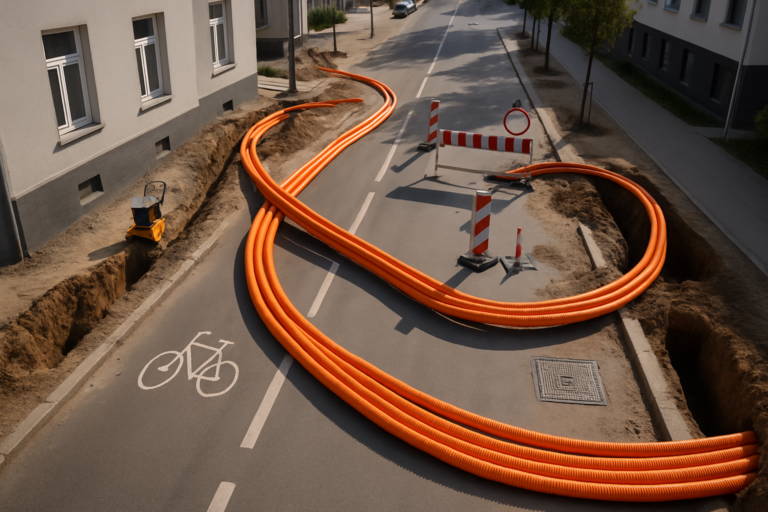
Intelligent municipal utilities coordinate the fiber optic expansion of municipal utilities with other infrastructure measures. When electricity, gas or water pipes are renewed, fiber optic ducts should be laid at the same time. This strategy reduces overall costs by up to 60 percent and minimizes citizen complaints due to repeated construction sites.
Maximize synergy effects:
- Shared use of excavation work
- Coordinated approval procedures
- Standardized construction site logistics
- Reduced traffic disruption
2. cooperation models and partnerships
Many municipal utilities rely on strategic partnerships with experienced telecommunications companies or other municipal utilities. These cooperations enable risk sharing, know-how transfer and more efficient procurement of splicing technology and fiber optic cables.
Successful special-purpose association model: Smaller municipal utilities join together to form special-purpose associations in order to jointly implement larger FTTH projects. This enables better conditions with suppliers and more professional project management.
Cooperation advantages:
- Risk minimization through shared investments
- Knowledge transfer and exchange of best practice
- Better negotiating position with suppliers
- Sharing specialized resources
3. phased expansion strategies
Successful fiber optic expansion municipal utility projects follow well thought-out phase planning:
Phase 1: Backbone expansion
- Structure of the main distribution points
- Connection to supra-regional networks
- Installation of splice boxes and distributors
Phase 2: Industrial estates
- Development of lucrative business customers
- Rapid amortization of investments
- Development of reference customers
Phase 3: Residential areas
- Gradual development based on demand
- Optimized marketing strategies
- Long-term customer loyalty
4. innovative financing models
Municipal utilities use various financing approaches for their fiber optic expansion projects:
Self-financing: utilization of existing liquidity and credit lines
Funding: federal and state funding programs
Citizen participation: Cooperative models and citizen loans
PPP models: public-private partnership with experienced investors
The biggest challenges for municipal utilities in 2025
Skills shortage and building up expertise
The acute shortage of qualified splice technicians and network planners poses considerable problems for many municipal utilities. It takes months to train their own specialists, while external service providers are often overloaded.
Solution approaches:
- Early personnel planning and training programs
- Partnerships with vocational schools and technical universities
- Cooperation with neighboring municipal utilities for knowledge exchange
- Investment in modern splicing technology for more efficient work processes
Regulatory complexity
Telecommunications regulation brings with it extensive compliance requirements. Municipal utilities have to deal with issues such as network charges, wholesale offers and non-discrimination.
Compliance challenges:
- Telecommunications Act (TKG) conformity
- Grid fee regulation
- Open Access obligations
- Data protection and security requirements
Technological decisions and future viability
Choosing the right FTTH technology (GPON, XGS-PON, P2P) has a long-term impact on capacity and profitability. Municipal utilities must make decisions that will still be viable in 20 years’ time.
Technology evaluation criteria:
- Scalability and future viability
- Investment and operating costs
- Vendor lock-in risks
- Compatibility with existing systems
Competition from established providers
Large telecommunications groups are reacting increasingly aggressively to municipal fiber optic expansion projects. They are using their market power for price wars and exclusive contracts with property management companies.
Competitive strategies:
- Focus on local benefits and proximity to citizens
- Premium service and personal support
- Flexible, customer-oriented solutions
- Partnership with local companies
Success factors for municipal utility fiber optic projects
Professional project management
Successful FTTH projects require professional project management with clear milestones, budget control and risk management. Many municipal utilities underestimate the complexity of fiber optic expansion projects.
Project management essentials:
- Detailed project planning with buffer times
- Regular monitoring and reporting
- Proactive risk management
- Stakeholder management and communication
Quality assurance for splicing work
The quality of the fiber optic splice connections determines the long-term network performance. Municipal utilities should define strict quality standards and carry out regular checks.
Quality criteria:
- Splice losses in line with standards (<0.05 dB)
- Documentation of all measurements
- Use of high-quality splicing components
- Regular training for technicians
Customer-oriented marketing
Technical excellence alone is not enough. Municipal utilities must market their fiber optic offerings in a customer-friendly way and provide excellent service.
Marketing strategies:
- Target group-specific packages
- Transparent pricing
- Personal advice on site
- Digital booking and service platforms
Economic prospects and funding landscape 2025
Current funding programs
The German government has recognized the importance of the expansion of fibre optics for municipal utilities and has launched various funding programmes. Municipal utilities can benefit from the following programs:
Gray-spot funding: Support for areas with inadequate broadband coverage
Gigabit vouchers: Support for businesses and schools
Municipal guideline: Direct funding for municipal digitization projects
Country-specific programs: Additional regional funding opportunities
Return on investment and amortization
Realistic fiber optic expansion municipal utility projects achieve payback periods of 12-18 years with self-financing. These periods can be shortened to 8-12 years through the clever use of subsidies.
ROI factors:
- Connection rate and penetration rate
- ARPU (Average Revenue per User)
- Operating costs and energy efficiency
- Additional business areas (B2B, Smart City)
Example calculation (10,000 households):
- Investment: 25 million euros
- Funding: 8 million euros (32%)
- Own contribution: 17 million euros
- Amortization: 14 years without / 10 years with subsidy
Best practices of successful municipal utility projects
Citizen involvement and communication
Successful municipal utilities invest in comprehensive citizen communication at an early stage. Information events, transparent timetables and regular updates create trust and reduce resistance.
Communication strategies:
- Early and transparent information
- Multimedia communication channels
- Regular progress reports
- Direct contacts for citizens’ questions
Digital planning tools
Modern GIS systems and digital network planning tools speed up planning and documentation considerably. Investments in these technologies pay off through more efficient project management.
Digitization benefits:
- Precise network planning and visualization
- Automated cost calculations
- Integrated project and resource planning
- Real-time monitoring of construction progress
Equipment selection and quality
The choice of high-quality splicing equipment and professional splice cassettes influences both working speed and network quality. Municipal utilities should not save money at the wrong end.
Selection criteria for equipment:
- Long-term reliability and guarantee
- Compatibility with different fiber types
- Ease of use and maintenance
- TCO consideration over the entire service life
Technology trends and future prospects
Integration of 5G and edge computing
Fiber optic networks form the backbone for 5G mobile communications and edge computing applications. Municipal utilities that build future-proof fiber optic infrastructures today are positioning themselves as enablers of the digital transformation.
5G backhauling requirements:
- High bandwidths (10+ Gbps per location)
- Low latency (<1ms)
- High availability (99.99%+)
- Scalable infrastructure
Smart City applications
Municipal fiber optic networks enable smart city applications such as intelligent traffic systems, IoT sensor networks and efficient energy management systems.
Smart City Use Cases:
- Intelligent street lighting
- Environmental and air quality monitoring
- Digital parking space management
- Networked mobility solutions
Sustainability and energy efficiency
Modern fiber optic technologies are more energy-efficient than copper lines and support climate targets. Municipal utilities can market their fiber optic expansion projects as a contribution to sustainability.
Sustainability benefits:
- 90% less energy consumption vs. copper
- Longer service life (25+ years)
- Recyclable materials
- Enabling digital efficiency solutions
Case studies of successful municipal utility projects
Stadtwerke Musterhausen: Full development in 5 years
Initial situation:
- 45,000 inhabitants, mixed settlement structure
- Poor broadband coverage (<50 Mbps)
- High demand from businesses and citizens
- Limited financial resources
Implementation strategy:
- Phased development according to profitability
- Strategic partnership with regional provider
- Optimal use of subsidies (35% subsidy rate)
- Intensive citizen communication and participation
Results after 3 years:
- 25,000 connections available (56% of the city)
- 18,000 active customers (72% take-up rate)
- ARPU: 45€/month on average
- Project is 8% under budget
Success factors:
- Systematic network planning with modular distributors
- High-quality splicing technology minimizes reworking
- Close coordination with other infrastructure measures
- Proactive customer care and service
Energy supplier RegioNet: Inter-municipal cooperation
Cooperation model:
- 8 Municipal utilities as shareholders
- Joint development of 120,000 households
- Division of labor according to competencies
- Central procurement and project management
Advantages of cooperation:
- 25% cost savings through economies of scale
- Risk sharing between partners
- Knowledge transfer and exchange of best practice
- Stronger negotiating position with suppliers
Lessons Learned:
- Clear governance structures essential
- Uniform technical standards required
- Regular coordination and communication
- Flexible adaptation to local conditions
Recommendations for municipal utilities
Strategic planning
Development of a long-term fiber optic roadmap:
- 10-20 year perspective with flexible milestones
- Integration into municipal development plans
- Consideration of demographic trends
- Scenario planning for different expansion speeds
Competence building
Investment in training and recruitment:
- Systematic personnel development plans
- Partnerships with educational institutions
- External advice for knowledge gaps
- Building up internal expertise in key areas
Partnerships
Evaluation of strategic cooperations:
- Examination of special-purpose association options
- Technology partnerships with manufacturers
- Service partnerships with service providers
- Inter-municipal exchange of experience
Funding optimization
Systematic use of available programs:
- Early application and reservation
- Professional funding advice
- Combination of different programs
- Compliance with funding guidelines
Quality focus
Implementation of strict standards:
- Definition of uniform quality criteria
- Regular audits and checks
- Investment in high-quality components
- Continuous improvement processes
Proximity to citizens
Building trusting communication:
- Transparent information about planning
- Direct contact for citizens’ concerns
- Regular information events
- Digital communication channels
Integration with high-quality splicing technology
Importance of professional components
High-quality splice boxes and distributors are essential for successful fiber optic expansion in municipal utilities. The quality of the passive components determines long-term network stability and maintenance costs.
Quality criteria for municipal utilities:
- Standard-compliant design according to current standards
- High packing densities for efficient use of space
- Modular expandability for growing requirements
- Long-term reliability with low maintenance requirements
Fiber Products solutions for municipal projects
Our modular fiber optic systems have been specially developed to meet the requirements of municipal network operators. From compact 1U splice boxes to expandable 4U systems, we offer scalable solutions for every project scope.
Advantages for municipal utilities:
- 5-year guarantee for long-term planning security
- European production with German quality standards
- Modular design for needs-based expansions
- Comprehensive technical support and advice
Conclusion: municipal utilities as fiber optic pioneers
In 2025, municipal utilities will have the unique opportunity to expand their role as infrastructure providers and make their municipalities digitally fit for the future. Successful fiber optic expansion municipal utility projects require professional planning, qualified implementation and a long-term perspective.
The most important success factors:
Strategic positioning:
- Utilization of municipal advantages (trust, infrastructure, proximity to citizens)
- Long-term perspective instead of short-term return orientation
- Integration into existing care structures
- Focus on sustainable regional development
Professional implementation:
- Systematic project planning and control
- Investment in high-quality technology and components
- Qualified personnel development
- Consistent quality assurance
Sustainable financing:
- Optimal use of funding programs
- Innovative financing models
- Realistic ROI planning
- Risk minimization through partnerships
The challenges are considerable, but the potential is even greater. Municipal utilities that act decisively now and invest in high-quality fiber optic technology and professional infrastructure are laying the foundations for the digital future of their region.
Investing in fiber optic expansion for municipal utilities is an investment in the future viability of the municipality – and thus in the well-being of citizens and the attractiveness for companies. Municipal utilities that seize this opportunity will be among the winners of the digital transformation.
At Fiber Products, we understand the special requirements of municipal fiber optic projects. Our municipal utility solutions combine technical excellence with economic efficiency. With European manufacturing to German quality standards and a 5-year guarantee, we offer the reliability that long-term infrastructure projects require.
Discover our complete product range or visit our online store. Contact us – together we will develop the optimal strategy for your municipal fiber optic expansion. Contact us for an individual consultation or find out more about other strategic topics in our fiber optic knowledge blog.