Tier 3 Data Centre Fibre Optic Infrastructure – High-Availability Requirements
Tier 3 Data Centre Fibre Optic Infrastructure – High-Availability Requirements
Tier 3 data centre fibre optic infrastructure requires 99.982% availability with a maximum of 1.6 hours downtime per year, achieved through redundant fibre paths, modular splice systems with up to 96 fibres per 1U, and standards-compliant connectors per IEC 61754. Tier 3 optical fibre infrastructure must remain maintainable while ensuring high-availability through N+1 redundancy and physically separated cable routes. Modern data centres deploy pre-terminated high-density assemblies with MPO connectors for 1.6T and 3.2T transmission speeds, increasingly driven by AI inference workloads.
Growing latency and bandwidth demands in data centres require precise fibre cabling planning. Whilst conventional systems typically accommodate only 48 fibres per rack unit, modern modular solutions enable double the packing density whilst improving accessibility.
Tier 3 Classification: What It Means for Fibre Optic Infrastructure
The Tier classification system from the Uptime Institute defines four levels of data centre infrastructure. Tier 3 stands for “Concurrently Maintainable” – maintenance-capable without operational interruption. For fibre cabling, this specifically requires redundant cable routes, separate entry points, and modular splice systems that can be expanded during live operation.
- Minimum two independent fibre entries from different directions
- Physically separated cable trays within the building with minimum 20-metre spacing
- N+1 redundancy for all critical components including patch fields
- Modular splice systems for interruption-free maintenance
- Documentation requirements per EN 50173-5 for structured cabling
Practical implementation requires well-designed cable management systems with adequate bend radii. For singlemode fibres, the bend radius must not fall below 30mm to maintain attenuation losses below 0.1 dB.
Redundancy Concepts for Tier 3 Optical Fibre Cabling
High-availability data centre operation relies on consistent redundancy from the building entrance to the server rack. Physical separation of fibre routes prevents single-point failures from causing total outages. Modern data centres implement ring topologies with automatic failover within 50 milliseconds.
| Redundancy Layer | Tier 3 Requirement | Technical Implementation |
|---|---|---|
| Building entry | 2 separate entrances | Different street frontages, min. 20m spacing |
| Backbone cabling | Dual routing | Separate fire compartments, OS2 fibres |
| Splice distribution | N+1 redundancy | Modular 1U systems, hot-swap capable |
| Patch connections | Active/passive configuration | Automatic failover < 50ms |
Splice reserve capacity is critical: at least 20% free capacity per splice cassette should be reserved for emergency repairs. This enables rapid response to cable damage without service disruption.
High-Density Splice Systems: Space Optimisation with Maximum Availability
Space requirements in modern data centres are increasing continuously. Whilst 24-fibre systems were once standard, current applications demand up to 9,000 fibres per cabinet. High-density splice systems resolve the conflict between space constraints and accessibility through modular design.
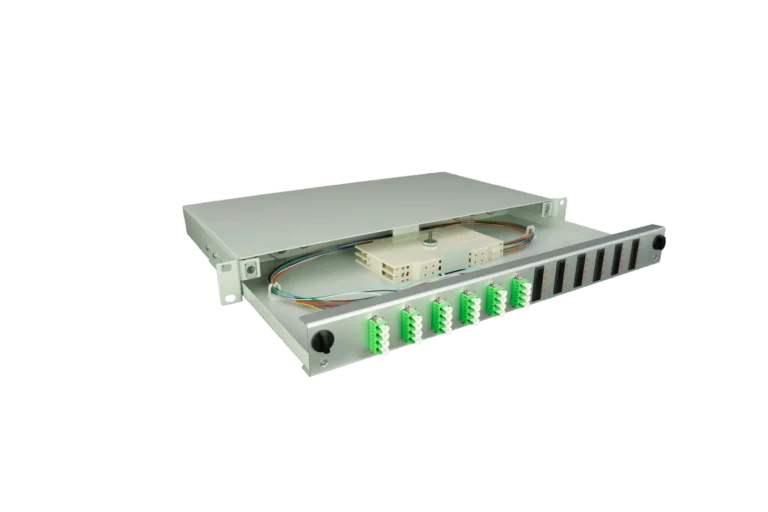
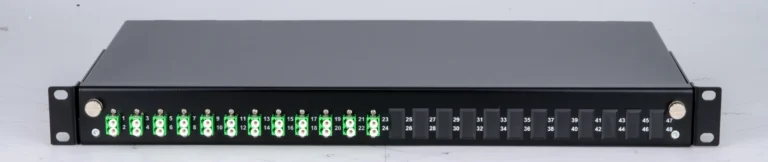
- SlimConnect systems: 96 fibres per 1U with front-facing accessibility
- VarioConnect solutions: up to 288 fibres on 3U with slide-out drawer
- Pre-terminated MPO/MTP modules for 12 or 24 fibres
- Colour coding per TIA-598-C for unambiguous identification
- Integrated cable management systems with defined bend radii
Fiber Products Quality Commitment: As an official Diamond partner and European manufacturer, we produce modular splice systems in-house. Benefit from Swiss precision engineering and in-house manufacturing.
Connector Selection for Tier 3: APC versus PC Comparison
Correct connector selection significantly impacts system performance. Whilst PC connectors (Physical Contact) suffice for many applications, critical Tier 3 environments often require APC connectors (Angled Physical Contact) with their 8-degree angled-polish technology.
| Property | PC Connector | APC Connector | Tier 3 Recommendation |
|---|---|---|---|
| Return loss | -45 dB | -60 dB | APC for critical paths |
| Insertion loss | < 0.3 dB | < 0.25 dB | Both suitable |
| Mating cycles | 500 | 500 | Identical durability |
| Cost | Standard | +15-20% | ROI through higher availability |
E2000 connectors particularly excel in Tier 3 environments through their integrated protective shutter and vibration resistance. As a Diamond partner, Fiber Products offers the complete E2000 product range for highest demands in data centre cabling infrastructure.
Cable Management and Documentation per EN 50174
The standard EN 50174 defines mandatory installation guidelines for data centres. Tier 3 requires complete documentation of every individual fibre from building entrance to end device. Modern cable management systems therefore integrate QR codes and digital twins for real-time documentation.
- Maximum cable fill in cable trays: 40% of cross-section
- Minimum spacing from power cables: 200mm for parallel routing
- Bend-radius compliance through predefined guide elements
- Colour coding of patch cables by function (yellow = singlemode, orange = multimode OM3/OM4)
- Label each cable at both ends with unique identifier
Documentation requirements extend to attenuation measurements, OTDR protocols, and splice records. Every change must be recorded in central documentation within 24 hours.
MPO/MTP Technology for 1.6T and 3.2T Transmission Speeds
AI inference workloads drive data centres toward ever-higher transmission speeds. MPO/MTP connectors with 12, 24 or 72 fibres per connector enable the required parallelisation. Tier 3 optical fibre infrastructure must consistently implement polarity methods A, B, or C.
Pre-terminated MPO cassettes reduce installation time compared to individual fibre splicing. Factory quality control guarantees insertion losses below 0.35 dB per MPO connection.
- Base-8 cabling for 400G applications with QSFP-DD transceivers
- Base-12 structure for maximum flexibility with mixed speeds
- OM5 fibres for wavelength-division multiplexing up to 100 metres range
- Cleaning protocol: inspect every MPO connection before mating
Scalability and Future-Proofing of Fibre Optic Infrastructure
Tier 3 data centre fibre infrastructure must be designed for a minimum 15-year operational life. Investment security requires forward-looking planning with adequate capacity reserves. Modular systems like VarioConnect 3U enable stepwise expansion without service interruption.
Migration to Co-Packaged Optics (CPO) by 2030 already requires preparation of cabling infrastructure today. Fiber Products splice systems are CPO-ready through their modular design and support all current form factors.
| Period | Technology Trend | Infrastructure Requirement |
|---|---|---|
| 2024-2025 | 400G standard | OM4/OM5, 8-fibre MPO |
| 2026-2027 | 800G/1.6T adoption | OS2 singlemode, 16-fibre MPO |
| 2028-2030 | 3.2T and CPO | Ultra-low-loss fibres, < 0.20 dB/km |
Maintenance Concepts for Interruption-Free Operation
Tier 3 is defined by concurrent maintainability without service interruption. For fibre infrastructure, this requires well-planned maintenance windows and redundant paths. Mean Time To Repair (MTTR) must not exceed 4 hours.
- Stockpile critical components on-site in the data centre
- Train maintenance personnel on specific splice systems
- Define escalation paths with 24/7 availability
- Regular attenuation measurements for early degradation detection
- Automatic failover to backup paths within 50ms
Monitoring and Performance Oversight of Optical Fibre Routes
Continuous monitoring identifies problems before they become critical. Modern Tier 3 data centres deploy automated OTDR measurements with alerting on threshold exceedance. Attenuation budgets must include 3 dB reserve for ageing.
Integration with higher-level DCIM systems (Data Centre Infrastructure Management) enables holistic oversight. Each fibre connection is assigned a unique identifier and continuously monitored for performance parameters.
Standards Compliance and Certification for Tier 3
Compliance with international standards is mandatory for Tier 3 data centres. Beyond the fundamental EN 50173-5 for data centre cabling, specific requirements apply for high-availability operation.
| Standard | Scope | Tier 3 Relevance |
|---|---|---|
| EN 50173-5 | Structured cabling in data centres | Core requirement |
| EN 50174-2 | Installation/cable management | Redundant routing |
| IEC 61754 | Connector specifications | Quality standard |
| ISO/IEC 14763-3 | Testing of fibre cabling | Acceptance protocol |
Fiber Products’ 5-year system warranty significantly exceeds minimum requirements and ensures long-term investment security.
Cost Optimisation Through Modular Systems
Total cost of ownership (TCO) for Tier 3 fibre infrastructure comprises initial investment, operational costs, and future expansion. Modular systems reduce TCO through reduced space requirements and faster installation.
- Lower cooling costs from more compact design
- Reduced labour costs from tool-free assembly
- Avoidance of overprovisioning through demand-based expansion
- Extended service life through modular component exchangeability
- ROI typically within 24-36 months
Practical Implementation: Step-by-Step Path to Tier 3 Standard
Migration of existing infrastructure to Tier 3 ideally progresses in defined phases. First, current conditions are documented and weaknesses identified. Implementation of modular splice systems then enables phased upgrades without service disruption.
As a manufacturer and Diamond partner, Fiber Products supports data centres in planning and implementing high-availability fibre optic infrastructure. Our modular SlimConnect and VarioConnect systems meet all Tier 3 requirements with maximum packing density.
FAQ: Common Questions on Tier 3 Fibre Optic Infrastructure
What minimum fibre count does a Tier 3 data centre require?
Minimum fibre count depends on facility size; typically one starts with 144 fibres in the backbone and provisions 100% reserve for redundancy and growth.
How do Tier 2 and Tier 3 differ in fibre cabling?
Tier 3 mandates complete redundancy with physically separated cable routes and N+1 configuration, whilst Tier 2 provides only partial redundancy with 99.741% availability.
What attenuation values are acceptable for Tier 3?
Total route attenuation should remain below 2.0 dB, with 3 dB reserve for ageing planned in. Individual connectors must not exceed 0.3 dB loss.
Can existing splice boxes be retrofitted for Tier 3?
Conventional splice boxes rarely meet modularity requirements. Migration to modular systems like SlimConnect enables phased upgrades during live operation.
What role do E2000 connectors play in Tier 3 environments?
E2000 connectors offer highest reliability through integrated protective shutter and spring mechanism. They excel for critical connections with high-availability demands.
How frequently must fibre routes be tested in Tier 3 data centres?
Initial acceptance testing occurs post-installation, followed by annual measurements. For critical routes, continuous monitoring with automatic alerting on threshold breach is recommended.
Request a Quote
Have questions about our fibre optic solutions? Our expert team is ready to advise you – free and with no obligation.