Fibre-Optic Infrastructure as Investment: Calculate ROI for Network Operators
Economic evaluation of fibre-optic infrastructure requires precise ROI calculation: network operators in the DACH region achieve full amortisation of their FTTH investments within 15 to 20 years with optimal planning.
Fibre rollout represents a strategic long-term investment for German network operators, with profitability dependent on numerous factors. At only 11.2 percent FTTH/FTTB coverage in Germany, significant expansion potential exists.
Understanding Key ROI Metrics for Fibre-Optic Investments
Economic evaluation of fibre projects is based on three central metrics: Return on Investment (ROI), Return on Capital Employed (ROCE), and Internal Rate of Return (IRR). ROI shows the ratio of net profit to investment costs over the entire project duration.
| Metric | Typical FTTH Values | Period | Critical Factor |
|---|---|---|---|
| ROI | 150–250% | 20 years | Take-rate |
| ROCE | 12–15% | From year 10 | Operating costs |
| IRR | 8–12% | Full duration | Initial investment |
| Payback | 8–10 years | — | Connection rate |
For municipal utilities, synergies with existing supply lines often yield better figures. Civil works costs are noticeably lower when laid jointly with electricity or gas lines.
Calculating Investment Costs for Fibre Rollout
Total investment for an FTTH network divides into several cost blocks. The largest share—60 to 70 percent—goes to civil works. Passive infrastructure including fibre-optic cable and splicing connections accounts for a further 20 to 25 percent.
- Civil works: €50 to €120 per metre of route length
- Fibre-optic cable and ducts: €8 to €15 per metre
- Building connection (NE4): €800 to €1,500 per building
- Splicing technology and distribution: €150 to €300 per connection
- Active technology: €200 to €400 per port
The new VDE guideline 2026 for building cabling reduces installation time by 20 to 30 percent. modular splice systems save additional assembly time.
Take-Rate as Critical Success Factor for FTTH Profitability
Connection rate is the primary determinant of a fibre project’s economic success. Below a take-rate of 25 percent, FTTH break-even analysis. Successful network operators achieve rates of 40 to 60 percent through active sales.
Customer uptake typically follows an S-curve: in the first two years, 15 to 20 percent of households connect. After five years, the rate stabilises at 35 to 45 percent. Municipal utilities with existing customer relationships often achieve higher values.
Fiber Products Quality Promise: As an official Diamond Partner and manufacturer, we produce modular splice systems in Europe. Benefit from Swiss precision and in-house manufacturing.
Optimising Operating Costs and Ongoing Expenses
Annual operating costs typically amount to 3 to 5 percent of initial investment. By using high-quality components with longer maintenance intervals, these costs can be significantly reduced.
| Cost Type | Annual Costs | Optimisation Potential |
|---|---|---|
| Passive infrastructure maintenance | 0.5–1% of investment | Quality components |
| Fault rectification | €20–€40 per connection | Preventive maintenance |
| Documentation/monitoring | €5–€10 per connection | Digitalisation |
| Spare parts/inventory | 0.3–0.5% of investment | Standardisation |
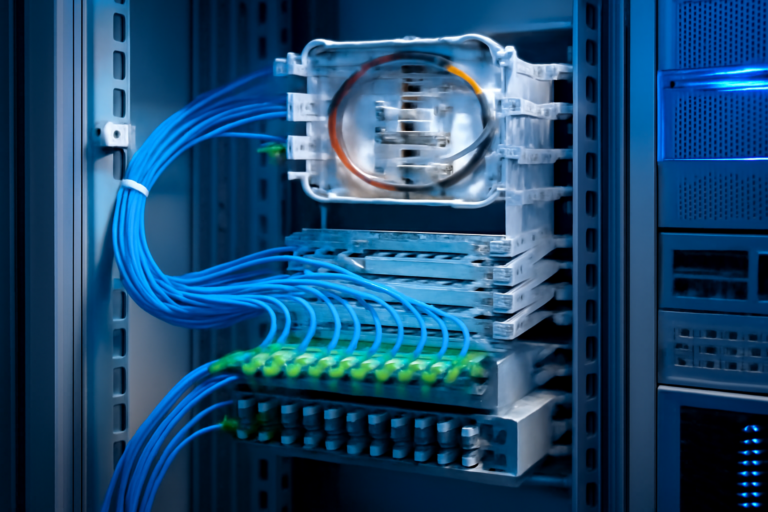
Modular splice systems such as the SlimConnect series with up to 96 fibres in 1U significantly reduce space requirements and thus rental costs for technical rooms.
Revenue Models and Sales Potential for Network Operators
Revenue structure in the fibre business is based on recurring monthly income. Municipal utilities and public network operators can choose between various business models: from pure infrastructure provider to full-service provider with proprietary services.
- Layer 1/2 wholesale products: €15 to €25 monthly per connection
- Business customer connections: €150 to €500 monthly
- Data centre connections: €500 to €2,000 monthly
- Mobile backhaul (5G): €200 to €800 per site
- Proprietary internet products: €40 to €80 monthly
Average revenue per user (ARPU) among successful network operators ranges from €35 to €45 monthly. Business customers generate disproportionately higher margins.
Sensitivity Analysis: Risk Factors for Fibre ROI
Profitability is highly sensitive to changes in input parameters. A 10-percent increase in construction costs shifts break-even by approximately one year. Schedule delays harm profitability doubly through lost revenue.
Critical risk factors include NE4 costs in multi-family buildings, which can exceed €2,000 in complex structures. Standardisation through the new VDE guideline and use of pre-terminated modules provide solutions.
- Construction delay of 6 months: ROI reduction of 5 to 8 percent
- Take-rate 10 percentage points lower: Break-even shifts by 2 to 3 years
- Construction costs 20% higher: IRR declines by 2 to 3 percentage points
- Higher interest rates (+2%): Capital costs rise by 15 to 20 percent
Subsidy Schemes and Their Impact on FTTH Profitability
State subsidies significantly improve the business case. The grey-spots programme covers up to 50 percent of eligible costs. The profitability gap narrows accordingly.
The Federal Network Agency requires open-access obligations for at least seven years on subsidised projects. This secures additional wholesale revenue from alternative service providers. Municipal utilities benefit from their neutral market position.
Technical Standards and Their Impact on ROI
Selecting the right technical standards affects both initial investment and operating costs significantly. Standard IEC 61754 defines requirements for fibre-optic connectors.
| Connector Type | Application | Attenuation | Cost Index |
|---|---|---|---|
| LC/APC | Standard FTTH | < 0.3 dB | 100% |
| SC/APC | Distribution | < 0.3 dB | 90% |
| E2000/APC | Industrial/premium | < 0.2 dB | 150% |
| MPO/MTP | Data centres | < 0.35 dB | 300% |
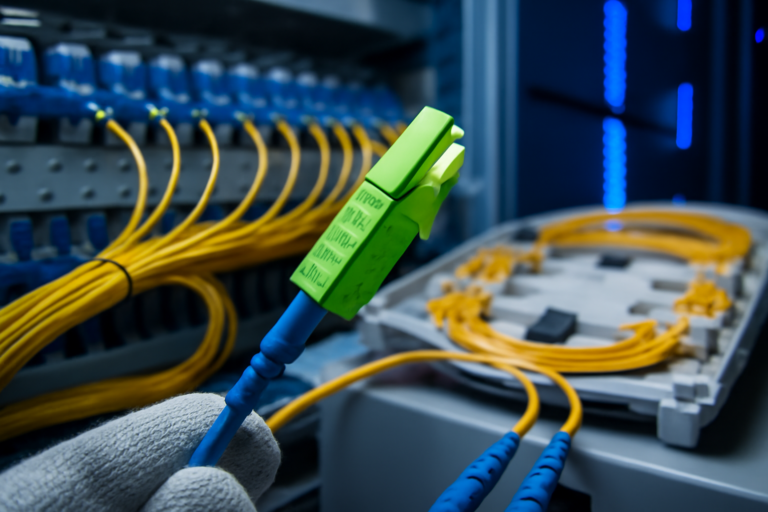
High-quality components with 5 years warranty significantly reduce lifecycle costs. Diamond-grade E2000 connectors ensure over 1,000 mating cycles without quality loss.
Case Study: ROI Calculation for a Typical Municipal Utility
A mid-sized municipal utility plans to deploy 10,000 households in its service area. Investment totals €25 million, equivalent to an average of €2,500 per household.
At a target take-rate of 40 percent and ARPU of €40, annual revenue reaches €1.92 million. After deducting €500,000 annual operating costs, operating cash flow is €1.42 million.
- Break-even after 9.5 years
- ROI after 20 years: 185 percent
- ROCE from year 10: 13.5 percent
- IRR over full duration: 10.8 percent
Future-Proofing as a Value Factor in Investment Appraisal
Fibre networks offer virtually unlimited bandwidth reserves for future requirements. While copper networks reach physical limits at 250 Mbit/s, modern fibre enables transmission rates of several terabit/s per fibre.
Bandwidth demand grows annually by 25 to 35 percent. Cloud computing, video conferencing, and Industry 4.0 drive this growth. Network operators with future-ready infrastructure secure lasting competitive advantages.
Modular expansion concepts such as VarioConnect systems with up to 288 fibres in 3U enable demand-driven scaling without complete infrastructure replacement.
Optimising Network Expansion ROI Through Strategic Partnerships
Cooperation with other infrastructure companies significantly reduces investment costs. Shared use of ducts and routes cuts civil works costs by 30 to 50 percent. Municipal utilities optimise their existing infrastructure.
- Parallel laying during road construction saves up to 70 percent in civil works costs
- Use of existing ducts reduces investment by €40 to €60 per metre
- Shared technical rooms lower operating costs by 20 to 30 percent
- Wholesale agreements secure baseline utilisation of at least 25 percent
Standardisation on modular splice systems further simplifies technical integration of different network operators and reduces interface problems.
Frequently Asked Questions on Fibre ROI for Network Operators
How is ROI calculated with only 25 percent take-rate?
At a take-rate of 25 percent, break-even typically shifts to 12 to 15 years. Long-term ROI reduces to approximately 120 to 150 percent over 20 years. Additional business customer connections can improve the business case.
What impact do construction cost increases have on FTTH profitability?
Each 10-percent increase in construction costs reduces IRR by approximately 1 percentage point. Cost increases exceeding 30 percent often make the project uneconomical without subsidies. Standardised components and efficient construction methods counteract this.
Is fibre rollout worthwhile in rural areas?
In sparsely populated areas with fewer than 50 households per kilometre, self-sustaining expansion is typically not viable. However, with subsidy rates of 70 to 90 percent, a positive ROI is achievable even there.
How do new technologies such as 5G affect fibre ROI?
5G networks require dense fibre infrastructure for cell-site backhaul. Each mobile site generates additional revenue of €200 to €800 monthly. This significantly improves the business case.
Which splice systems optimise installation costs?
Modular systems with pre-terminated cassettes reduce assembly time. Higher material costs are recovered through labour savings after 100 splices.
What is the economic lifespan of fibre networks?
Passive infrastructure has a technical lifespan of over 40 years. For profitability calculations, 20 to 25 years are typically assumed. High-quality components with extended warranties improve residual value.
Conclusion: Fibre ROI as Strategic Investment Decision
Return on investment for fibre projects depends on numerous factors but can be optimised through strategic planning. Network operators investing in quality components, modular systems, and efficient construction methods typically achieve positive ROI within 8 to 10 years.
The long-term perspective is clear: fibre networks are essential for the digital future. With well-planned rollout strategies, professional technology, and active sales, network operators secure sustainable returns. As a manufacturer of modular fibre-optic solutions, Fiber Products supports you with innovative splice systems that safeguard your investment through quality and efficiency.
Request a Quote
Have questions about our fibre-optic solutions? Our expert team is happy to advise you—free and without obligation.