Fibre Optic Ploughing and Microtrenching: Fast Installation Methods Explained
Fibre Optic Ploughing and Microtrenching: Fast Installation Methods Explained
Ploughing and microtrenching are transforming fibre rollout across Central Europe: both rapid deployment methods reduce civil works costs compared to conventional trenching, with significantly shorter construction periods.
The DIN 18220 standard, valid since July 2023, establishes uniform standards for ploughing, milling, and trenching methods in the German market for the first time. This standardisation enables shallow installations down to 40 cm depth and significantly accelerates approval procedures.
Key rapid deployment methods at a glance
Three main techniques have proven particularly efficient in modern fibre rollout. Each method offers specific advantages for different applications and soil conditions.
| Method | Installation Depth | Daily Output | Ideal Application | Surface Restoration |
|---|---|---|---|---|
| Ploughing | 60–120 cm | up to 1000 m | Rural areas, grassland | Immediately passable |
| Microtrenching | 20–30 cm | 100–250 m | Urban streets, pavements | After 2–4 hours |
| Milling | 40–60 cm | 200–400 m | Asphalt surfaces | After 4–6 hours |
Selection of the optimal method depends primarily on local conditions, existing infrastructure, and desired installation speed. Modern civil works contractors frequently combine multiple techniques within a single project.
Fibre optic ploughing: Maximum efficiency in rural areas
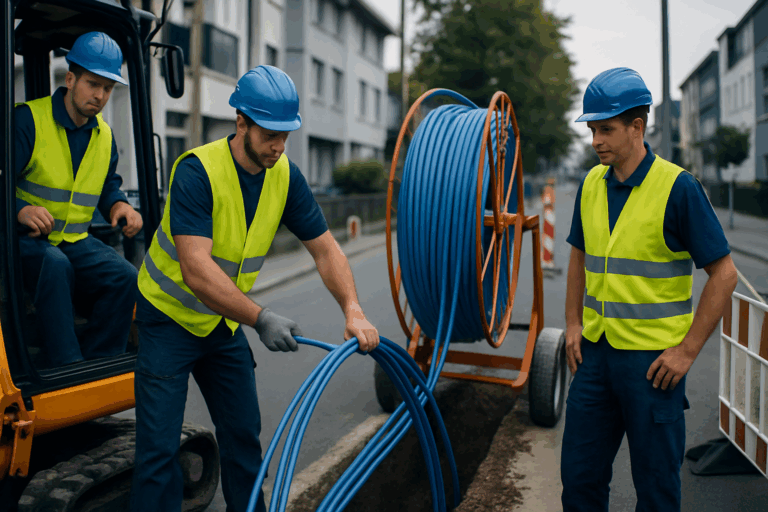
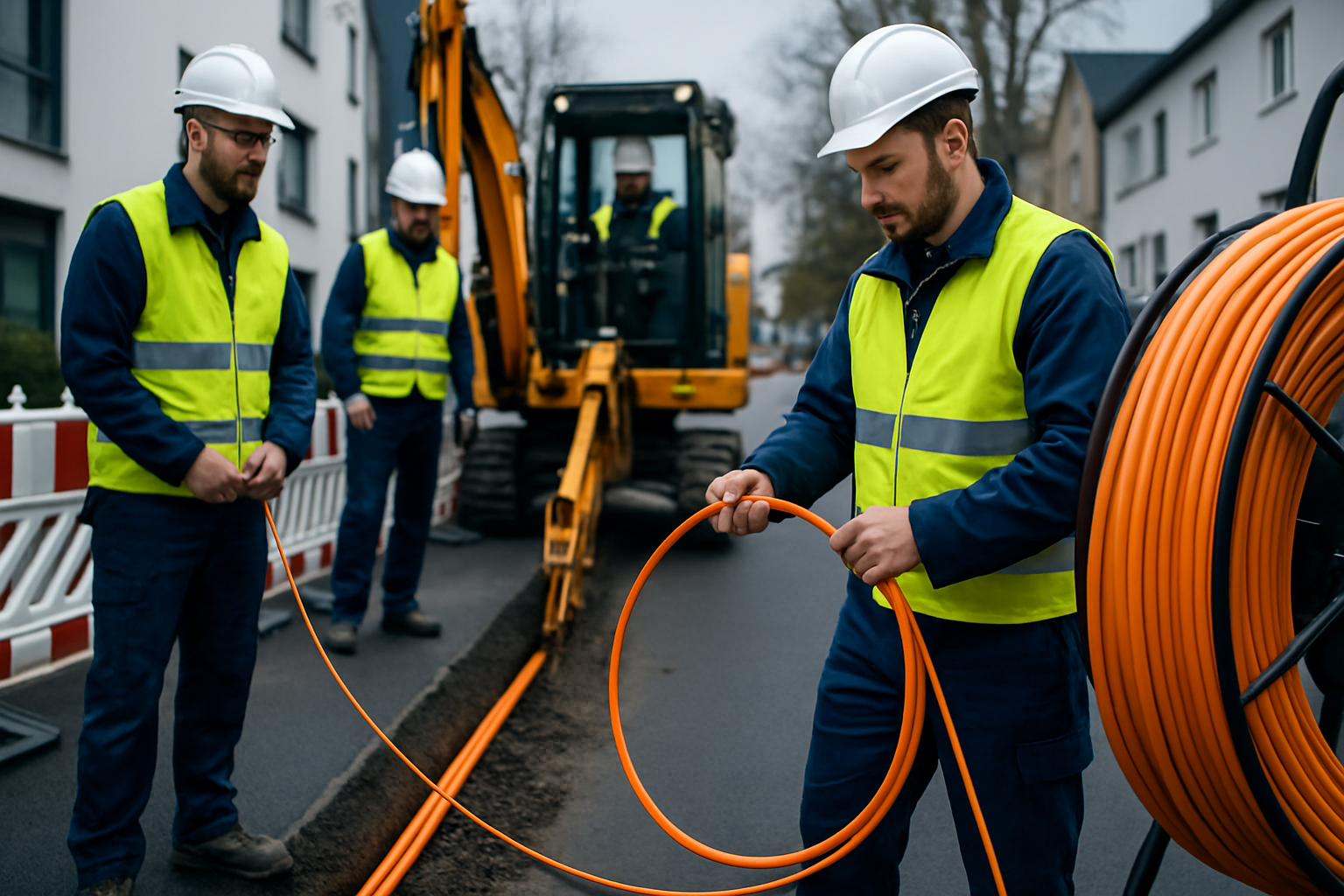
Ploughing is the fastest method for fibre installation in unpaved areas. A specialised cable plough draws conduits or micro-cables directly into the ground without excavating an open trench.
- Installation of up to 1000 metres daily possible
- No soil excavation work required
- Minimal ground damage on agricultural land
- Immediate surface accessibility
- Cost savings compared to trenching
- Weather-independent installation possible
This technique proves particularly effective when connecting rural communities to the fibre network. DIN 18220 defines minimum distances to existing utility lines and ensures planning certainty.
Technical requirements for successful ploughing
Not all substrates are equally suited to ploughing. Rocky or heavily compacted soils sometimes require preliminary work or alternative installation methods.
- Soil type: ideally sandy-loam soils
- Maximum stone content: < 30% for grain sizes over 60 mm
- Plough working width: 8–12 cm
- Required pull force: 80–150 kN depending on depth
- Observe minimum cable bend radius
Microtrenching: Revolution for urban fibre networks
Fibre microtrenching enables rapid installation in sealed surfaces via minimally invasive slots only 8–12 cm wide. This technique significantly reduces construction site duration in city centres and minimises traffic disruption.
Deutsche Telekom increasingly employs this method, installing 100 metres of fibre within a single morning. For residents, this means substantially shorter disruption periods and faster availability of high-speed internet.
Fiber Products quality commitment: As an official Diamond Partner and manufacturer, we produce modular splice systems in Europe. Benefit from Swiss precision and in-house manufacturing.
Applications and limitations of microtrenching
While microtrenching excels in urban areas, clear application limits exist. Shallow installation depth requires careful planning regarding frost protection and mechanical stress.
| Criterion | Suitable | Conditionally suitable | Unsuitable |
|---|---|---|---|
| Surface type | Asphalt, concrete | Paving stones | Cobblestone |
| Traffic load | Residential streets | Main roads | Heavy-traffic routes |
| Utility density | Low | Medium | High |
| Ground frost | Mild | Moderate | Severe |
Rapid optical fibre deployment: Standards-compliant planning under DIN 18220
The new DIN 18220 standardises all rapid deployment methods for the first time and provides legal certainty for planners and contractors. This standard defines quality requirements, documentation obligations, and technical parameters for modern installation techniques.
- Shallow installation down to 40 cm officially permissible
- Standardised acceptance protocols accelerate approvals
- Uniform protection distances to third-party lines
- Mandatory survey and documentation
- Quality assurance through defined test procedures
- Standard review scheduled by 2028
For civil works contractors, this represents significant simplification in tenders and project execution. Clear specifications reduce coordination effort with authorities and network operators considerably.
Integration of modular splice systems in rapid deployment projects
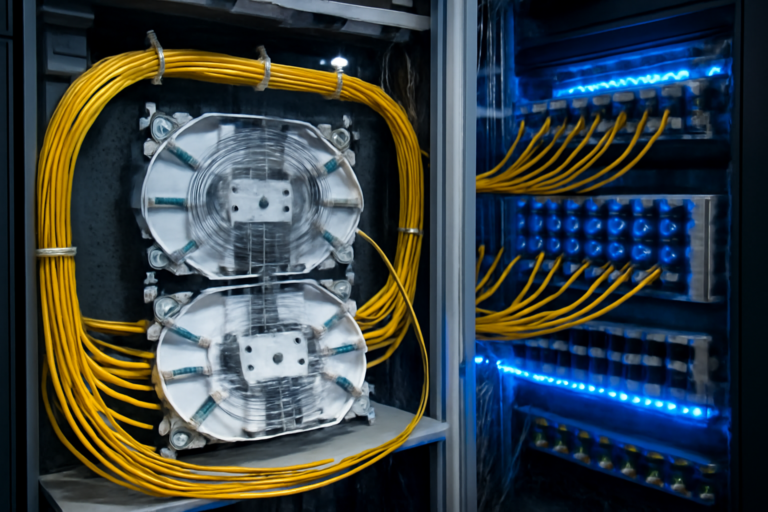
Following efficient cable installation comes proper fibre splicing and distribution. Modern splice modules enable packing densities of up to 96 fibres in just 1 rack unit.
The modular design of SlimConnect systems offers decisive advantages in rapid deployment projects. Pre-configured modules substantially reduce on-site installation time and minimise error sources.
Benefits of modular systems in rapid deployment
- Time savings during installation
- Flexible expansion according to demand
- Uniform documentation across all sites
- Reduced inventory through standard components
- Tool-free installation of front modules
- 5 years’ warranty on all system components
Cost-benefit analysis: savings and time gains
Investment in modern rapid deployment methods pays for itself through substantial time and cost savings. Large-scale rollout projects demonstrate economic benefits particularly clearly.
Cost comparison per installed metre reveals savings potential compared to conventional civil works. This saving results from reduced labour costs, shorter construction periods, and lower material consumption.
| Cost item | Conventional civil works | Rapid deployment | Savings |
|---|---|---|---|
| Labour costs/m | €45–60 | €15–25 | 50–65% |
| Equipment cost/m | €25–35 | €20–30 | 15–20% |
| Restoration/m | €40–80 | €5–20 | 75–85% |
| Total cost/m | €110–175 | €40–75 | 55–65% |
Quality assurance and documentation in rapid deployment
Despite high installation speeds, quality and documentation must not be neglected. DIN 18220 mandates comprehensive documentation to ensure long-term operation.
Modern installation machines feature integrated GPS systems for automatic route documentation. This data feeds directly into geographic information systems and enables precise inventory records.
- Continuous position and depth recording
- Automatic generation of installation protocols
- Photographic documentation of critical areas
- Attenuation measurements after installation
- Handover protocol with all relevant parameters
Challenges and practical solutions
Each rapid deployment method presents specific challenges. Experienced civil works contractors continuously develop solution strategies for typical problem scenarios.
Managing existing infrastructure
High utility density in urban areas requires precise pre-investigation. Modern detection technology and careful operator briefing minimise damage risk.
- Ground-penetrating radar for utility location
- Trial excavations at critical points
- Coordination with all utility providers
- Compliance with protection distances per DIN 18220
- Verify insurance coverage for utility damage
Weather effects and seasonality
While ploughing functions largely independently of weather, milling requires dry conditions. Planning must account for seasonal restrictions and include buffer time.
Future prospects for fibre rapid deployment
Technology development in rapid deployment methods advances continuously. New machine concepts and optimised techniques promise further efficiency gains.
By 2026, experts expect a doubling of installation performance through improved automation and AI-assisted planning tools. Integration of modern splice boxes with higher packing densities supports this trend.
- Robotic installation in complex environments
- Self-healing backfill materials for microtrenching
- Drone-based route surveying and documentation
- Predictive maintenance via cable-integrated sensors
- Standards extension for new methods by 2028
Tendering and award of rapid deployment projects
DIN 18220 provides clear specifications for public procurement and planners. Standardisation simplifies bills of quantities and enables better comparability of quotations.
When tendering, aspects beyond pure installation performance—such as documentation quality, warranty, and response times for faults—should be considered. Modular systems with 5 years’ manufacturer warranty provide additional investment security.
Evaluation criteria for rapid deployment quotations
| Criterion | Weighting | Evaluation aspects |
|---|---|---|
| Price | 40% | Total cost, value for money |
| Execution time | 25% | Daily output, total duration |
| Quality | 20% | Certifications, references |
| Sustainability | 10% | CO₂ footprint, recycling |
| Service | 5% | Warranty, maintenance |
Best practices for successful rapid deployment projects
Successful fibre ploughing and microtrenching projects require careful preparation and professional execution. Experienced project managers follow proven practices to minimise risk.
- Early involvement of all stakeholders
- Detailed soil investigation before project start
- Flexible method mix depending on route section
- Continuous quality control during installation
- Immediate attenuation measurement after section completion
- Complete documentation for future expansion
Frequently asked questions about fibre rapid deployment methods
What installation depth is frost-safe with microtrenching?
In Germany, an installation depth of at least 60 cm is considered frost-safe. With microtrenching at only 20–30 cm depth, frost resistance must be ensured through special cable types or backfill materials.
How long does surface restoration take after ploughing?
With proper execution, the surface is immediately passable after ploughing and fully loadable after 24–48 hours. Elaborate restoration is completely unnecessary.
Can existing conduits be used for rapid deployment?
Yes, modern blowing techniques achieve speeds of up to 100 m/min in existing conduits. This reduces civil works to connections at distribution points.
What minimum distances apply to other utility lines?
DIN 18220 specifies minimum distances of 10 cm to power lines and 20 cm to gas lines. At crossings, protective ducts or spacers are required.
Is microtrenching economical for short sections?
From a route length of 50 metres, microtrenching becomes economically attractive. Setup costs amortise quickly through extreme time savings over conventional methods.
What warranty applies to rapid deployment methods?
Under VOB/B, warranty for civil works is 4 years. Use of certified system components with extended manufacturer warranty can extend this to 5 years.
Conclusion: Rapid deployment as key to broadband expansion
Fibre optic ploughing, microtrenching, and modern rapid deployment techniques are essential for swift broadband rollout across Central Europe. The combination of innovative installation technology, standardised methods per DIN 18220, and high-quality modular splice systems enables civil works contractors and planners to realise projects efficiently.
With daily outputs of up to 1000 metres and cost savings, rapid deployment methods represent the future of fibre infrastructure expansion.
Request a quote
Have questions about our fibre optic solutions? Our expert team is happy to advise you—free of charge and without obligation.