Open RAN Infrastructure: Fibre Optic Backhaul for 5G Antennas and vRAN
Open RAN Infrastructure: Fibre Optic Backhaul for 5G Antennas and vRAN
Open RAN infrastructure fundamentally transforms 5G network deployment in Germany: high-capacity fibre optic backhaul connections delivering up to 25 Gbit/s per wavelength form the technical backbone between distributed antenna sites and centralised data centres.
The extensive fibre optic infrastructure rollout across the DACH region provides the foundation for nationwide 5G coverage. With 12.6 million bookable FTTH households at Deutsche Telekom alone and planned 2.5 million new connections by 2026, a dense fibre optic network is emerging that simultaneously serves as backhaul infrastructure for 5G mobile sites.
Technical Fundamentals: Open RAN and Fibre Optic Backhaul in 5G Networks
Open RAN architecture disaggregates traditionally integrated mobile base stations into standardised functional units. This disaggregation requires high-performance fibre optic connections between Radio Units (RU), Distributed Units (DU) and Centralised Units (CU). The fronthaul connection between RU and DU requires latencies below 100 microseconds at data rates of up to 25 Gbit/s.
| Network Layer | Connection Type | Latency Requirement | Bandwidth | Fibre Type |
|---|---|---|---|---|
| RU to DU | Fronthaul | < 100 μs | 10-25 Gbit/s | Singlemode OS2 |
| DU to CU | Midhaul | < 1 ms | 1-10 Gbit/s | Singlemode OS2 |
| CU to Core | Backhaul | < 10 ms | 10-100 Gbit/s | Singlemode OS2 |
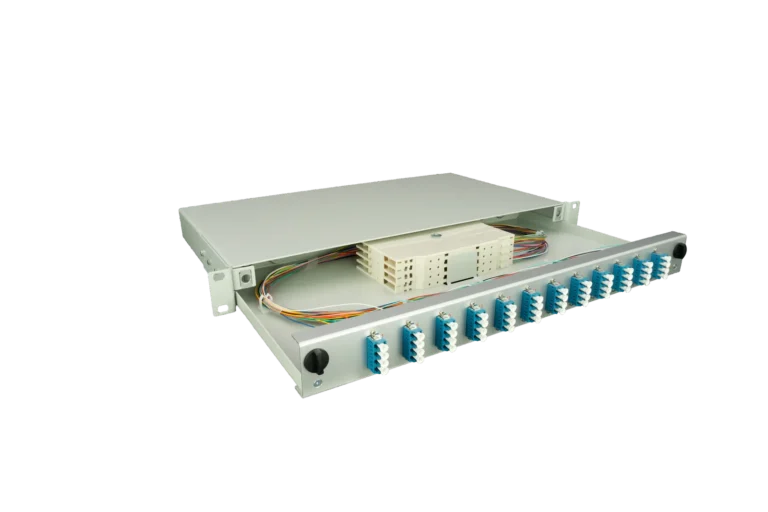
For the physical implementation of these connections, modular splice systems are employed that enable structured fibre distribution in 19-inch cabinets. Packing density plays a decisive role – modern systems achieve up to 96 fibres per rack unit.
Modular Splice Systems for vRAN Infrastructure: Requirements and Solutions
The virtualisation of RAN functions (vRAN) shifts processing capacity to centralised data centres. This requires high-density fibre solutions with maximum port density and minimal floor space. Modular splice systems offer decisive advantages over conventional splice boxes.
- Scalable expansion stages from 12 to 288 fibres per system
- Pre-terminated modules reduce installation time
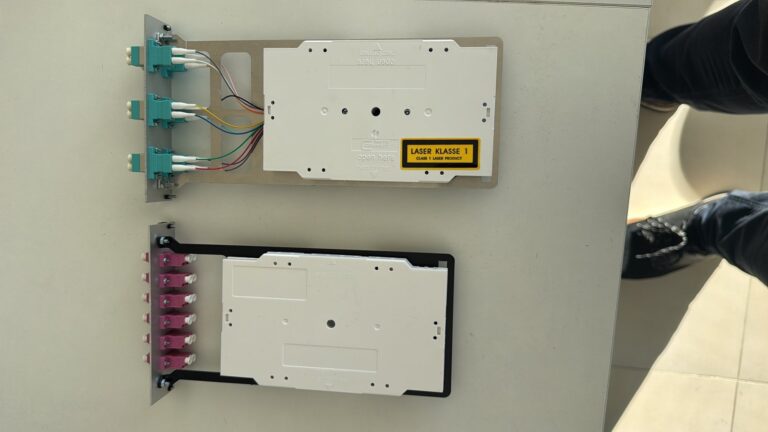
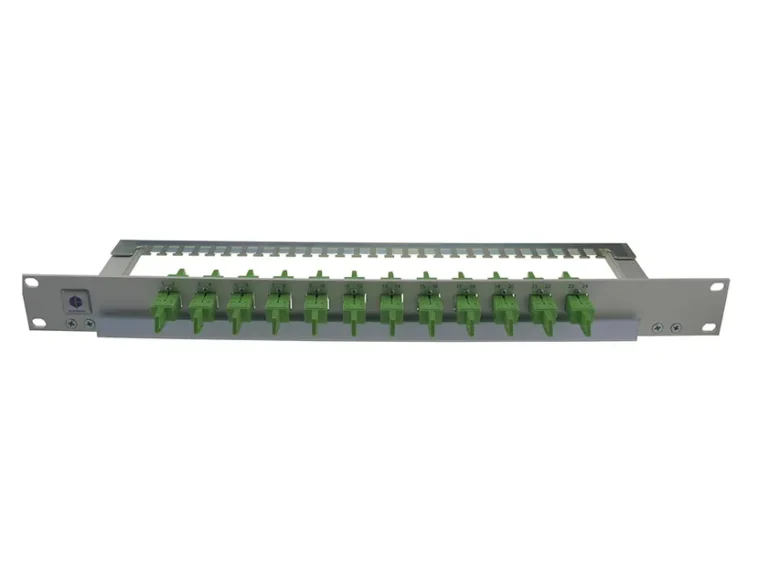
- Replaceable front modules for various connector types (LC, SC, E2000, MPO)
- Integrated cable management with defined bend radii per IEC 61756-1
- Backward compatibility with existing fibre optic networks
When selecting connectors for Open RAN fibre, 5G backhaul optical fibre, vRAN infrastructure, specific requirements must be considered. While LC connectors with attenuation values below 0.25 dB form the standard in data centres, vibration-resistant E2000 connectors are used in industrial environments.
5G Backhaul Architecture: From Antenna to Core Network
The fibre optic backhaul architecture for 5G networks differs fundamentally from previous mobile generations. While 4G networks primarily use point-to-point connections, 5G requires a meshed topology with redundant paths. This network architecture creates new demands on splice infrastructure.
Municipal utilities and regional network operators increasingly utilise their FTTH infrastructure for 5G backhaul. Federal funding for Open RAN projects accelerates this trend. Projects such as the O-RAN Town in Neubrandenburg demonstrate how municipal fibre optic networks become 5G infrastructure.
Fiber Products Quality Promise: As an official Diamond partner and manufacturer, we produce modular splice systems in Europe. Benefit from Swiss precision and in-house manufacturing.
Technical implementation requires carefully planned fibre distribution at strategic network nodes. Modular splice boxes in 1U form factor prove their worth here, enabling flexible configurations.
Standards Compliance and Specifications for Open RAN Fibre Networks
The O-RAN Alliance defines open interfaces for vendor-neutral network components. For fibre optic infrastructure, established telecommunications standards apply additionally to ensure quality and interoperability.
| Standard/Specification | Application Area | Relevance for Open RAN |
|---|---|---|
| IEC 61300-3-35 | Attenuation measurement | Fronthaul connections |
| IEC 61754-15 | E2000 connector | Industrial 5G sites |
| ITU-T G.652.D | Singlemode fibre | All backhaul links |
| ISO/IEC 11801-1 | Structured cabling | Data centre connection |
Compliance with these standards ensures not only technical compatibility but is also a prerequisite for public procurement and funding projects in the German market.
Practical Implementation: Splice Concepts for vRAN Data Centres
The concentration of vRAN functions in data centres requires high-density fibre optic. A typical edge data centre for Open RAN fibre, 5G backhaul optical fibre, vRAN infrastructure processes signals from 20 to 50 mobile sites.
- Each site requires 4 to 8 fibres for redundant connection
- Total requirement: 200 to 400 fibres per edge data centre
- Modular systems with 96 fibres per rack unit optimise space utilisation
- MPO/MTP connectors enable 12 or 24 fibres per connector
- Pre-spliced cassettes reduce installation time
The choice between single-fibre connectors (LC, SC) and multi-fibre connectors (MPO) depends on the specific network architecture. While fronthaul connections often use single fibres, MPO connections for backhaul links offer higher scalability.
Power Supply and Environmental Conditions for 5G Fibre Optic Infrastructure
Open RAN installations at mobile sites are subject to special environmental requirements. Fibre optic distribution must withstand temperature fluctuations from −40°C to +70°C and meet protection class IP65 for outdoor installations.
Modern Open RAN implementations reduce power consumption compared to traditional base stations. This is partly achieved through more efficient fibre optic connectivity, replacing copper-based connections. Telekom demonstrates this at the airport campus network with 42 antennas and significant energy savings.
For industrial environments, DIN rail-mounted boxes with robust E2000 connectors are suitable. These provide additional protection against vibration and electromagnetic interference per EN 61000-6-2.
Cost-Effectiveness of Modular Splice Systems in 5G Deployment
Investment in modular fibre optic infrastructure for Open RAN fibre, 5G backhaul optical fibre, vRAN infrastructure pays for itself through reduced operating costs and increased flexibility. German network operators benefit from multiple economic advantages.
- Reduced installation time saves labour costs
- Modular expansion avoids over-investment in initial phases
- Standardised components reduce inventory costs
- Longer product lifecycles through replaceable modules
- 5 years warranty on high-quality systems reduces maintenance risks
Deutsche Telekom plans investments of 30 billion euros by 2030 in fibre optic expansion. A substantial portion flows into backhaul infrastructure for 5G networks. Modular splice systems maximise the value of these investments through future-proof scalability.
Integration into Existing FTTH Infrastructure
Municipal utilities and regional network operators face the challenge of upgrading their FTTH networks for 5G backhaul. Integration of Open RAN fibre, 5G backhaul optical fibre, vRAN infrastructure into existing networks requires strategic planning of fibre utilisation.
M-net is expanding in Bavaria and Hesse with a focus on multiple utilisation of fibre optic infrastructure. The 9,000 GEWOBAU apartments in Erlangen are not only supplied with FTTH but the infrastructure simultaneously serves as 5G backhaul. These synergies justify higher initial investments in modular splice systems.
Technical implementation is accomplished through Wavelength Division Multiplexing (WDM), enabling FTTH and mobile services to share the same fibres. Modern splice modules support this technology through low attenuation values below 0.1 dB per splice.
Future Perspectives: 6G Preparation and Network Evolution
While 5G networks are still being built, requirements for 6G are already emerging. Experts forecast data rates of up to 1 Tbit/s and latencies in the microsecond range. Fibre optic infrastructure must support this evolution.
- Increase in fibre density to 288 fibres per 3U
- Migration to 400G Ethernet for backhaul connections
- Implementation of hollow-core fibres for ultra-low latency
- Expansion of edge computing sites with modular fibre optic solutions
- Integration of AI-driven network management
The modular design of today’s splice systems enables this gradual evolution without complete infrastructure replacement. Investments in high-quality, expandable systems pay off in the long term.
Quality Assurance and Measurement Technology for Open RAN Fibre Networks
The quality of fibre optic connections determines the performance of the entire 5G network. For Open RAN fibre, 5G backhaul optical fibre, vRAN infrastructure, strict measurement criteria apply per international standards.
Critical measurement parameters include attenuation, return loss and polarisation mode dispersion. Modern OTDR test sets document these values automatically for each fibre path. Measurement protocols per IEC 61280-4-2 are prerequisites for network acceptance.
| Measurement Parameter | Fronthaul Limit | Backhaul Limit | Test Method |
|---|---|---|---|
| Attenuation | < 0.5 dB/km | < 0.3 dB/km | OTDR |
| Return Loss | > 45 dB | > 50 dB | OCWR |
| PMD | < 0.5 ps/√km | < 0.2 ps/√km | Interferometry |
The use of high-quality splice modules with precise manufacturing tolerances minimises attenuation values and maximises network range. Swiss precision in manufacturing, as offered through the Diamond partnership, ensures reproducible quality.
FAQ: Frequently Asked Questions on Open RAN and Fibre Backhaul
What fibre capacity does a typical 5G mobile site require?
A single 5G site requires a minimum of 4 to 8 optical fibres for redundant connection. For macrocells with multiple sectors and frequency bands, up to 24 fibres may be required. Modular splice systems with 12-fibre cassettes offer optimal scalability here.
How do fronthaul and backhaul differ in fibre optic infrastructure?
Fronthaul connects radio units with distributed processing units over distances up to 20 km with strict latency requirements below 100 microseconds. Backhaul transports aggregated traffic to the core network over longer distances with more tolerant latencies up to 10 milliseconds.
What advantages do E2000 connectors offer for 5G installations?
E2000 connectors feature an integrated, spring-loaded metal shutter that closes automatically for dust and laser-eye protection. Typical insertion loss is 0.1 dB (max. 0.3 dB; Grade B: typ. ≤ 0.12 dB, 97 % ≤ 0.25 dB). Vibration behaviour is tested per IEC 61300-2-1; standard versions are specified for indoor use, so outdoor mast installations need the IP-rated variant or a protected enclosure.
Can existing FTTH networks be used for 5G backhaul?
Yes, through Wavelength Division Multiplexing, FTTH and mobile services can share the same fibres. Prerequisites are adequate fibre reserves and modular distribution systems enabling flexible switching. The 12.6 million FTTH connections at Telekom already form the foundation for 5G backhaul today.
What role does packing density play in vRAN data centres?
Edge data centres for vRAN have limited floor space. Systems with 96 fibres per rack unit double capacity compared to standard solutions. This reduces space costs and improves cooling energy efficiency.
How does Open RAN impact fibre optic standardisation?
Open RAN promotes vendor-neutral standards and increases demands on documentation and measurement protocols. The O-RAN Alliance defines uniform test procedures exceeding previous telecommunications standards. This increases transparency and comparability of fibre optic components.
Conclusion: Modular Fibre Optic Solutions as Enabler for Open RAN
Open RAN fibre, 5G backhaul optical fibre, vRAN infrastructure fundamentally transform mobile network architecture. Successful rollout in the DACH market depends significantly on high-performance fibre optic infrastructure. Modular splice systems prove to be the enabling technology that combines flexibility, quality and cost-effectiveness. As network operators face the challenge of simultaneous FTTH and 5G deployment, standardised solutions with proven reliability become critical. Investments in premium systems with long warranty periods and comprehensive support maximise return on infrastructure investment and ensure readiness for 6G evolution.
Request a Quote
Have questions about our fibre optic solutions? Our expert team will be happy to advise you – free and without obligation.