Next-Generation Access Infrastructure and Gigabit Strategy 2030: What Operators Need to Know
Next-Generation Access Infrastructure and Gigabit Strategy 2030: What Operators Need to Know
The Gigabit Strategy 2030 establishes the framework for German fibre-optic deployment: NGA infrastructure and the Broadband Atlas Germany provide network operators and municipalities with clear guidance for strategic investment decisions.
Technical implementation of NGA infrastructure requires precise coordination between commercially-driven deployment and subsidised projects. Municipal utilities and regional network operators face the challenge of achieving maximum area coverage with limited resources – modular splice systems emerge as a critical lever for cost efficiency and future-proofing.
Technical Requirements of the Gigabit Strategy 2030 for NGA Networks
The Gigabit Strategy 2030 defines clear technical parameters for NGA deployment: minimum bandwidth of 1 Gbit/s symmetrical, latency under 10 ms, and availability of 99.9%. These requirements can only be met through pure fibre-optic infrastructure (FTTH/FTTB). The Broadband Atlas Germany reveals significant regional variations – whilst metropolitan areas already achieve coverage rates above 60%, rural areas often fall below 20%.
For technical planning, this means prioritising backbone connections and point-of-presence locations. The new DIN 18220 standard simplifies approval procedures and standardises installation techniques.
- Maximum splice density: 288 fibres on 3HE for main distribution frames
- Standards-compliant connector types: LC-APC for FTTH, E2000-APC for industrial connections
- Loss budgets: maximum 0.25 dB per connector
- Bend radius: compliance with G.657.A2 for in-building installation
- Documentation requirement per DIN EN 50173-1
Broadband Atlas Germany: Technical Analysis of Coverage Gaps
The current Broadband Atlas identifies over 3.2 million under-served households in Germany without NGA fibre-optic access to future-proof broadband. These white spots concentrate in areas with low settlement density below 100 residents per km². Technically, this means longer trench routes and higher civil works costs per connection.
| Federal State | FTTH Coverage 2024 | Target 2030 | Required Rollout Rate |
|---|---|---|---|
| Brandenburg | 41% | 90% | 8.2% p.a. |
| Saxony-Anhalt | 38% | 100% | 10.3% p.a. |
| Rhineland-Palatinate | 30.85% | 100% | 11.5% p.a. |
Network operators must adapt their deployment strategies accordingly: pre-terminated splice modules reduce installation time noticeably, whilst modular systems enable capacity expansion without service interruption.
Modular Splice Systems as the Key to NGA Infrastructure
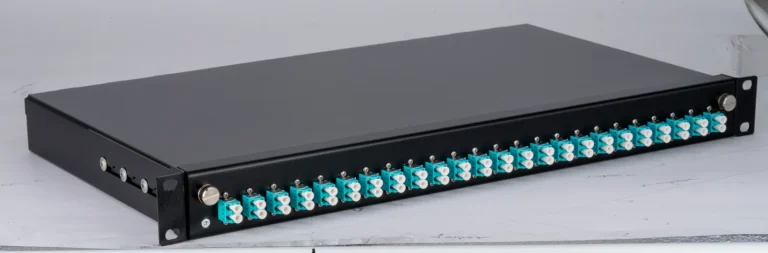
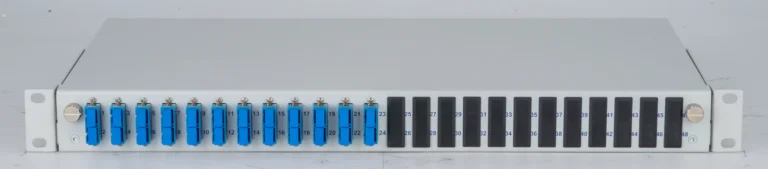
Technical realisation of the Gigabit Strategy 2030 requires highly flexible splice systems that adapt to growing fibre capacity. Modern 1HE systems today achieve packing densities of 96 fibres. This density is essential for limited infrastructure in existing buildings and data centres.
Modularity manifests in three critical areas: first, replaceable front modules enable retrofit adjustment of connector types without re-splicing. Second, capacity can be expanded incrementally through insertion modules. Third, pre-termination reduces installation error rates.
Fiber Products Quality Commitment: As an official Diamond Partner and manufacturer, we produce modular splice systems in Europe. Benefit from Swiss precision and in-house manufacturing.
Technical Standards for NGA Fibre Optics under DIN 18220
The new DIN 18220 standard has defined mandatory requirements for NGA deployment in Germany since 2024. This standard harmonises installation techniques, documentation requirements, and quality parameters. Central technical specifications include minimum bend radii of 15 mm for indoor cables, maximum tensile loads of 1000 N, and temperature resistance from -20°C to +60°C.
- Splice loss: maximum 0.1 dB for single-mode fibres
- Return loss: minimum 50 dB for APC connectors
- Mating cycles: minimum 1000 without degradation
- Protection class: IP54 for indoor, IP65 for outdoor installations
- Colour coding per DIN VDE 0888-2
For municipal utilities, this means enhanced requirements for system documentation and quality assurance. Modular splice systems with factory testing per IEC 61300-3-35 ensure standards compliance from the outset.
Funding Guidelines and Financing for Gigabit Strategy 2030
The Gigabit Strategy funding programmes for under-served regions. Technical funding criteria mandate FTTH technology with transmission rates of at least 1 Gbit/s symmetrical. Funding covers only passive infrastructure with a minimum useful life of 25 years.
The pickup threshold has been raised by the EU Gigabit Infrastructure Act to areas without available 100 Mbit/s. Technically, funded projects must be open-access capable and provide neutral handover points with standardised interfaces.
| Funding Component | Technical Requirement | Funding Rate |
|---|---|---|
| Civil Works | Ducts DA 40mm, 7 bar | up to 90% |
| Household Connection | 2-fibre, OS2, LC-APC | up to 100% |
| Main Distribution Frame | min. 144 fibres, modular | up to 70% |
Connector Types and Termination Technology for NGA Networks
Selection of the correct connectors fundamentally determines the performance of NGA infrastructure. Whilst LC connectors with their compact design (1.25 mm ferrule) represent the standard for FTTH, E2000 connectors are increasingly adopted in industrial environments. These offer with their integrated protective shutter and return loss exceeding 60 dB optimal properties for demanding installations.
The Broadband Atlas Germany shows that different regions prefer different connector standards. Northern German operators increasingly adopt SC-APC for outdoor installations, whilst southern operators more frequently use E2000-APC.
- LC-APC: Standard FTTH connector, loss <0.2 dB, 1000 mating cycles
- E2000-APC: Industrial standard, IP65 with shutter, loss <0.15 dB
- SC-APC: Robust alternative, 2.5 mm ferrule, loss <0.3 dB
- MPO/MTP: High-density applications, 12–72 fibres, for backbone
Practical Implementation: From Planning to Completed NGA Installation
Technical realisation of an NGA project under Gigabit Strategy 2030 follows a structured sequence. First, network planning is conducted using the Broadband Atlas Germany to identify under-served areas. Route planning considers synergies with existing infrastructure and minimises civil works costs through co-installation.
During execution, pre-terminated modules significantly reduce installation time. A typical main distribution frame with 288 fibres can be fully populated with modular systems in a short time. Splicing is performed per ITU-T G.671 using automatic fusion splicers that guarantee loss values below 0.05 dB.
Final documentation per DIN EN 50173-1 includes OTDR measurements for all routes, loss budgets, and detailed cable plans. Modern documentation systems integrate this data directly into GIS platforms for long-term network management.
Future Outlook: NGA Evolution to 2030 and Beyond
The Gigabit Strategy 2030 is just an interim step towards complete digitalisation. Technologies already emerging that go beyond NGA fibre optics include 400G Ethernet for backbone connections, next-generation PON technologies with 50 Gbit/s, and hollow-core fibres with minimal latency.
- XGS-PON with 10 Gbit/s symmetrical will become standard by 2026
- 25G-PON in initial field trials, market-ready by 2028
- Wavelength-division multiplexing enables 40 channels per fibre
- AI-driven network optimisation reduces downtime
Network operators investing today in modular systems with high packing density establish the foundation for these future technologies. Selection of splice systems with 5-year warranty and European manufacturing secures investment protection and planning certainty.
Regional Variations in German NGA Deployment
The Broadband Atlas Germany reveals significant regional disparities in NGA fibre-optic deployment. Whilst city-states such as Hamburg already achieve over 80% FTTH coverage, rural federal states like Mecklenburg-Western Pomerania fall below 25%. These variations require adapted technical solutions.
In sparsely populated regions, network operators increasingly adopt decentralised network architectures with smaller distribution frames. Here, compact 1HE splice boxes with high fibre density prove effective, fitting into existing switching cabinets. The Gigabit Strategy 2030 accounts for these regional variations through differentiated funding rates.
| Region | Population Density | Recommended System | Fibre Density |
|---|---|---|---|
| Urban Centres | >1000 residents/km² | 4HE modular | up to 384 fibres |
| Suburban Areas | 200–1000 residents/km² | 3HE modular | up to 288 fibres |
| Rural Areas | <200 residents/km² | 1HE compact | up to 96 fibres |
Quality Assurance and Test Equipment for NGA Fibre-Optic Networks
The Gigabit Strategy 2030 defines rigorous quality parameters for NGA infrastructure. Every fibre route must be documented with OTDR measurements at 1310 nm and 1550 nm. Maximum route loss must not exceed 0.35 dB/km at 1310 nm.
Modern test systems automatically capture all relevant parameters and generate standards-compliant reports per IEC 61280-4-2. Critical measurements include insertion loss, return loss, polarisation mode dispersion, and chromatic dispersion. For acceptance of funded projects, complete test reports are mandatory.
Integration of real-time monitoring systems enables continuous network quality supervision. When threshold deviations occur, automatic alarms trigger preventive maintenance.
Frequently Asked Questions on NGA Infrastructure and Gigabit Strategy 2030
What specific technical requirements does the Gigabit Strategy 2030 place on splice systems?
The Gigabit Strategy 2030 requires splice systems with packing density of at least 48 fibres per HE, loss values below 0.1 dB per splice, and service life of at least 25 years. Modular systems must additionally permit capacity expansion without service interruption.
How do funding criteria differ between NGA fibre optics and conventional broadband?
NGA fibre optics receive funding of up to 90% of civil works costs, whilst copper-based technologies no longer qualify. The Broadband Atlas Germany defines fundable areas as regions without available 100 Mbit/s, with only pure fibre solutions eligible.
What role does the Broadband Atlas Germany play in network planning?
The Broadband Atlas Germany is the central database for identifying under-served areas. It provides street-level coverage data and enables prioritisation of deployment areas by economic and social criteria. Network operators must register deployment plans in the Atlas to prevent double funding.
Why are E2000 connectors particularly suitable for industrial NGA applications?
E2000 connectors provide permanent protection against contamination through their integrated protective shutter and achieve return loss exceeding 60 dB. With their IP65 certification and vibration resistance per IEC 61753-1, they are optimally suited for harsh industrial environments with high operational reliability requirements.
How can existing copper networks be efficiently migrated to NGA fibre optics?
Migration typically occurs in three phases: first, backbone connections are replaced with fibre, then FTTC expansion to cabinet nodes follows, and finally FTTH provisioning completes deployment. Modular splice systems enable phased migration without complete infrastructure replacement.
What test equipment is required for NGA project acceptance under Gigabit Strategy 2030?
Required are bidirectional OTDR measurements at 1310 nm, 1550 nm, and 1625 nm, loss measurements per IEC 61280-4-2, and comprehensive documentation per applicable standards.
Request a Quote
Have questions about our fibre-optic solutions? Our expert team is happy to advise you – free and without obligation.