Fibre Rollout Ruhr Valley 2026: Multi-Utility Operators and Regional Networks
The fibre rollout Ruhr Valley, DEW21 Fibre, GELSENWASSER FTTH is developing into a successful model of public infrastructure provision: Over 52.8 percent of German households already have access to a potential fibre connection, with utility operators in the Ruhr Valley advancing digital transformation through their regional networks. The municipal providers are developing not only profitable city centre locations but also structurally weaker areas with state-of-the-art FTTH infrastructure.
The Ruhr Valley exemplifies how multi-utility operators, through pooled expertise in energy, water and telecommunications infrastructure, make fibre rollout economically viable. With investments of over 200 million euros in the next three years alone, regional network operators such as GLASFASER RUHR, DOKOM21 and GELSEN-NET are creating the foundation for comprehensive gigabit coverage.
Current Deployment Plans for Utility Operators in the Ruhr Valley for 2026
Utility operators in the Ruhr Valley are pursuing ambitious deployment targets for 2026, with a clear focus on underserved areas. GLASFASER RUHR more than 20,000 additional residential units, with large parts of Bochum-Bergen, the north of Günnigfeld and the Stadtpark district in focus.
- GLASFASER RUHR: Deployment area from Schützenstraße to Weitmarer Holz
- DOKOM21: Over 20,000 buildings in the government-sponsored broadband rollout
- GELSEN-NET: 60 million euros investment volume over five years
- DEW21 (Dortmund Energy and Water Supply): Cooperation with DOKOM21 for integrated infrastructure projects
- Essen Utility Services: Partnership with Westconnect for 250,000 households
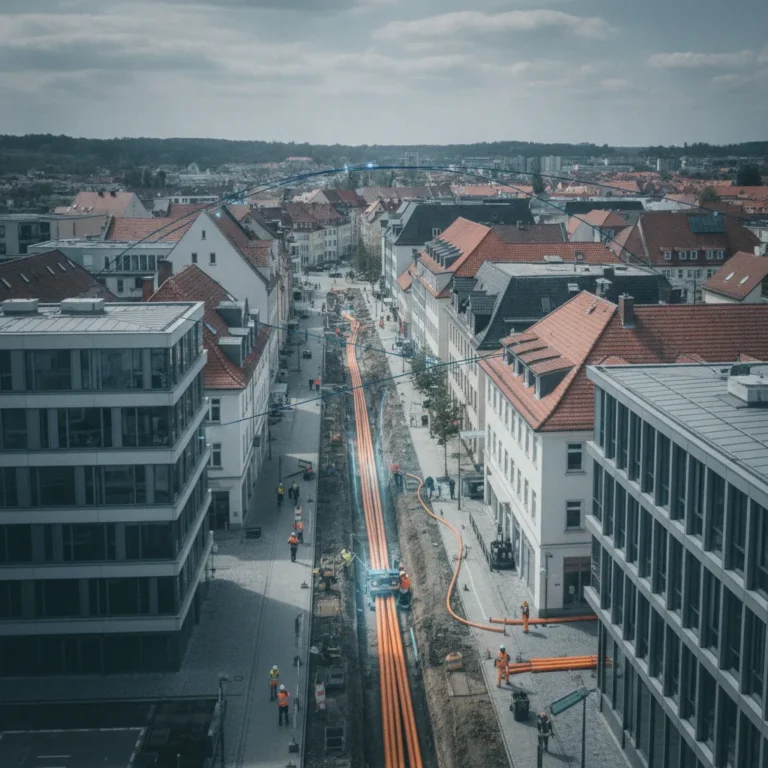
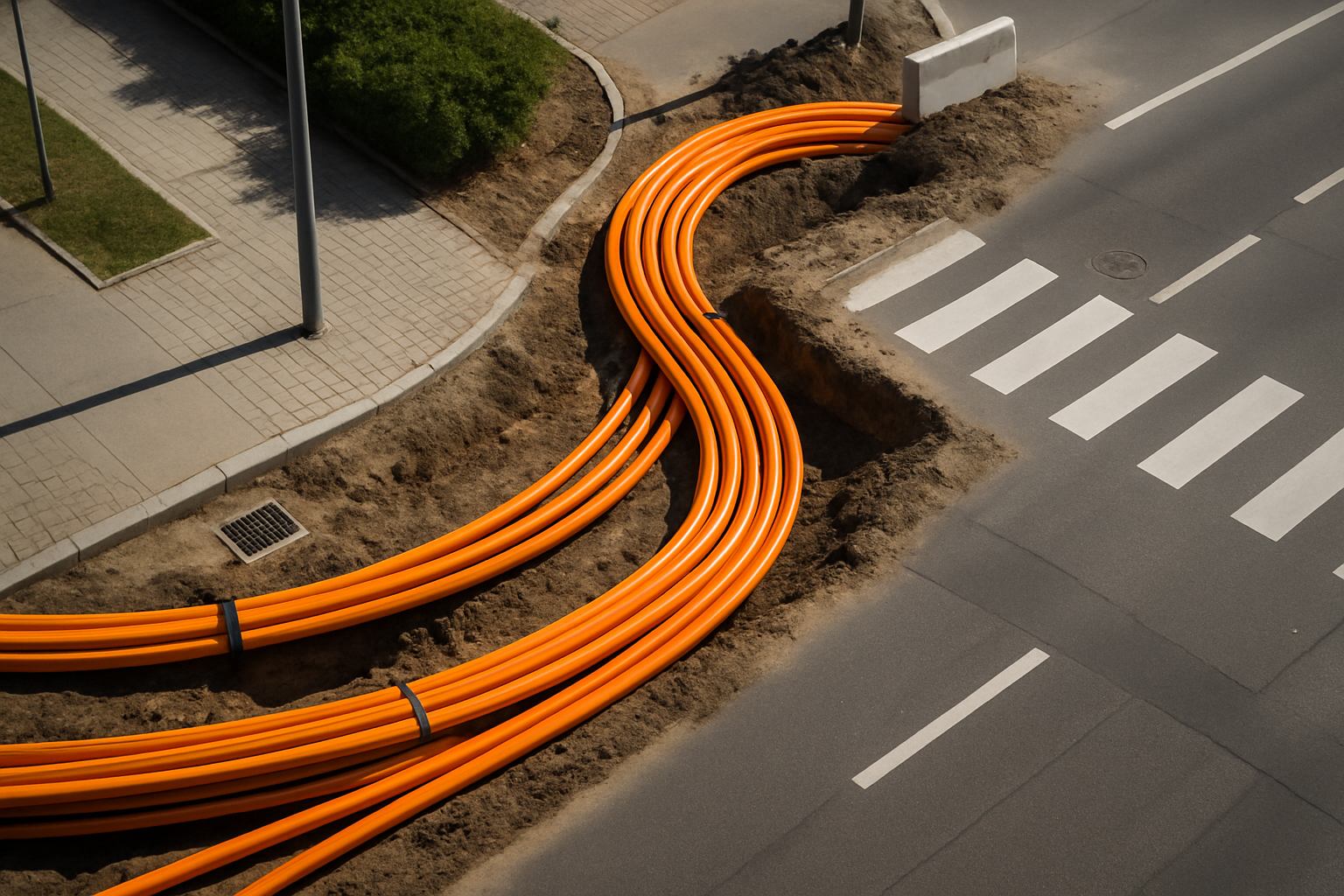
The deployment strategy of utility operators is based on proven multiple-use principles of existing infrastructure. When laying new power or water lines, empty conduits for fibre optic cables are systematically installed alongside, reducing civil works costs substantially.
Technical Infrastructure for Fibre Rollout Ruhr Valley, DEW21 Fibre, GELSENWASSER FTTH
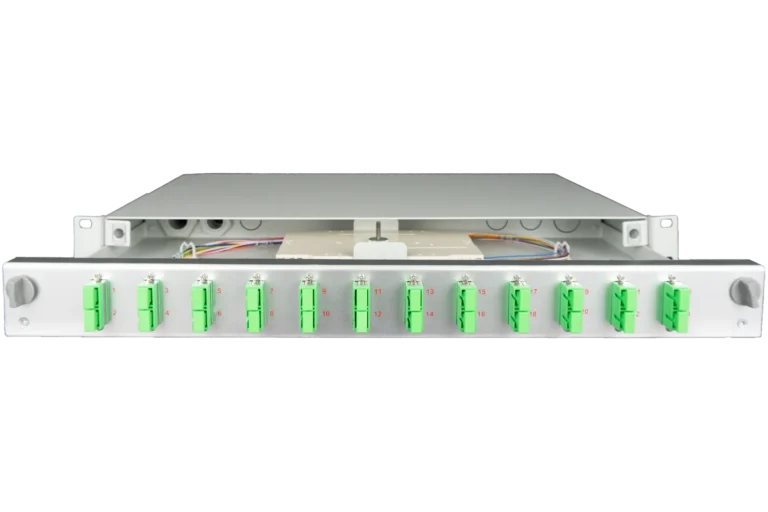
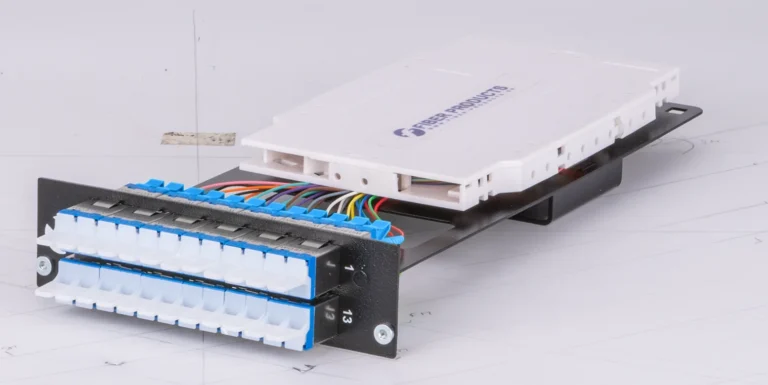
Successful FTTH deployment requires state-of-the-art distribution technology that meets growing demands for port density and scalability. Utility operators rely on modular splice modules that can accommodate up to 96 fibres in just one unit height (1U).
| System Type | Height | Fibre Capacity | Application |
|---|---|---|---|
| SlimConnect | 1U (44.45mm) | Up to 96 fibres | Handover points in multi-family buildings |
| VarioConnect | 3U | Up to 288 fibres | District centres, large residential complexes |
| DIN Rail Boxes | Variable | 12–48 fibres | Industrial installations, distribution cabinets |
Selecting the right splice modules is critical for network deployment economics. High port density in modern systems reduces floor space requirements in equipment rooms compared to conventional solutions.
Fiber Products Quality Commitment: As an official Diamond Partner and manufacturer, we fabricate modular splice systems in Europe. Benefit from Swiss precision and in-house manufacturing.
Funding Models and Economics of Municipal Fibre Networks
Fibre rollout financing is based on an intelligent mix of federal and state grants plus municipal funding. The Federal Broadband Programme alone provides 48.5 million euros for Dortmund, with a total investment volume of 97 million euros.
- Federal funding: Up to 50 percent of eligible costs
- North Rhine-Westphalia state funding: Additional 40 percent in underserved areas
- Municipal contribution: Only 10 percent with optimal grant utilisation
- Economic viability gap funding for “white spots”
- Special funding for schools and hospitals
The profitability of municipal fibre networks improves significantly through the open-access model. Utility operators provide their infrastructure on a non-discriminatory basis to all service providers, resulting in utilisation rates of over 60 percent after three years.
New VDE Standard 0800-730: Simplified Installation in Existing Buildings
The VDE Standard 0800-730, published in February 2026, transforms fibre installation in existing buildings. The key innovation: fibre optic cables are no longer treated as electrical cables since they pose no intrinsic fire risk.
This regulatory adjustment enables entirely new installation routes and drastically reduces installation times. In escape routes, fibres can now be laid in a metal conduit or as adhesive fibres, provided they meet the appropriate building classification under DIN 4102-B2.
| Installation Method | Previous Regulation | New VDE 0800-730 | Time Saving |
|---|---|---|---|
| Escape routes | Fire-rated conduit only | Metal conduit or adhesive fibre | 60% |
| Risers | Separate fire barriers required | Joint installation with other utilities | 40% |
| Unit feed | Complex core drilling | Surface mounting possible | 70% |
Fibre Rollout Ruhr Valley, DEW21 Fibre, GELSENWASSER FTTH: Connector Systems and Standards Compliance
Selecting the right connector systems is essential for FTTH network performance and future-proofing. Utility operators in the Ruhr Valley rely on proven standards under IEC 61754 and IEC 61755.
- LC Connectors: Compact design for high port density, ideal for splice modules in multi-family buildings
- SC Connectors: Robust snap closures for simple installation
- E2000-APC: Return loss >60 dB through 8-degree angled polish, Swiss precision
- MPO/MTP: Up to 12 fibres per connector for backbone connections
The E2000 connector has proven particularly successful in the municipal sector. With integrated dust protection and push-pull mechanism, it meets the highest demands for operational safety and longevity—essential for utility operators with their stringent availability requirements.
Gigabit-Ready Infrastructure Regulation (GIA): New Requirements from February 2026
The EU Gigabit-Ready Infrastructure Regulation takes effect on 12 February 2026 and requires all new buildings and extensively renovated buildings to install fibre-ready infrastructure. This regulation applies immediately in Germany and replaces the previous technology-neutral requirements under the Telecommunications Act.
For utility operators and their partners, this represents significant market opportunities. Every new multi-family building requires a central handover point (APL) with appropriate distribution technology. This is where modular systems such as the VarioConnect 3U come into use, which can be flexibly adapted to growing requirements.
- Approval timeframes: Maximum 4 months plus extension option
- Approval by default after 4 months without decision
- Coordination obligation for publicly funded construction work
- Access obligation to existing physical infrastructure
- Transparency obligation on planned construction work
Practical Example: GELSEN-NET and the Emscher-Lippe Region
GELSEN-NET demonstrates successfully how regional utility operators can multiply their reach through strategic partnerships. With its own fibre network of over 1,000 kilometres across eight cities and the Westconnect partnership, the company reaches 250,000 households.
Technical implementation is based on high-density splice boxes in district centres. On average, 288 fibres are terminated per site, with modular 7-unit systems offering maximum flexibility for future expansion. Investment in high-quality distribution technology pays off through reduced maintenance costs and higher network availability.
Fibre Rollout Ruhr Valley, DEW21 Fibre, GELSENWASSER FTTH: Quality Requirements and Certifications
Utility operators in the Ruhr Valley rely on certified quality to European standards. Requirements for splice modules and distribution technology are defined in DIN EN 50173-1 and IEC 61300 series.
| Quality Criterion | Standard Requirement | Premium Standard |
|---|---|---|
| Insertion Loss LC | < 0.50 dB | < 0.25 dB |
| Return Loss APC | > 55 dB | > 60 dB |
| Mating Cycles | 500 | > 1000 |
| Temperature Range | –25°C to +70°C | –40°C to +85°C |
These quality standards are particularly relevant for long-term operational reliability of municipal networks. With a typical service life of 25 to 30 years, components must withstand the highest stresses.
Future Outlook for Utility Operators in Fibre Deployment
The fibre rollout Ruhr Valley, DEW21 Fibre, GELSENWASSER FTTH demonstrates: utility operators are the decisive actors for comprehensive gigabit coverage. By 2030, municipal operators in the Ruhr Valley plan to invest over 500 million euros in fibre infrastructure.
Success factors for utility operators in FTTH deployment are clear: synergies with existing infrastructure, regional anchoring and the use of high-quality, modular distribution technology. Systems with 5 years warranty and European manufacturing ensure the necessary investment security.
- Planned doubling of FTTH connections by 2028
- Integration of smart city applications over the fibre network
- Expansion of open-access models for greater competition
- Strengthened inter-municipal cooperation
- Focus on energy-efficient network technology
FAQ: Frequently Asked Questions on Municipal Fibre Deployment
Which splice modules are suitable for utility operator projects?
For utility operators, modular systems such as SlimConnect with up to 96 fibres on 1U or VarioConnect for larger installations are recommended. Systems should be IEC 61300 certified and provide at least 5 years warranty.
How long does payback of municipal fibre networks take?
At a connection rate of 30 percent, FTTH deployment trends for municipal operators their investment after 12 to 15 years. Open-access models can reduce this timeframe to 8 to 10 years.
Which connector types are standard for GELSENWASSER FTTH?
GELSENWASSER and other utility operators in the Ruhr Valley primarily use LC duplex for end customer connections and E2000-APC for critical infrastructure. Connectors must be IEC 61754 compliant.
How many fibres does DEW21 provision per residential unit?
DEW21 and DOKOM21 plan for 2 fibres per residential unit plus 30 percent reserve for future expansion. For commercial units, 4 to 8 fibres are standardly provided.
What port density do modern splice boxes achieve?
Current premium systems achieve up to 96 ports on 1U—representing higher density than conventional 48-port systems and saving significant space in equipment rooms.
How does fibre rollout in the Ruhr Valley differ from other regions?
The Ruhr Valley benefits from the unique cooperation of multiple utility operators that employ common standards and realise synergies in purchasing distribution technology. The investment sum of over 200 million euros by 2026 is leading nationwide.
Interested in Modular Fibre-Optic Solutions?
Fiber Products GmbH – official DIAMOND SA Partner. Made in EU, 5 years warranty.