Military splice modules for defence applications | Fiber Products
Military splice modules, rugged fibre-optic solutions, defence FTTH form the backbone of modern military communications infrastructure, with specially hardened fibre-optic systems featuring extended temperature range from -40°C to +85°C, MIL-STD-810G certification, and EMC shielding to MIL-STD-461 ensuring secure data transmission in tactical field environments. The distinctive physical properties of fibre-optic technology—particularly complete electromagnetic invisibility and wiretap immunity—make optical transmission systems the preferred choice for defence-critical applications. German and European armed forces increasingly deploy modular splice systems characterised by rapid assembly, IP65 protection rating, and integration of NATO standard fibre optic connectors.
Specific requirements for military fibre-optic systems in the defence sector
The technical specifications for military splice modules, rugged fibre-optic solutions, defence FTTH differ fundamentally from civilian telecommunications systems. Military deployment environments require fibre-optic components that withstand extreme mechanical stress, including vibration resistance per IEC 61373 and shock resistance to 50G. The German Armed Forces and other NATO allies define precise performance parameters for tactical fibre-optic systems, including attenuation values below 0.15 dB during field installation.
Modern defence applications demand splice modules with specialised construction features. Housings are manufactured from anodised aluminium with 3mm wall thickness or glass-fibre reinforced polyamide to achieve mechanical robustness with minimal weight. Critical are the transitions between stationary and mobile infrastructure—here hybrid splice boxes are deployed, enabling both 19-inch rack mounting per DIN 41494 and field installation with quick-release couplings.
- Temperature resistance: -40°C to +85°C for Arctic and desert operations
- Protection rating: Minimum IP65, optimally IP67 for outdoor use
- EMC shielding: 60 dB at 1 GHz per MIL-STD-461
- Fibre management: Bend radius ≥30mm for G.657.A2 fibres
- Splice capacity: 24 to 144 fibres per module
Electromagnetic advantages and tactical invisibility of fibre-optic communications
The inherent electromagnetic neutrality of fibre-optic technology offers decisive tactical advantages. Unlike copper cables, which generate measurable electromagnetic signatures with detection ranges up to 500 metres, fibre-optic lines remain completely invisible to electronic reconnaissance systems. This property makes military splice modules, rugged fibre-optic solutions, defence FTTH the first choice for covert operations and electromagnetically contested environments.
The wiretap immunity of optical transmission links is based on fundamental physical principles. Any attempt to couple light signals from a fibre causes measurable attenuation changes of at least 0.5 dB, which modern monitoring systems detect immediately. Additionally, wavelength division multiplexing enables transmission of differently classified data streams over the same physical fibre with 80 channels at 100 GHz channel spacing per ITU-T G.694.1.
| Feature | Fibre optic | Copper cable | Tactical advantage |
|---|---|---|---|
| EM signature | None | Detectable to 500m | Complete concealment |
| Wiretap immunity | >0.5 dB alarm | Inductively tappable | Intrusion detection |
| Weight/100m | 2.8 kg | 45 kg | Mobility |
| Bandwidth | 100 Gbit/s | 10 Gbit/s | Real-time capability |
Modular splice systems for rapid field deployment and tactical mobility
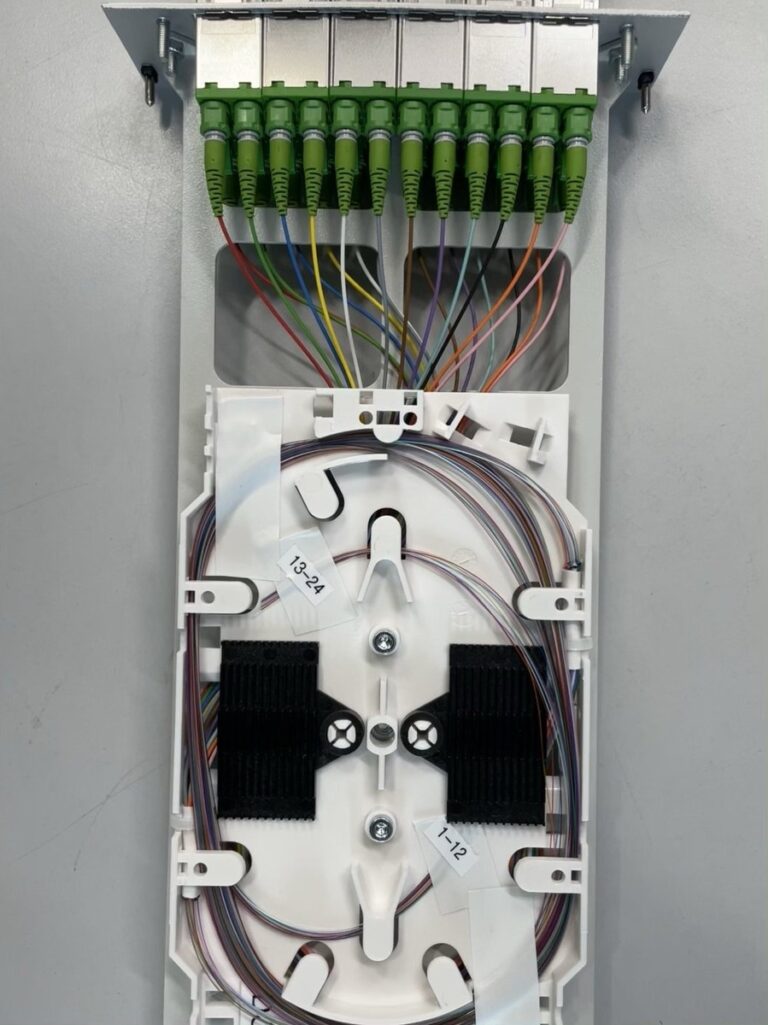
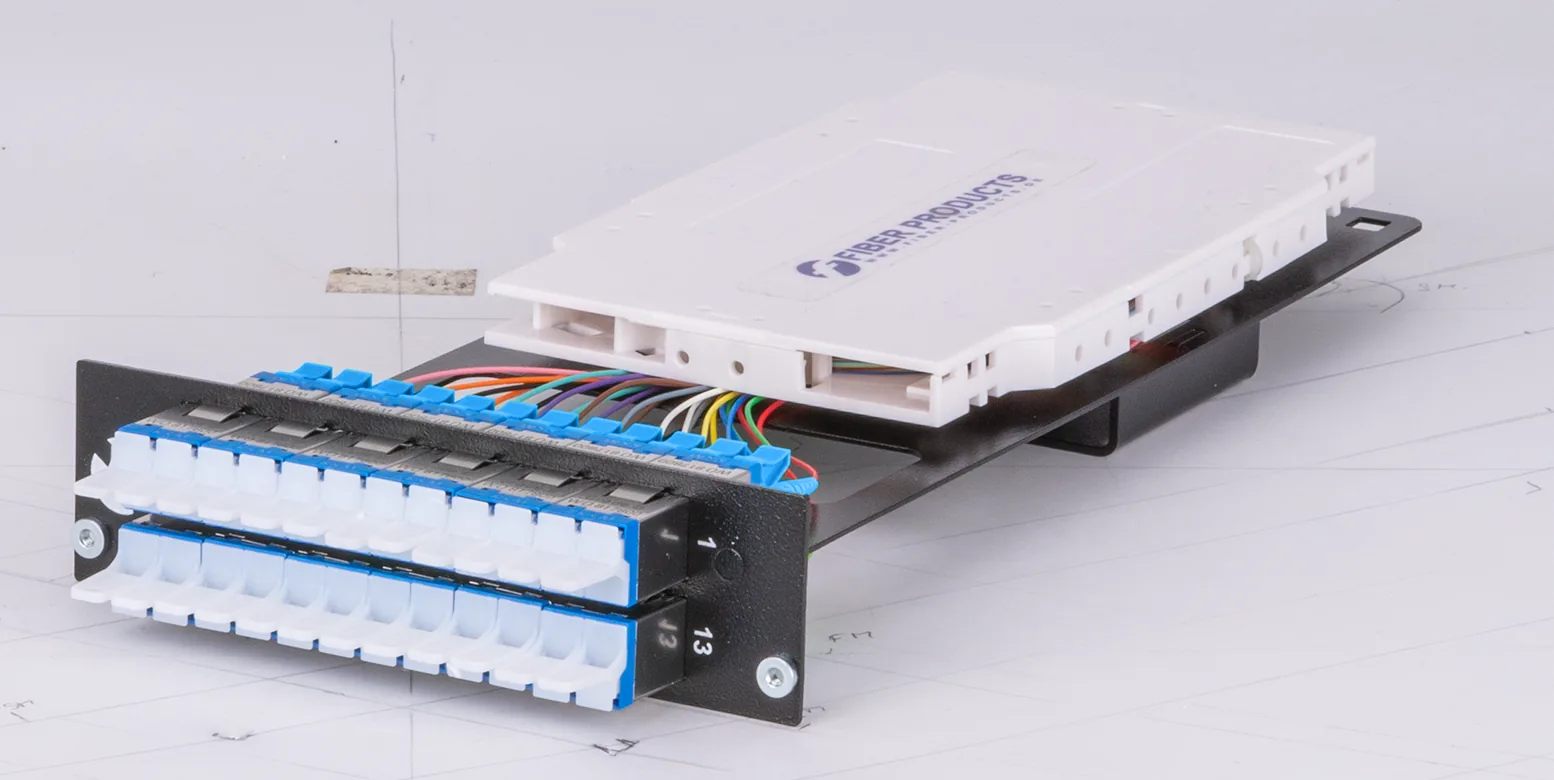
The demands for speed and flexibility in military operations have driven the development of specialised modular splice systems. Pre-terminated splice cassettes with 12 fibres enable complete transmission links to be commissioned in a short time. These systems employ the proven SlimConnect principle with 1U form factor, enhanced with military-specific hardening measures.
Fiber Products quality promise: As official Diamond Partner and manufacturer, we produce modular splice systems in Europe. Benefit from Swiss precision and 5 years’ warranty on our systems.
Tactical splice modules integrate quick couplings per MIL-DTL-38999 for accelerated assembly and disassembly under field conditions. Internal fibre routing follows a redundant design with primary and secondary splice levels, automatically compensating for individual connection failures. Particularly proven are modular splice systems with tool-free installation and colour-coded fibre management per DIN VDE 0888.
- Assembly time: low for 24-fibre module
- Splice loss: < 0.05 dB with fusion splice technology
- Mating cycles: > 1000 for E2000-APC connectors
- Packed size: 380 x 250 x 44mm for 48 fibres
- Module replacement: Hot-swappable during operation
Connector technology for military applications: E2000 and expanded beam technology
The choice of connector technology fundamentally determines the operational capability of military fibre-optic systems. E2000-APC connectors with 8° angled finish have become the standard for military splice modules, rugged fibre-optic solutions, defence FTTH. Integrated spring-loaded protective caps close automatically upon disconnection, preventing contamination by particles > 5 micrometres.
Expanded beam technology addresses the field-operability challenge by expanding the light beam to 200 micrometre diameter. This technology tolerates contamination and misalignment that would disable conventional ferrule-based connectors. The resulting attenuation is < 0.5 dB even under adverse environmental conditions.
| Connector type | Attenuation | Return loss | Military suitability |
|---|---|---|---|
| E2000-APC | < 0.25 dB | > 65 dB | Very high |
| LC-APC hardened | < 0.35 dB | > 55 dB | High |
| Expanded beam | < 0.50 dB | > 50 dB | Highest |
| MPO/MTP-12 | < 0.35 dB | > 60 dB | Medium |
Integration into existing military communications infrastructure
Seamless integration of optical transmission systems into existing military networks requires hybrid interface modules. Media converters with 10 Gbit/s Ethernet to single-mode fibre bridge the technology gap between older copper-based systems and modern fibre-optic networks. These converters comply with MIL-STD-1275E for vehicle mounting and operate at supply voltages of 18 to 36 VDC.
Particular importance attaches to documenting and managing military fibre-optic networks. Digital infrastructure management systems record every splice point with GPS coordinates ±1 metre and automatically manage attenuation budgets. Integration into tactical command systems occurs via standardised interfaces per STANAG 4586.
- Network management: SNMPv3 with AES-256 encryption
- Redundancy: Ring and mesh topologies with < 50ms switchover time
- Power supply: -48 VDC with battery backup for 72 hours
- Monitoring: OTDR integration with 0.01 dB resolution
- Scalability: Modular expansion from 12 to 288 fibres
Standards compliance and military certifications for fibre-optic systems
Procurement of military splice modules, rugged fibre-optic solutions, defence FTTH is subject to strict certification requirements. Beyond civilian standards such as IEC 61300 for optical connectors, military systems must meet additional standards. NATO AQAP-2110 defines quality assurance requirements for defence goods, while DEF STAN 59-411 prescribes specific environmental tests.
German procurement authorities increasingly demand evidence of supply-chain security. BSI Grundschutz and the EU Directive 2019/1937 require complete documentation of component provenance. Manufacturers with European production and established quality management systems per ISO 9001:2015 fully satisfy these requirements.
Practical deployment scenarios: From mobile command posts to barracks networks
Mobile command posts use transportable splice modules with 24 to 48 fibres in shock-damped transport cases. These systems enable temporary high-speed networks with 100 Gbit/s backbone capacity to be established quickly. Fibre-optic solutions for defence applications include pre-terminated cable reels with tactical hybrid cables combining optical fibres and copper conductors for power supply.
Stationary barracks networks benefit from high-density splice systems with up to 96 fibres in 1U. The modular architecture enables incremental expansion as bandwidth requirements grow. Particularly successful are VarioConnect systems with 3U, managing up to 288 fibres in a single frame whilst combining maximum packing density with straightforward maintenance.
- Field camps: Ring networks with 4 splice points for redundancy
- Vehicle integration: Vibration-resistant modules per MIL-STD-810G
- Marine applications: Salt-fog resistant housings per IEC 60068-2-52
- Air force: Airfield systems with lightning protection class LPL I
- Border security: Long-distance transmission > 80 km without amplification
Future perspectives: Quantum communication and photonic radar systems
The next generation of military fibre-optic systems integrates quantum key distribution (QKD) for absolutely wiretap-proof communication. Early pilot projects demonstrate key rates of 1 Mbit/s over 50 km of standard fibre. This technology requires specialist splice modules with attenuation values < 0.02 dB and return loss > 70 dB to minimise quantum bit errors.
Photonic radar systems use fibre-optic networks for distributed signal processing with bandwidths to 100 GHz. Required splice modules must limit dispersion and polarisation mode dispersion to < 0.1 ps/nm/km. These requirements drive development of new manufacturing technologies for military splice modules, rugged fibre-optic solutions, defence FTTH.
FAQ: Technical questions on military fibre-optic systems
What environmental conditions must military splice modules withstand?
Military splice modules must withstand extreme environmental conditions: temperatures from -40°C to +85°C, relative humidity to 95% non-condensing, vibrations per MIL-STD-810G method 514.6, and shocks to 50G. Additionally, salt-fog resistance per IEC 60068-2-52 is required for maritime deployments.
How do military E2000 connectors differ from civilian versions?
Military E2000 connectors feature reinforced housings of stainless steel 316L instead of plastic, increased mating cycles > 2000, extended temperature rating, and specialised seals for IP67 protection. The spring force of protective caps is increased by 30% to ensure reliable closure even under vibration.
Which splicing methods are suitable for field operations?
For military field operations, battery-powered fusion splicers with arc splicing technology are recommended, achieving attenuation values < 0.05 dB. Alternatively, mechanical splices with < 0.3 dB attenuation serve temporary connections. Splicing time is < 15 seconds per fibre.
How is electromagnetic compatibility ensured?
EMC compliance of military fibre-optic systems is achieved through metallic housings with shielding attenuation > 60 dB at 1 GHz, conductive seals at all penetrations, and potential equalisation via M8 earthing bolts. All electronic components comply with MIL-STD-461F for electromagnetic interference.
What redundancy concepts are common for critical military networks?
Critical military networks use physically separated routing with at least 50 metre separation, automatic switchover in < 50 ms on line failure, ring topologies with bidirectional transmission and load sharing, and continuous OTDR monitoring with alerting on > 0.5 dB attenuation change.
How is quality assurance performed for military splice modules?
Quality assurance includes 100% optical inspection of all connectors, attenuation measurement of every splice with logging, environmental simulation per MIL-STD-810G on samples, and full component traceability via serial numbers. Documentation follows NATO AQAP-2110 standards.
Interested in modular fibre-optic solutions?
Fiber Products GmbH – official DIAMOND SA partner. Made in EU, 5 years’ warranty.
Order directly from our shop: fiber-products.de