Hospital network architectures: Modular splicing solutions for networked patient care
Modern hospital network architectures must support complex medical workflows and seamlessly integrate a wide variety of systems. From patient admission to diagnostics, therapy and aftercare – all stages of patient care today require high-performance network infrastructures. Modular fibre optic solutions enable scalable hospital network architectures that can grow with the growing requirements of digitalized medicine and at the same time offer optimum service friendliness for 24/7 hospital operations.
The convergence of various medical technologies on IP-based platforms is fundamentally revolutionizing hospital network architectures. Imaging, patient monitoring, communication systems and building technology now use uniform fiber optic infrastructures. This convergence enables synergies and cost savings, but also places new demands on the flexibility and ease of maintenance of the network infrastructure.
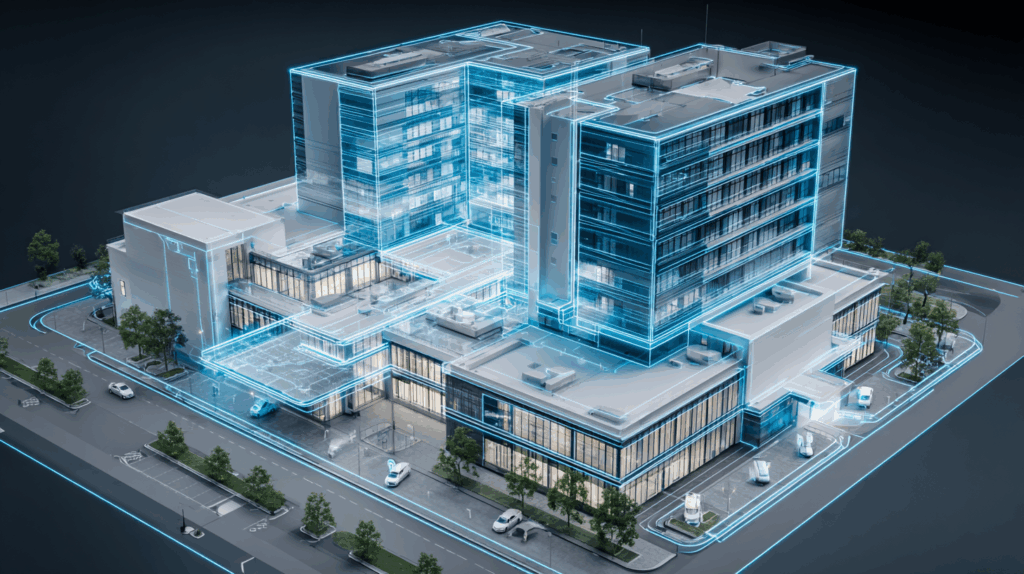
Basic principles of modern hospital network architectures
Successful hospital network architectures follow proven design principles that optimally combine scalability, reliability and ease of maintenance. These principles fundamentally influence the selection and configuration of fiber optic components.
Hierarchical network structures
Hospital network architectures typically use three-tier hierarchies: core layer for central high-performance connections, distribution layer for area aggregation and access layer for end device connections. This structure enables efficient bandwidth utilization and simplifies network management.
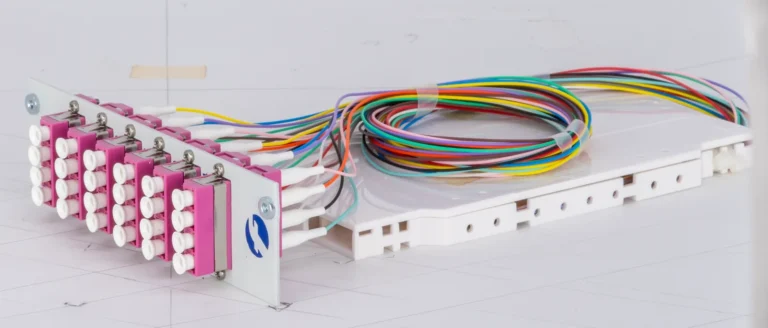
The VarioConnect modular system is particularly suitable for core and distribution layer implementations. The 3U and 4U subracks can combine different connection types in one system: 100 Gigabit uplinks for backbone connections, 10 Gigabit links for area distribution and standard Gigabit connections for access layer switches.
The modular architecture enables step-by-step modernization without a complete reinstallation. Individual layers can be upgraded to higher bandwidths, while others continue to work with existing capacities.
Network segmentation for medical applications
Hospital network architectures need to isolate different application classes: critical medical systems, administrative networks, guest WLAN and IoT devices. This segmentation ensures both security and performance isolation.
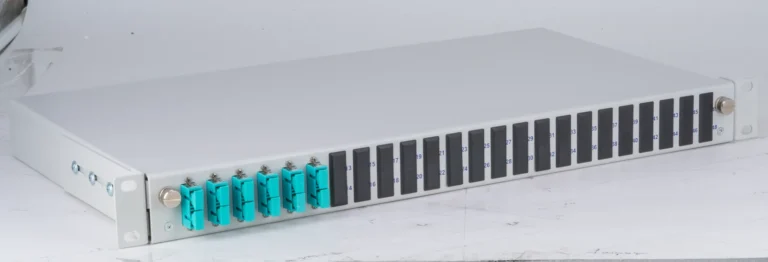
Physical segmentation via dedicated optical fibers offers maximum security for critical systems. The SlimConnect 1U system with up to 96 fibers per height unit enables comprehensive physical separation even with limited rack space in technical rooms.
For less critical areas, logical segmentation via VLANs may be sufficient. The high bandwidth of fiber optics enables many parallel VLANs without any loss of performance.
Service friendliness and maintenance concepts
Hospital network architectures must be available around the clock. Maintenance work should therefore be able to be carried out without interrupting operations and require minimal specialist knowledge.
The EasyConnect splice modules revolutionize the maintenance of hospital network architectures with tool-free click-and-play functionality. Janitors can carry out simple reconfigurations themselves without having to hire external specialists.
Hot-swap capabilities with appropriate redundancy allow components to be replaced during operation. Defective modules can be replaced while patient care is maintained via alternative paths.
Integration of medical systems and workflows
Hospital network architectures must support the entire patient journey, seamlessly integrating different medical systems. Each step of patient care has specific network requirements.
Patient admission and registration processes
The first contact often begins before the hospital visit: online appointment booking, digital pre-registration and electronic referral require secure Internet connections. Hospital network architectures must securely integrate these external systems.
Admission desks require access to hospital information systems (HIS), insurance databases and often also external systems from payers. BasicConnect front modules can flexibly connect admission desks to various network segments.
Mobile registration via tablets enables patient admission directly at the bedside or in waiting areas. WLAN access points require powerful fiber optic backbones for stable connectivity even with high user density.
Diagnostic procedures and imaging
Radiology is often the most bandwidth-intensive area of hospital network architectures. Modern CT and MRI devices generate terabytes of image data per day that need to be transferred between different locations.
Picture Archiving and Communication Systems (PACS) require high-speed connections for real-time image transmission. A typical trauma CT can contain 2,000-5,000 images, each image being several megabytes in size. The transmission of such data sets requires multi-gigabit connections.
The VarioConnect 3U system can connect PACS systems via 100 Gigabit connections and simultaneously provide lower bandwidths for other applications. The modular architecture enables needs-based scaling.
Laboratory automation and point-of-care testing
Modern laboratories are highly automated and continuously generate large amounts of data. Hospital network architectures must transmit this data to the treating physicians in real time, as laboratory values are often decisive for treatment.
Point-of-care testing brings laboratory diagnostics directly to the patient. Mobile analysis devices require a WLAN connection for immediate transmission of results. The fiber optic infrastructure must support appropriate WLAN coverage in all patient areas.
Laboratory information systems (LIS) must be integrated with HIS systems and electronic patient records. This integration requires reliable, high-performance connections between different system components.
Special application areas and their network requirements
Different hospital areas place specific demands on the network infrastructure. Hospital network architectures must take this diversity into account and offer customized solutions.
Operating theaters and interventional suites
Operating theaters are the most technically demanding areas of hospital network architectures. A modern operating room integrates dozens of networked systems: Anesthesia machines, patient monitors, imaging, navigation systems and OR documentation.
4K endoscopy and 3D imaging for minimally invasive surgery generate enormous data streams. Live transmissions for teaching purposes or for remote consultations require additional bandwidth. A single operating room can fully utilize gigabit connections.
The SlimConnect system offers the necessary capacity for complex operating theaters. With up to 96 fibers per height unit, even large operating theaters with 20+ rooms can be efficiently wired, with each room receiving multiple high-speed connections.
Hybrid ORs combine traditional surgery with imaging and require particularly high bandwidths. Real-time CT or MRI during surgery generates continuous data streams that must be transmitted without delay.
Intensive care units and continuous monitoring
Intensive care units have unique requirements for hospital network architectures. Continuous patient monitoring, automated medication administration and ventilation control must function with absolute reliability.
Central monitoring systems aggregate data from dozens of patient stations and enable monitoring by specialized personnel. These systems require redundant connections, as failures can be life-threatening.
Modern intensive care units are increasingly using AI-based systems for the early detection of complications. These systems continuously analyze vital parameters and require corresponding computing capacities and network connections.
Emergency rooms and trauma centers
Emergency rooms have unpredictable load peaks and must be able to react flexibly to mass casualty incidents. Hospital network architectures need to cope with these peaks while keeping resources free for normal operations.
Trauma centers need immediate access to imaging, lab data and external databases. Helipads often need to be equipped with mobile systems that can be configured quickly.
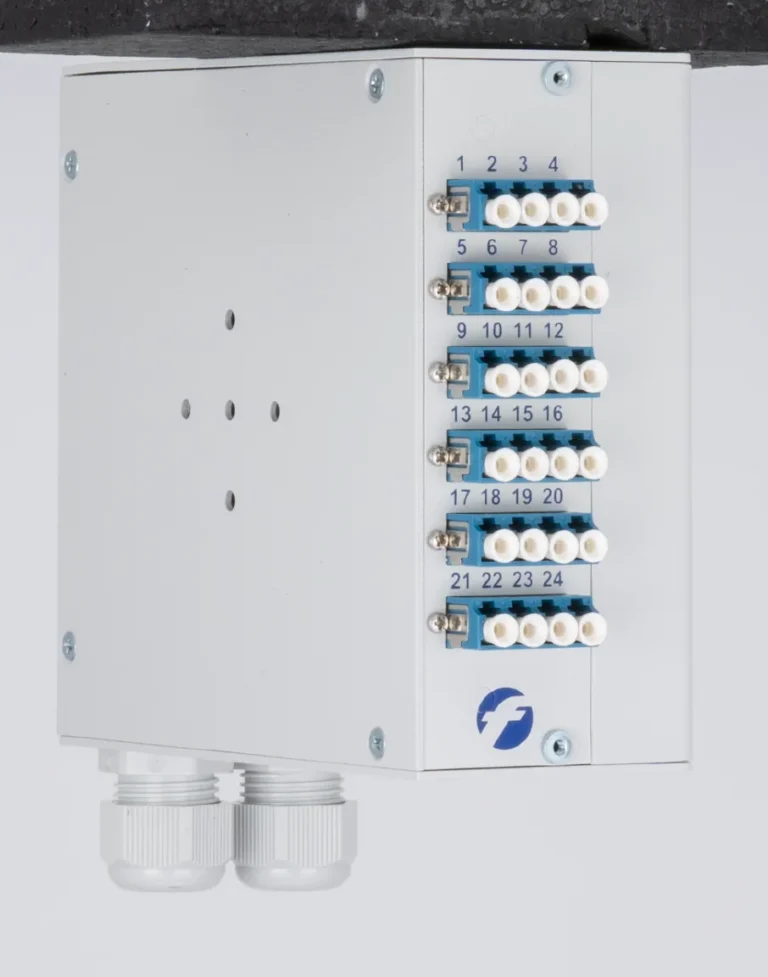
RailConnect top-hat rail boxes are suitable for mobile or temporary installations in emergency rooms. The compact 7TE format can be quickly integrated into emergency distribution cabinets.
Service friendliness as a key criterion
Hospital network architectures must be particularly service-friendly, as failures can endanger lives and qualified technicians are not always immediately available.
Tool-free installation and maintenance
The EasyConnect splice modules enable tool-free connection establishment and reduce installation times by up to 70%. In emergency situations, even less experienced technicians can make reliable connections.
Click-and-play functionality eliminates sources of error and speeds up repairs. Color-coded connectors prevent mix-ups and enable intuitive operation even under stress.
Hot-swap capabilities in modular systems allow components to be replaced without interrupting operations. Redundant fiber optic distribution can intercept maintenance work while critical systems continue to run.
Standardized components and spare parts inventory
Hospital network architectures should use standardized components to simplify spare parts management. The modular design enables the use of identical modules in different application areas.
A spare parts set with just a few module types can cover various failure scenarios. This reduces storage costs and ensures fast availability of critical components.
The 5-year guarantee on high-quality European production reduces the risk of failure and offers cost security for hospital budgets. Defective components are replaced free of charge, which eases the burden on maintenance budgets.
Remote diagnostics and remote support
Modern hospital network architectures support remote diagnostics and remote support by manufacturers and system integrators. This enables quick problem solving without travel times.
Secure VPN connections allow manufacturers remote access to critical systems for maintenance and updates. The fiber optic infrastructure must support appropriate bandwidths and security features.
Predictive maintenance can prevent many problems before they lead to failures. Continuous monitoring and AI-based analysis identify creeping deterioration at an early stage.
Mobile devices and WLAN integration
The mobility of medical workflows makes WLAN a critical component of hospital network architectures. Mobile documentation, tablets and medical devices require reliable connectivity everywhere.
Comprehensive WLAN coverage
Hospital Wi-Fi must be available everywhere: patient rooms, corridors, elevators and even outdoor areas such as helipads. This requires dense access point distribution and corresponding fiber optic backbones.
The SlimConnect system can connect hundreds of WLAN access points via dedicated optical fibers. The high fiber density enables individual connections for each access point without complex cabling hierarchies.
High-frequency areas such as waiting rooms or cafeterias require particularly powerful access points. These can be connected via multi-gigabit fiber optic connections to ensure optimum performance even with a high user density.
Medical-grade WLAN for critical applications
Medical applications place special demands on WLAN performance. Patient monitoring, infusion pumps and mobile diagnostic devices require guaranteed bandwidths and low latency.
Dedicated WLAN networks for medical devices can ensure quality of service and avoid interference with consumer devices. The fiber optic infrastructure must support separate networks and provide appropriate bandwidths.
Bring Your Own Device (BYOD) for medical staff
Doctors and nursing staff are increasingly using private devices for professional purposes. BYOD concepts require secure network separation and appropriate bandwidth planning.
Guest WLAN for patients and visitors must be separated from medical networks. Separate WLAN infrastructures require corresponding fiber optic backbones and can require considerable bandwidths.
Internet of Medical Things (IoMT) and sensor integration
Hospital network architectures must support the growing number of networked medical devices. From smart beds to implantable sensors – all devices require network connectivity.
Asset tracking and device management
RFID and Bluetooth-based asset tracking systems help to manage expensive medical equipment. Wheelchairs, infusion pumps and mobile X-ray machines can thus be localized and monitored.
These tracking systems require comprehensive network coverage and corresponding backend systems for data processing. Gateways must be connected via the fiber optic infrastructure.
Environmental monitoring and smart building
Intelligent building technology can reduce energy costs and improve patient comfort. Sensors for temperature, air quality and occupancy require appropriate network connections.
BasicConnect front modules can flexibly integrate IoT gateways and connect various sensor technologies. The modular architecture enables step-by-step expansion for additional smart building functions.
Predictive maintenance for medical devices
Networked medical devices can continuously transmit status data and enable predictive maintenance. This reduces unplanned downtime and extends device service life.
These applications generate continuous data streams that have to be transferred to central analysis systems via the hospital network architectures.
Integration with external systems and telemedicine
Hospital network architectures must integrate various external systems and support telemedicine applications. This requires secure, high-performance Internet connections.
Connection to cost units and authorities
Billing systems must communicate with health insurance companies and other payers. These connections transport sensitive patient data and must meet appropriate security standards.
Reporting obligations to health authorities require automated data transmission. Infection protection, quality assurance and statistical data must be transmitted regularly.
Telemedicine and remote consultations
Telemedicine enables consultations with external specialists and reduces transfers. High-resolution video transmission and real-time data transmission place high demands on the Internet connection.
Telepathology and teleradiology enable findings to be made by external experts. These applications require secure transmission of large image files and real-time communication.
Research networks and databases
University hospitals and research institutions require connections to scientific networks and databases. Clinical studies and research projects generate large amounts of data.
The German Research Network (DFN) and international research infrastructures require specialized high-performance connections. These can be realized via the hospital network architectures.
Future security and technology trends
Hospital network architectures must be prepared for future technologies. The long service life of infrastructures requires forward-looking planning.
Artificial intelligence and machine learning
AI-based diagnostics and therapy support are increasingly being used. These systems require extensive data processing and corresponding network capacities.
Edge computing can reduce latency and improve data protection. Local AI processing directly in the hospital reduces dependency on cloud services and improves response times.
Virtual and augmented reality
VR/AR applications enable new forms of therapy and improved training. Surgical simulation, pain therapy and rehabilitation can benefit from immersive technologies.
These applications place extreme demands on networks: lowest latency, high bandwidths and absolute reliability. Motion-to-photon latency must remain below 20ms to avoid motion sickness.
Robotics and automation
Robotic systems for surgery, logistics and patient care are becoming increasingly widespread. These systems require real-time communication and corresponding network infrastructures.
Autonomous mobile robots for drug distribution or sample collection must be able to communicate anywhere in the hospital. Seamless roaming between different network areas is essential.
Conclusion: Modular fiber optics as the foundation of networked patient care
Hospital network architectures are evolving from supporting infrastructures to mission-critical systems that directly determine the success of treatment and patient safety. Choosing the right fiber optic components is therefore not only a technical decision, but also an ethical one.
Modular splicing solutions offer the flexibility needed to meet the complex and ever-changing requirements of the healthcare sector. They enable scalable architectures, support different application classes and reduce maintenance times and costs thanks to their service-friendly design.
Investing in future-proof, modular fiber optic infrastructures pays off not only through improved patient care, but also through reduced operating costs and better compliance with regulatory requirements.
At Fiber Products, we develop modular fiber optic systems for the highest quality requirements. Our modular systems combine proven technology with innovative features.
With a 5-year guarantee and European production according to German quality standards, we offer competitive conditions with professional quality for successful fiber optic networks.
Discover our complete product range or visit our online store. Talk to us – together we will develop the optimum solution for your project. Contact us for an individual consultation or find out about other specialist topics in our fiber optic knowledge blog.