GPU Cluster Fiber 800G: Modular cabling for next-generation AI data centers

The explosive development of artificial intelligence is presenting data center operators with completely new challenges. While NVIDIA’s latest GB200 NVL72 systems combine 72 GPUs with 1.8 TB/s interconnect speed in a single rack, traditional cabling concepts are reaching their physical limits. The answer lies in sophisticated GPU cluster fiber 800G migration strategies and modular fiber systems that can handle both today’s AI workloads and future scaling requirements.
GPU Cluster fiber optic 800G technologies represent a paradigm shift in data center cabling. While traditional server farms get by with 10G or 100G connections, modern AI systems require 400G-800G interconnects for optimal performance. This development makes modular, scalable fiber optic solutions indispensable for successful AI projects.
The complexity of modern GPU cluster fiber 800G infrastructures is reflected in the sheer number of connections required: A single NVIDIA HGX B200 server with 8 GPUs requires up to 16 fiber connections just for the network fabric. Clusters with thousands of GPUs require hundreds of thousands of interconnects, all of which must be accommodated in compact rack spaces.
The GPU revolution is fundamentally changing data center requirements
Artificial intelligence has evolved from an experimental field to a business-critical infrastructure. McKinsey predicts that generative AI will contribute between 2.6 and 4.4 trillion dollars annually to global economic output. However, this transformation requires GPU cluster fiber 800G infrastructures that go far beyond traditional server workloads.
The leap from H100 to B200: Exponential increase in complexity
The leap from NVIDIA’s H100 to B200 generations illustrates the GPU cluster fiber 800G evolution: While H100 systems already delivered impressive performance, B200 GPUs offer three times the training performance and 15 times the inference performance with similar power consumption. However, these performance increases do not come without infrastructural consequences.
GPU cluster scaling poses new challenges:
- H100 systems: 8 GPUs per node, 400 Gbit/s InfiniBand connectivity
- B200 systems: 8 GPUs per node, but 1:1 GPU to NIC ratio required
- GB200 NVL72: 72 GPUs in a 1.8 TB/s NVLink domain per rack
This development clearly shows that the GPU cluster fiber optic 800G architecture is moving from a supporting element to a critical infrastructure component that determines the success or failure of AI projects.
Data center planners must already include these exponentially increasing requirements in their infrastructure planning.
Scaling brings physical limits
Modern GPU generations offer more and more computing power per height unit, but at the same time require more network connections for GPU cluster fiber optic 800G applications. A typical AI server with 8 GPUs requires 8-16 fiber ports for optimal performance. With 42 height units per rack and increasingly dense GPU populations, this places extreme demands on the cabling infrastructure.
The traditional solution – larger data centers – is reaching its limits in German conurbations. Building land is scarce and approval procedures take years. The only sustainable answer is to optimize rack space efficiency through innovative GPU cluster fiber optic 800G front module technologies.
GPU cluster cabling requirements: From NVLink to InfiniBand
Intra-node communication: NVLink dominates
Modern GPU cluster fiber 800G systems use NVLink for direct GPU-to-GPU communication within individual servers. NVIDIA H100 systems use fourth generation NVLink with 900 GB/s bidirectional bandwidth, while B200 systems upgrade to NVLink 5.0 with 1.8 TB/s. This technology enables unified memory access between GPUs and reduces latency-critical bottlenecks in AI training.
Inter-Node Networking: InfiniBand vs. Ethernet
For communication between servers, GPU Cluster fiber optic 800G implementations rely on high-speed networks. InfiniBand NDR (400 Gbps) has long been the standard, but 800G Ethernet is gaining traction due to cost savings and better interoperability. DriveNet’s Network Cloud AI systems are already demonstrating architectures with 30.4 Tbps switching capacity per leaf switch.
Scaling challenges with GPU clusters
Scaling from 8-GPU systems to GPU cluster fiber 800G deployments with thousands of GPUs requires sophisticated network topologies. Spine-leaf architectures have become the standard, with each leaf switch providing direct access to GPU servers and spine switches providing inter-leaf communication. In 800G deployments, fabrics such as DriveNets Network Cloud-AI scale to up to 32,000 GPUs per cluster, with individual leaf switches providing 18x800G or 36x400G ports.
Splice modules with a high port density are essential for these complex topologies.
Latency-critical requirements
AI training, especially for large language models, is extremely sensitive to network latency. While traditional data center workloads tolerate latencies of 10-50 microseconds, GPU cluster fiber 800G training jobs require latencies below 1 microsecond between GPU clusters. This requirement makes high-quality fiber components and optimized cabling architectures essential.
800G/1.6T transceiver technologies: The path to extreme bandwidth
Form factor evolution: QSFP-DD vs. OSFP
The evolution to GPU cluster fiber 800G requires new transceiver form factors. QSFP-DD (Dual Density) offers backward compatibility to existing 400G systems and supports 8x100G PAM4 signaling. OSFP (Octal Small Form Factor Pluggable) is specifically designed for 800G applications and offers superior thermal characteristics for high performance environments.
Transmission distances and application scenarios
GPU Cluster fiber optic 800G transceivers are offered in different range variants:
Reach categories:
- SR8 (Short Reach): 100m via multimode fiber optics for intra-rack connections
- DR8 (8 parallel lanes): 500m over singlemode fiber for intra-building connectivity
- FR4/LR4: 2-10km for campus connections between data center buildings
PAM4 modulation: Efficiency through signal optimization
GPU Cluster fiber optic 800G systems use 4-Level Pulse Amplitude Modulation (PAM4) with 100 Gbit/s per optical lane. This technology doubles the data rate compared to traditional NRZ modulation with the same number of optical channels. For DCI links (80-120 km), coherent 800ZR modules (DP-16QAM, ~118 GBaud) are additionally available in the QSFP-DD/OSFP form factor.
Breakout strategies for flexible deployment
GPU Cluster fiber optic 800G ports offer multiple breakout options:
Breakout configurations:
- 2x400G for maximum single connection bandwidth
- 4x200G for balanced performance distribution
- 8x100G for maximum port flexibility for server connections
This flexibility makes it possible to optimize an 800G switch for both high-bandwidth AI training and distributed inference workloads. VarioConnect 3U/4U systems optimally support complex breakout scenarios.
Modular solutions for AI data centers: Flexibility as a success factor
High-density front modules: Optimize maximum GPU connections
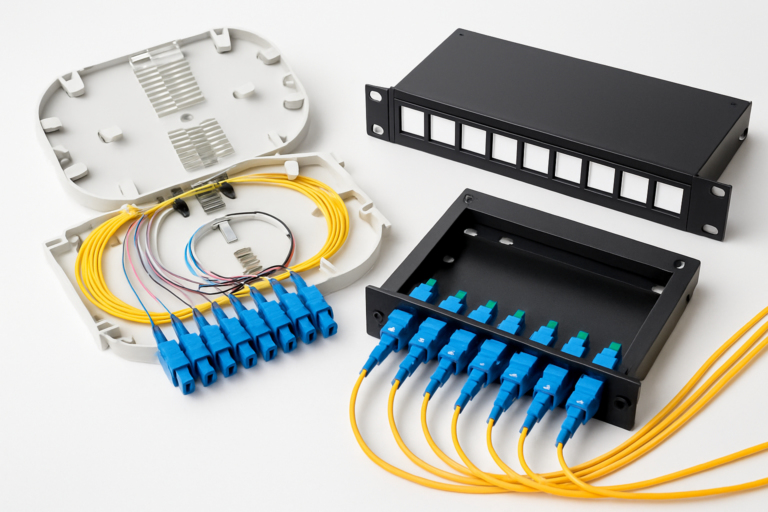
Modern GPU cluster fiber optic 800G implementations require extreme port densities with ease of maintenance. High-density concepts such as the SlimConnect system enable up to 96 fibers (48 LC duplex ports) per height unit in 19-inch systems. For GPU clusters, where each GPU typically requires 2-4 optical connections, this enables the connection of 12-24 GPUs per rack unit via a single patch panel.
Planning 800G Cabling for a GPU Cluster?
See our high-density boxes in the store – or request a rack-level port plan and project quote for your cluster.
Flexible port migration: future-proof through modularity
GPU technology is evolving rapidly: What starts today as a GPU cluster fiber optic 800G H100 cluster with 400G connectivity will be B200 systems with 800G requirements tomorrow. Modular fiber optic systems enable seamless migrations without complete infrastructure renewal. Adapter modules can convert LC duplex connections into MPO-based parallel optics or integrate Very Small Form Factor (SN, CS) connectors.
Fast deployment cycles: optimize time-to-market
GPU cluster fiber 800G projects typically have aggressive timelines. Elon Musk’s xAI Colossus supercomputer with 100,000 H100 GPUs was completed in just 122 days – a speed that was only possible with pre-terminated, modular cabling systems. Plug-and-play approaches reduce installation times from weeks to days and minimize costly project planning errors.
Scalable architectures: Support from 8-GPU to 32K-GPU
Modular GPU cluster fiber 800G systems need to support both small AI development environments and hyperscale deployments. The compact SlimConnect system offers flexibility for edge AI applications and smaller GPU clusters, while 3U/4U VarioConnect solutions enable complex breakout configurations for large GPU clusters.
This scalability protects investments as requirements change and future-proofs GPU Cluster fiber optic 800G infrastructures.
Practical examples: Successful AI data center implementations
xAI Colossus: The importance of professional cabling
The xAI Colossus system impressively demonstrates the importance of sophisticated GPU cluster fiber optic 800G architectures. With 100,000 NVIDIA H100 GPUs and a realization in only 122 days, the project shows how modular approaches enable extreme scaling. The system uses high-speed Ethernet networking with liquid cooling for maximum efficiency and scalability.
Microsoft Azure AI: Hollow-core fiber for lowest latency
Microsoft Azure relies on hollow-core fiber technology for GPU Cluster Fiber 800G workloads, which enables 50% faster light transmission compared to traditional fiber. This technology reduces latency by 1.54 microseconds per kilometer – a critical advantage for distributed AI training across multiple data center locations.
Together AI Clusters: Scaling from 16 to 100K+ GPUs
Together AI demonstrates flexible GPU cluster fiber 800G scaling with support for different GPU generations. The system supports seamless scaling from smaller development environments (16 GPUs) to production clusters with over 100,000 GPUs. The modular cabling architecture enables mixed workloads between H100, H200 and upcoming B200 systems.
Enterprise AI implementations: Practical requirements
Not all GPU cluster fiber 800G deployments require hyperscale dimensions. Many organizations start with 8-64 GPU clusters for specific use cases. These implementations particularly benefit from modular approaches as they enable iterative expansion without complete infrastructure refresh cycles.
System integrators can benefit from standardized modular solutions.
Cabling architectures for GPU clusters: systematically mastering complexity
Intra-node: GPU-to-GPU within servers
Modern GPU servers use NVLink for direct GPU-to-GPU communication. H100 systems implement NVLink 4.0 with 900 GB/s between adjacent GPUs, while GPU Cluster fiber 800G B200 systems upgrade to NVLink 5.0 with 1.8 TB/s. These connections are typically copper-based and do not require external fiber infrastructure.
The challenge lies in the integration: GPU servers simultaneously require NVLink for internal communication and external GPU cluster fiber optic 800G connections for cluster networking. Modular front module systems enable the space-saving integration of both technologies.
Inter-Node: Server-to-server interconnects
GPU Cluster fiber 800G networking primarily uses InfiniBand or high-speed Ethernet for inter-node communication. H100 systems typically use 400G NDR InfiniBand (4x100G PAM4), while B200 clusters upgrade to 800G XDR InfiniBand (Quantum-X800/ConnectX-8, 4x200G PAM4) or upcoming 1.6T standards.
The cabling requirements are considerable: a typical GPU node requires 8-16 fiber optic connections just for the compute fabric. For spine-leaf architectures with 32:1 oversubscription, this means 256-512 uplink connections per spine switch.
Storage Fabric: High-Performance Computing Storage
GPU cluster fiber 800G workloads are extremely data intensive. Training the GPT-3-175B model drew on 45 TB of raw text data (around 570 GB after filtering). GPU clusters therefore require parallel storage fabrics with extreme bandwidth. Distributed file systems such as Lustre or parallel NFS require dedicated fiber optic infrastructures.
Together AI’s cluster configurations show typical requirements: “Up to 3PB high-performance converged storage” per GPU node group. These storage systems use separate fiber fabrics in parallel to the compute networking, which doubles the cabling complexity.
Future-proof cabling strategies: Investment protection and 1.6T preparation
1.6T technology roadmap: Infrastructure requirements
The IEEE 802.3dj standard for 1.6T Ethernet (8x200G lanes) is being finalized in 2026, with the first 1.6T products expected in 2026/27. GPU Cluster fiber 800G infrastructures planned today for 800G migration should consider these future requirements. Structured cabling with sufficient fiber reserve and modular upgrade paths will be critical.
Investment protection through modular architectures
Traditional monolithic cabling systems require complete renewal for technology leaps. Modular GPU cluster fiber 800G approaches enable selective upgrades: A system installed today can be migrated from 100G to 400G and later to 800G by replacing the front modules without changing the backend infrastructure. This flexibility significantly reduces the total cost of ownership.
Ease of maintenance with 24/7 AI training
GPU cluster fiber 800G training jobs typically run continuously for weeks or months. Unplanned downtime can jeopardize multi-million dollar projects. Hot-swappable modular systems allow maintenance and upgrades without service interruption. German engineering quality with a 5-year warranty provides additional peace of mind for mission-critical deployments.
Edge-AI integration: hybrid architectures
Future GPU cluster fiber 800G deployments will use hybrid architectures: Massive training clusters in central data centers, coupled with edge inference systems for latency-critical applications. Modular cabling systems must support both scenarios – from high-density clusters to compact edge deployments.
Vendor Comparison & Best Practices: Protocol Decisions
InfiniBand vs. Ethernet: Technology choice for GPU workloads
GPU Cluster fiber optic 800G implementations primarily use two network technologies:
InfiniBand advantages:
- Lowest latency (sub-microsecond)
- Hardware-based collective operations
- Native GPU integration via GPUDirect RDMA
- Proven scaling to 100K+ nodes
Ethernet advantages:
- Lower costs for hardware and cabling
- Broader vendor selection and standardization
- Easier integration into existing infrastructures
- RoCE (RDMA over Converged Ethernet) for GPU compatibility
Modern GPU clusters fiber optic 800G increasingly use hybrid approaches: InfiniBand for latency-critical training, Ethernet for storage and management.
Power management with high port densities
Energy efficiency becomes critical in GPU cluster fiber 800G deployments. A 400G transceiver typically consumes 12-15 watts, while 800G modules can consume up to 25 watts. For switch systems with 32x800G ports, this means power consumption of 800+ watts for the transceivers alone. Intelligently designed cabling architectures with breakout functionality can optimize energy consumption by activating ports as needed.
Industry-specific implementations
Educational institutions and research
Educational institutions with AI research need scalable GPU cluster fiber 800G solutions:
- Flexible cluster sizes for different research projects
- Budget-optimized modular expansions
- Simple maintenance by facility management teams
- Integration with existing campus networks
Industrial AI applications
Industrial applications require robust GPU cluster fiber optic 800G implementations:
- Extended environmental tolerance for production environments
- Integration with production control systems
- Predictive maintenance through AI analyses
- Edge AI for real-time decisions
Recommendations for AI data center operators
The migration to GPU cluster fiber 800G capable AI data centers requires strategic planning and modular approaches. Successful implementations start with thoroughly planned cabling architectures that consider both today’s GPU cluster requirements and future scaling scenarios.
Immediate steps
Priority measures for GPU cluster fiber optic 800G migration:
- Inventory of existing fiber optic infrastructures for 800G compatibility
- Evaluation of modular front module systems for flexible GPU connections
- Planning structured cabling with sufficient fiber reserve for 1.6T migration
- Assessment of current rack space usage and optimization potential
Medium-term strategies
Setting the strategic course:
- Implementation of high-density solutions for optimal rack space utilization
- Training of technical teams on AI-specific cabling requirements
- Establishment of vendor partnerships for modular system components
- Development of standardized deployment processes for rapid cluster expansion
Long-term vision
Future-oriented infrastructure development:
- Hybrid cloud edge architectures for different AI workload types
- Sustainability integration through energy-efficient modular systems
- Continuous technology refresh through modular upgrade paths
- Skills development for specialized AI infrastructure competencies
Conclusion: The future of AI infrastructure
GPU cluster fiber 800G technologies are not just a trend, but a fundamental necessity for the growing demands of modern AI systems. The exponentially increasing bandwidth requirements from NVIDIA’s H100 to B200 generations and beyond can only be met by intelligent modular cabling architectures.
Investments in modular technologies pay off through flexibility, future-proofing and reduced total cost of ownership. While traditional cabling approaches require complete replacements with every GPU generation change, modular GPU cluster fiber optic 800G systems enable gradual upgrades by simply replacing modules.
The complexity of modern AI data centers with NVL72 systems, 1.8 TB/s NVLink domains and hundreds of thousands of GPU interconnects requires well thought-out cabling strategies. Only through a systematic approach with modular, standardized components can such projects be implemented successfully and on time.
Fiber Products’ SlimConnect and VarioConnect systems are specifically designed to meet these demanding GPU cluster fiber 800G requirements and, with their modular design and proven 5-year warranty, provide the ideal foundation for future-proof GPU cluster deployments.
Modern GPU cluster fiber optic 800G data centers require more than just powerful GPUs – they require sophisticated cabling architectures that combine flexibility, scalability and future-proofing.
Visit our online store for high-quality splice modules and modular fiber optic solutions. You can find more technical articles in our blog.
Contact us to jointly develop the optimal GPU cluster fiber optic 800G solution for your AI data center project and benefit from maximum performance with a future-proof investment.
Related data center guides
- Fiber optic solutions for data centers (port density, modularity, cable management)
- Data center front modules (high-density interfaces)
- Fiber optic system integration (architecture and scalability)
Request a Consultation
Our experts will advise you on modular fiber optic solutions for your specific application — fast, personal and non-binding.