FTTH module comparison 2025: The ultimate guide for optimal module selection
Choosing the right FTTH modules determines the success or failure of fiber optic projects. While all modules pursue the same goal – the reliable distribution of fiber optic signals – they differ considerably in terms of capacity, design, area of application and cost-effectiveness. A well-founded FTTH module comparison helps planners and decision-makers to find the optimum solution for their specific requirements.
The FTTH market today offers a bewildering variety of different module systems: from compact 1U solutions to high-capacity 4U systems, from simple splice modules to complex ODF architectures. Each variant has its justification, but not every one is suitable for every project. The right choice not only saves on acquisition costs, but also significantly influences installation costs, ease of maintenance and expandability over the entire operating time.
This FTTH module comparison structures the most important module systems according to objective criteria and shows which solution is best suited for which project requirements. From small municipal utility installations to large carrier networks – there is a suitable modular architecture for every application.
Overview of FTTH module systems
The FTTH market has produced various module system categories that differ fundamentally in their basic architecture and intended use. A structured FTTH module comparison begins with categorization according to design.
Compact 1U systems
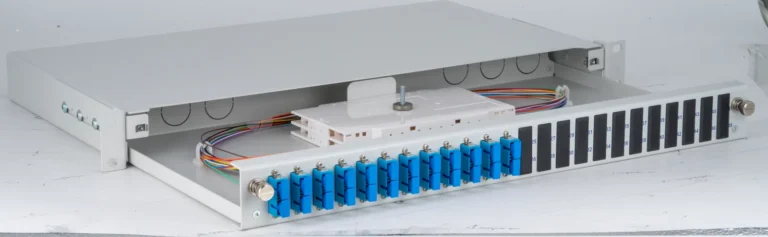
1U modules (19 inch, 44mm high) are the most compact solution for FTTH distributions. They are particularly suitable for space-limited installations and smaller numbers of connections.
Typical specifications:
- 12-48 fiber optic connections per module
- Installation depth mostly 200-300mm
- Weight 2-5 kg
- Splice capacity 24-96 fibers
The low overall height enables installations in standard wall distributors or compact outdoor housings. Especially in apartment buildings or small commercial areas, 1U systems are often the most economical solution for fiber optic solutions for installers.
Limitations become apparent when it comes to expandability: the compact design only allows a limited number of connections. For growing networks, 1U modules can quickly reach their limits.
Versatile 3U systems
3U modules (19 inch, 133mm high) offer the best compromise between compactness and capacity. They can be used in a wide variety of FTTH projects and are particularly flexible to expand.
Typical specifications:
- 48-144 fiber optic connections per module
- Installation depth 250-400mm
- Weight 5-12 kg
- Splice capacity 96-288 fibers
3U systems usually support different connector types (LC, SC, FC) and can be equipped with different splice cassettes. This flexibility makes them the first choice for medium-sized FTTH projects and fiber optic solutions for data centers.
The installation height enables clear cable management and maintenance-friendly arrangement of all components. Subsequent configuration changes are also possible without any problems.
High-capacity 4U systems
4U modules (19 inch, 177mm high) are designed for large FTTH projects with the highest connection densities. They offer maximum capacity in the smallest of spaces.
Typical specifications:
- 144-576 fiber optic connections per module
- Installation depth 300-500mm
- Weight 8-20 kg
- Splice capacity 288-1152 fibers
4U systems enable high-density installations in data centers, large residential complexes or carrier hotels. The high port density significantly reduces the space required per connection.
The disadvantage lies in the complexity: 4U modules require systematic planning and experienced technicians for installation and maintenance.
Capacity and density analysis in FTTH module comparison
The connection capacity is often the first selection criterion for FTTH modules. However, not only the maximum possible number of ports should be considered, but also practical aspects.
Realistic vs. theoretical port densities
Manufacturer specifications usually refer to the theoretical maximum possible number of ports. In practice, these values are often not fully usable as space is required for cable management, splice reserves and service loops.
With 1U modules with 48 ports, often only 36-40 ports can be used in practice. The remaining space is required for proper cable routing and strain relief.
In practice, 3U modules with 144 port capacity usually achieve 120-130 usable connections. The greater height enables better cable management than with 1U systems.
4U modules come closest to the theoretical capacity, as there is sufficient space for systematic cable organization.
Expandability and scalability
FTTH networks usually grow continuously over several years. Modules should support this development without the need for completely new installations.
Modular systems enable step-by-step expansion: frames are initially only partially equipped and further modules are added as required. This flexibility is particularly important for fiber optic solutions for municipal utilities, which often start with limited budgets.
Non-modular systems often require complete modules to be replaced when expanding capacity. This causes operational interruptions and higher costs.
Design and installation aspects
The physical properties of FTTH modules largely determine where and how they can be installed. A detailed FTTH module comparison takes these practical aspects into account.
Space requirement and housing requirements
Compact 1U modules fit into standard wall-mounted distributors and require only minimal cabinet sizes. This makes them ideal for installations in stairwells or technical rooms with limited space.
The shallow installation depth also allows wall mounting without protruding cabinets. This is particularly advantageous in listed buildings or architecturally demanding environments.
3U and 4U modules require correspondingly larger cabinets or racks. However, the higher space requirement is compensated for by better accessibility and a clearer arrangement.
Cable management and fiber routing
Professional cable management is crucial for maintenance-friendly FTTH installations. The module design largely determines how well fibres can be organized.
1U modules often only offer basic cable routing. Service loops and splice reserves usually have to be accommodated outside the module.
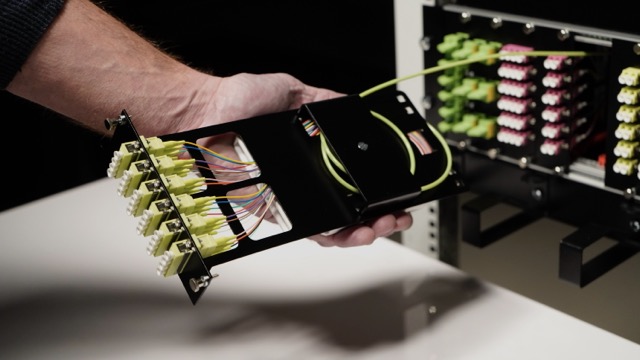
3U modules enable systematic cable management with integrated guides, fixing points and splice cassette holders.
4U modules offer the best cable organization with separate areas for different functions: Entrance area, splice area, distribution area.
Fiber optic solutions for industry benefit in particular from systematic cable management.
Areas of application and usage scenarios
Different FTTH projects place different demands on module systems. The optimal choice in the FTTH module comparison depends on project size, environment and specific boundary conditions.
Residential buildings and apartment buildings in FTTH module comparison
Space-saving solutions dominate in residential buildings. 1U modules are often the first choice here, as they fit into compact wall distributors and can be installed inconspicuously.
Typical requirements:
- 12-48 connections per building
- Compact design for stairwells
- Quiet operation
- Vandalism protection
3U modules are used in larger residential complexes where higher connection densities are required. The improved expandability is important for growing numbers of residents.
Commercial areas and industrial plants in FTTH module comparison
Commercial FTTH installations often require higher connection densities and more robust designs. 3U and 4U modules are standard here.
Typical requirements:
- 48-200 connections per location
- Redundant cabling
- Industrial enclosures (IP65)
- Extended temperature range
Modular ODF systems allow flexible configuration for different tenants or areas of use in the same commercial area.
Data centers and carrier hotels in FTTH module comparison
Data centers require the highest port densities in the smallest possible space. 4U modules and ODF systems dominate here.
Typical requirements:
- 200-1000+ connections per rack
- Highest packing density
- Hot-swap capability
- Precise documentation
The high connection density justifies more complex and more expensive module systems, as the space required per port must be minimized.
Campus networks and educational institutions in FTTH module comparison
Universities and large school complexes require flexible, expandable systems. Fiber optic solutions for educational institutions usually use modular ODF solutions.
Typical requirements:
- Mixed connection densities
- Gradual expansion
- Different user groups
- Long-term scalability
Profitability comparison in FTTH module comparison
The total costs of FTTH modules far exceed the purchase price. A well-founded profitability analysis in the FTTH module comparison takes into account all cost factors over the entire service life.
Total Cost of Ownership (TCO)
Acquisition costs:
- 1U modules: 15-30 euros per port
- 3U modules: 10-20 euros per port
- 4U modules: 8-15 euros per port
- ODF systems: 12-25 Euro per port
Installation costs: Compact modules reduce installation time, but more complex systems offer better ease of maintenance. Installation costs can amount to 50-100% of the module costs.
Operating costs: Maintenance-friendly modules with good accessibility and documentation significantly reduce operating costs. Over 15 years of operation, these savings can compensate for the higher acquisition costs.
Break-even analysis
For smaller projects (<50 connections), 1U modules are often economically optimal, despite higher port costs.
Medium-sized projects (50-200 connections) usually benefit from 3U modules with the best cost-benefit ratio.
Large projects (>200 connections) justify 4U modules or ODF systems despite their greater complexity.
Fiber optic solutions for network operators usually require a differentiated TCO analysis.
Technical specifications in detail
When selecting FTTH modules in the FTTH module comparison, various technical parameters must be taken into account that go beyond the pure number of ports.
Optical performance in FTTH module comparison
Attenuation values (insertion loss) vary between different module systems. High-quality modules achieve values below 0.2 dB, while simpler solutions can attenuate up to 0.5 dB.
Return loss values should be better than 50 dB to minimize reflections. This is particularly important for longer transmission distances.
Polarization Dependent Loss (PDL) becomes more important with coherent transmission methods and should be less than 0.1 dB.
Comparison of mechanical properties in FTTH modules
Mating cycles determine how often connections can be disconnected and reconnected. Professional modules manage 1000+ cycles without any loss of quality.
Vibration resistance is important for installations near traffic routes or in industrial environments. Standards such as IEC 61300-2-1 define test procedures.
Temperature range and climate resistance must match the installation conditions. Outdoor modules must withstand -40°C to +70°C.
Compatibility and standards in FTTH module comparison
Connector compatibility with various fiber types (G.652, G.657) and connector types (LC, SC, FC) increases flexibility.
Compliance with international standards (ITU-T, IEC, Telcordia) ensures interoperability and long-term behavior.
RoHS compliance and other environmental standards are becoming increasingly important for public tenders.
Selection criteria and decision matrix
The optimum module selection in the FTTH module comparison requires systematic evaluation of various criteria according to the project requirements.
Project size and number of connections
Small (up to 50 connections):
- Recommendation: 1U modules
- Priority: Compactness, low acquisition costs
- Pitfall: check expandability at an early stage
Medium (50-200 connections):
- Recommendation: 3U modules
- Priority: Flexibility, ease of maintenance
- Advantage: Best cost-benefit ratio
Large (200+ connections):
- Recommendation: 4U modules or ODF
- Priority: Port density, scalability
- Success factor: systematic planning
Ambient conditions
Indoor installation:
- Standard housing sufficient
- Focus on ease of maintenance
- Observe low noise level
Outdoor installation:
- IP65 protection required
- Extended temperature range
- UV resistance important
industrial environment:
- Vibration resistance
- Chemical resistance
- EMC properties
Fiber optic solutions for system houses usually take complex requirement profiles into account.
Future-proofing and technology trends
FTTH modules must function reliably for 15-25 years and be able to adapt to technological developments. A future-oriented FTTH module comparison takes these aspects into account.
Bandwidth evolution
Current 1G-PON systems will be replaced by 10G-PON (XGS-PON) and in future 25G/50G-PON. Modules must support these technology upgrades.
Passive modules are usually technology-agnostic and support various PON standards without any problems. The compatibility of the connectors and optical properties is important.
Connector development
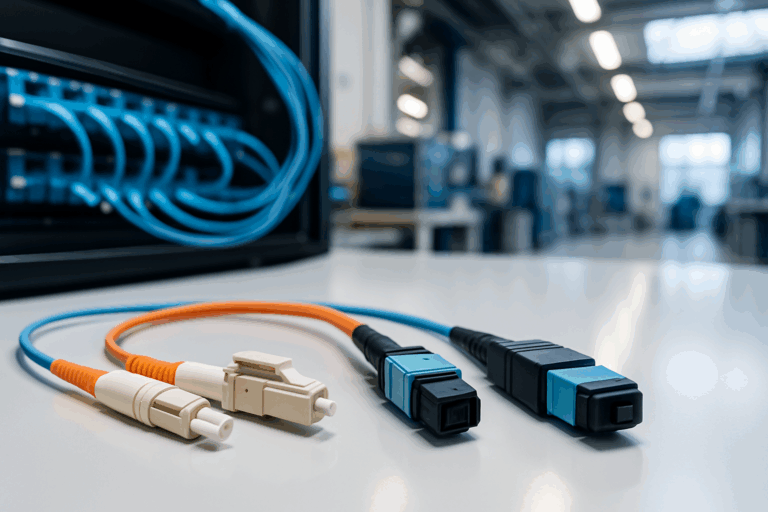
LC connectors currently dominate, but smaller connector formats (SN, MDC) are gaining in importance. Modular systems with interchangeable adapter plates remain flexible.
Push-pull connectors and tool-free systems simplify installation and maintenance. These features will become standard for new modules.
Automation and smart features
Intelligent modules with sensor integration enable automatic monitoring and fault diagnosis. RFID tags and QR codes support digital documentation.
Smart City fiber optic projects are driving these developments forward.
Practical tips for optimum module selection
A successful FTTH module comparison requires a systematic approach and practical experience.
Planning phase
Needs analysis:
- Determine current and planned connection figures
- Create growth forecasts over 10+ years
- Specify technical requirements
- Clarify budget and financing options
Site evaluation:
- Precise measurement of space conditions
- Document environmental conditions
- Check accessibility for installation and maintenance
- Consider expansion options
Procurement and tendering
Specification:
- Define minimum technical requirements
- Ensure compatibility with existing systems
- Include maintenance and support services
- Clarify delivery times and availability
Supplier evaluation:
- Check reference projects and experience
- Confirm certifications and conformity to standards
- Ensure long-term availability and spare parts
- Evaluate local support structures
Fiber optic solutions for system integrators benefit from detailed supplier evaluation.
Conclusion: The right choice for every project
The FTTH module comparison shows that there is no one “best” FTTH module, but rather the optimum solution for every project requirement. The right choice depends on the number of connections, environmental conditions, budget and expansion planning.
Recipe for success for the optimal module selection
- Systematically analyze project requirements (number of connections, environment, budget)
- Consider long-term development (growth, technology evolution)
- Calculate total cost of ownership (not just acquisition costs)
- Prioritize ease of maintenance (significantly reduces operating costs)
- Prefer modular systems (for flexible expansion)
Module type recommendations by application
- Small residential buildings: 1U modules for compactness
- Medium-sized projects: 3U modules for optimum flexibility
- Large installations: 4U modules for maximum densities
- Growing networks: ODF systems for maximum scalability
Investing in the right FTTH module system pays off over the entire operating time through lower maintenance costs, better expandability and higher customer satisfaction.
Quality as the basis for successful FTTH projects
Regardless of the selected module design, the quality of the components determines the long-term success of the project. High-quality splice cassettes, precise fiber guides and robust housings significantly reduce maintenance costs and the risk of failure.
At Fiber Products, we develop FTTH modules for all described application areas: from compact SlimConnect 1U systems to high-capacity VarioConnect 4U solutions. Our modular system enables needs-based configuration and gradual expansion.
With a 5-year guarantee and Europe-wide production, we offer the reliability that successful FTTH projects need. Discover our complete product range or visit our online store.
Talk to us – together we will find the optimum modular system for your project. Contact us for an individual consultation or find out more about other specialist topics in our fiber optic knowledge blog.