Slimmer optical fibers: The revolution for 40% higher connection densities
 higher connection densities” class=”wp-image-4224″ srcset=”https://fiber-products.com/wp-content/uploads/2025/08/Artikel_4-1024×637.jpeg 1024w, https://fiber-products.com/wp-content/uploads/2025/08/Artikel_4-300×187.jpeg 300w, https://fiber-products.com/wp-content/uploads/2025/08/Artikel_4-768×478.jpeg 768w, https://fiber-products.com/wp-content/uploads/2025/08/Artikel_4-1536×956.jpeg 1536w, https://fiber-products.com/wp-content/uploads/2025/08/Artikel_4-2048×1275.jpeg 2048w, https://fiber-products.com/wp-content/uploads/2025/08/Artikel_4-600×374.jpeg 600w” sizes=”auto, (max-width: 1024px) 100vw, 1024px” />
The fiber optic industry is on the brink of a technological revolution that seems inconspicuous at first glance: slimmer optical fibers are becoming a reality. What sounds like a marginal improvement turns out to be a game changer for the entire industry. New production technologies make it possible to manufacture single-mode fibers with a significantly reduced diameter without compromising the optical properties. The result: up to 40 percent more connections in existing distributors and considerable cost savings in the infrastructure.
While conventional glass fibers have a total diameter of 200-250 micrometers, the new slimmer glass fibers are only 160-180 micrometers. This reduction of 20-30 percent may seem minimal, but in cables with hundreds of fibers it multiplies into considerable space gains. Distributors that could previously accommodate 144 fibers can now easily handle 200 or more connections – with the same dimensions and without any loss of quality.
This development opens up new opportunities for municipal utilities and local network operators in particular. Existing infrastructures can be used more efficiently, new distributors can be built more compactly and installation costs can be reduced. In times of rising construction costs and a shortage of skilled workers, any increase in efficiency becomes a decisive competitive factor. Slimmer optical fibers are not just a technical innovation – they are a lever for more economical fiber optic projects.
The technology has come at the right time: with the ongoing expansion of fiber optics, distribution rooms are becoming scarcer and more expensive. At the same time, the requirements for connection densities are increasing, especially in urban areas and new developments. Slimmer optical fibers solve both problems at the same time and enable more sustainable, cost-efficient network infrastructures.
The physics behind slim optical fibers
The development of slimmer optical fibers required fundamental advances in production technology. The actual glass core, which transmits the optical signals, remains unchanged at eight micrometers in diameter. The reduction only affects the protective layers – the glass cladding and acrylate coating.
Optimized material layers
The glass cladding surrounding the core has been reduced from the original 125 micrometres to 120 micrometres thanks to more precise manufacturing processes. This five micrometer difference appears minimal, but has a significant impact on the overall dimensions of the finished fiber.
The acrylate coating, which provides mechanical protection, has been optimized from 62.5 to 50 micrometres. Modern coating materials achieve the same protective effect as conventional thicker coatings despite being thinner. New polymer formulations are mechanically more robust and enable thinner coatings without any loss of quality.
Additional color coding, which previously required separate layers, is now integrated directly into the acrylate coating. This integration saves additional micrometers and simplifies production at the same time.
Breakthroughs in production technology
The production of thinner glass fibers required investment in new drawing tower technologies. Precise temperature control and optimized drawing speeds make it possible to apply thinner coatings evenly.
Inline quality control continuously monitors diameter and coating thickness during production. Deviations in the micrometer range are detected and corrected immediately, ensuring consistently high quality.
Modern coating systems work with several nozzles simultaneously and can apply different layers in a single operation. This increase in efficiency makes slimmer glass fibers economically competitive with conventional variants.
Optical properties remain unchanged
Despite their reduced dimensions, slimmer optical fibers fully comply with the international standards ITU-T G.652 and G.657. Attenuation, dispersion and bending properties remain unchanged compared to conventional fibers.
Extensive tests confirm that mechanical properties such as tensile strength and bendability also meet the usual standards. The thinner coating does not affect the long-term reliability or installation properties.
Compatibility with existing systems is fully guaranteed. Slimmer optical fibers can be easily processed with conventional splicers, connectors and measuring devices.
Practical effects on distribution density
The effects of slimmer optical fibers become particularly clear when considering real distribution scenarios. In practice, the reduced dimensions lead to considerable increases in the capacity of existing infrastructures.
More fibers in the same tubes
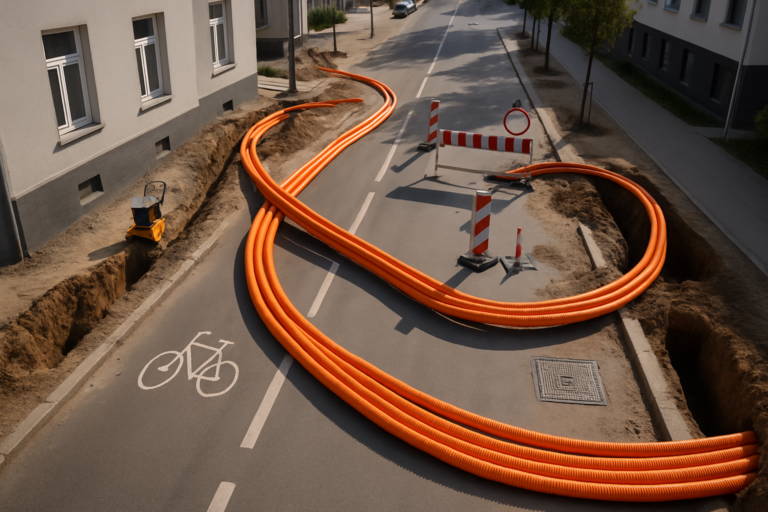
A typical 40mm empty pipe can now hold 200-220 slender fibers instead of 144 conventional fibers. This 40-50 percent increase in capacity means fewer tubes, less civil engineering and significant cost savings.
New possibilities arise, particularly in empty conduit infrastructures that have already been laid. Pipes that were intended for future expansions can be used earlier. Reserve capacities are utilized more efficiently.
In urban areas with limited space for new empty conduits, slimmer optical fibers enable subsequent capacity expansions without additional civil engineering work. Existing infrastructures are optimally utilized.
More compact splice housings and distributors
Splice housings can accommodate significantly more fibers with the same external dimensions. A housing that previously housed 96 splice connections can now accommodate 130-140 connections. This increase in density significantly reduces the number of housings required.
Wall-mounted distributors in buildings are becoming more compact and inconspicuous. This is a decisive advantage, particularly in listed buildings or architecturally demanding environments.
Street distributors require smaller protective cabinets or can accommodate more connections in the same design. This reduces both acquisition costs and the space required in public areas.
More efficient patch panels
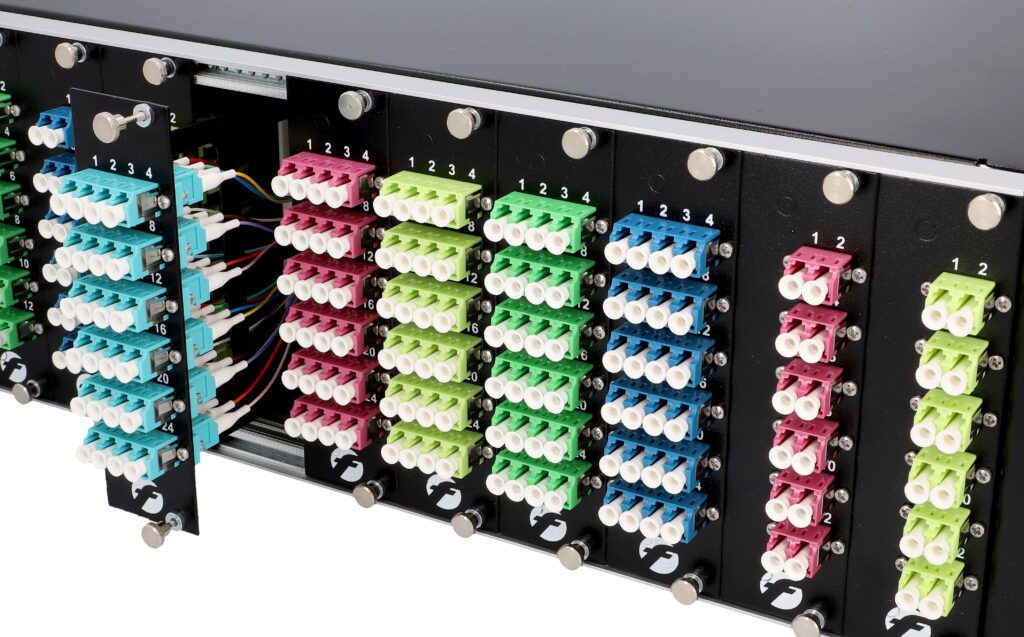
High-density patch panels benefit in particular from slimmer optical fibers. 19-inch panels can now accommodate up to 144 LC duplex connections instead of 96. This 50 percent increase significantly reduces the space required in data centers and technical rooms.
MPO cassettes achieve even higher densities. Slimmer optical fibres enable 144-fiber MPO connections in more compact designs, which is particularly relevant for hyperscale data centers.
The higher packing density also improves cable management. Fewer cables mean clearer installations and easier maintenance.
Cost savings through higher density
The economic benefits of slimmer optical fibers go far beyond pure material costs. Higher packing densities lead to savings in various areas of the fiber optic infrastructure.
Reduced infrastructure costs
Fewer distributor housings mean direct cost savings on procurement and installation. A project that originally required ten street distributors can now manage with seven more compact units. The savings are not only in equipment costs, but also in installation costs and long-term maintenance.
Smaller technical rooms reduce rental or construction costs. In urban areas, where land prices are high, more compact distribution stations can mean considerable savings.
Civil engineering costs are reduced due to fewer empty conduits required. If the same number of connections can be realized with fewer pipes, the excavation volume and installation costs are reduced proportionally.
Lower installation costs
Fewer distribution boxes mean less installation work. Technicians have to travel to fewer locations and can work more efficiently. This is particularly relevant in view of the shortage of skilled workers in the fiber optic industry.
More compact installations reduce the working time required per location. Simpler cable routing and clearer arrangements speed up both installation and subsequent maintenance work.
Reduced material transportation lowers logistics costs. Fewer and smaller components mean more efficient transportation and lower storage costs.
Long-term operating benefits
Fewer distributor locations reduce maintenance effort and costs. Every distributor eliminated saves on regular inspections, cleaning and potential repairs.
Energy consumption of active components is reduced thanks to more compact designs. Fewer and smaller housings require less heating or cooling, which is particularly relevant for outdoor distribution boxes that are operated all year round.
Improved reliability results from fewer potential points of failure. Fewer housings mean fewer seals, screw connections and other mechanical components that can fail.
Data centers and hyperscale applications
In data centers, slimmer glass fibers show their advantages particularly clearly. The constant pressure for higher density and more efficient use of space makes every space saving worthwhile.
Higher port densities in switches
Modern switches can accommodate more ports in the same space thanks to slimmer optical fibers. 100 Gbit switches with 64 ports become 96-port devices with the same housing dimensions. This increase in port density significantly reduces the number of switches required.
400 Gbit connections benefit in particular from slim fibers. The high number of fibers per port (up to 16 fibers) leads to considerable space savings in the cabling.
Spine-leaf architectures become more compact and efficient. Less cabling between the switching levels reduces installation time and improves clarity.
Optimized cable routing
Slimmer optical fibers enable more efficient cable routing in data centers. Cable trays can accommodate more connections without hindering air circulation. This is crucial for cooling modern high-performance servers.
More free space for air circulation is created under raised floors. Thicker cable strands often block cooling flows and lead to hotspots. Thinner glass fibers significantly reduce this problem.
Overhead installations are cleaner and easier to maintain. Less bulky cable harnesses mean better accessibility to other infrastructure components.
Scalability and future-proofing
Existing data centers can increase their capacity by retrofitting with slimmer optical fibers without any structural changes. This is particularly valuable for established locations with limited expansion options.
New data centers can be planned for the highest densities from the outset. The additional capacity of slimmer optical fibers creates reserves for future technology upgrades.
Modular extensions are easier to plan. If it is known that existing infrastructures support higher densities, extensions can be dimensioned more efficiently.
Challenges during the changeover
Despite the clear advantages, the introduction of slimmer optical fibers also brings challenges that need to be taken into account.
Compatibility and transition management
Mixed installations of conventional and slimmer glass fibers require careful planning. Different diameters can lead to problems with cable strain relief or guide elements.
Inventory management becomes more complex when different fiber types are used in parallel. Stocks, spare parts and tools must be kept for both variants.
Training is required for installers, even if the differences are minimal. Technicians must be informed about the properties of slimmer optical fibers, especially when splicing.
Supply chain conversion
Manufacturers have to retool production lines or operate them in parallel. This can lead to temporary supply bottlenecks or price fluctuations.
Standardization processes for slimmer optical fibres have not yet been fully completed. International standards need to be adapted and harmonized.
Qualification processes for network operators often take years. New products have to undergo extensive testing before they are approved for critical infrastructures.
Cost considerations
Slimmer glass fibers are currently still more expensive than conventional variants. The cost difference is amortized through space savings and efficiency gains, but requires higher initial investment.
Project financing must take longer-term benefits into account. Not all financing models are designed for the long-term savings of slimmer fiber optics.
ROI calculations must include all cost factors: higher material costs, but lower infrastructure, installation and operating costs.
Application scenarios for various network operators
Slimmer optical fibers offer different advantages to different types of network operators. The optimal application depends on specific requirements and framework conditions.
Municipal utilities and municipal grid operators
Municipal providers benefit in particular from more compact distribution solutions. Limited budgets for infrastructure make cost savings through higher densities particularly valuable.
Fewer distributor locations reduce approval costs. Every street distributor eliminated means fewer bureaucratic hurdles and faster project realization.
Retrofitting existing infrastructures is becoming more interesting for municipal utilities. Existing empty conduits can be used more efficiently and subsequently expanded.
Local acceptance increases thanks to less conspicuous installations. More compact distributors disturb the cityscape less and reduce complaints from residents.
Regional telecommunications providers
Regional telecommunications providers can use leaner fiber optics to increase their competitiveness against large corporations. More efficient infrastructures enable competitive prices with higher margins.
Faster market development is possible if existing infrastructures can be used more efficiently. New areas can be developed with less effort.
Scalable solutions enable expansion in line with demand. Distributors can initially be dimensioned economically and then expanded with higher densities as required.
Industrial network operators
Industrial companies with their own fiber optic networks benefit from more compact solutions in production environments. Less space consumption in technical rooms creates space for production-relevant systems.
More maintenance-friendly installations reduce downtimes. Clearer cabling enables faster fault diagnosis and repairs.
Modular expandability supports growing automation. Industry 4.0 applications require flexible, expandable network infrastructures.
Future prospects and technology development
The development of slimmer glass fibers is not yet complete. Further innovations will drive the increase in density and open up new fields of application.
Ultra-thin fibers of the next generation
Research projects are working on fibers with a total diameter of less than 150 micrometers. These ultra-thin variants could enable a further 20-30 percent space saving.
New coating materials promise even thinner protective layers without any loss of quality. Nanocomposites and ceramic coatings are being researched as promising alternatives.
Integration of additional functions into the fiber itself could make separate components superfluous. Sensor functions or power transmission could be integrated directly into ultra-thin fibers.
New packaging concepts
Ribbon cables with ultra-thin fibers enable extreme packing densities. 3456 fiber cables are possible in compact designs that are unthinkable today.
Flexible connection technologies adapt to different fiber diameters. Universal connectors could combine different fiber types in one system.
Automated laying of ultra-thin cables could further reduce installation costs. Robotic systems work more precisely and can handle fragile, thinner fibers better.
Integration with other technologies
5G networks with high fiber requirements benefit from the highest densities. Millimeter-wave base stations require many optical fibres in a very small space.
Edge computing infrastructures require flexible, high-density cabling. Slimmer optical fibers enable compact edge data centers in urban environments.
IoT networks with millions of sensors could use ultra-thin optical fibers for data transmission. Cost-effective, space-saving cabling will then become crucial.
Implementation strategies for network operators
The successful introduction of leaner optical fibers requires well thought-out strategies and gradual implementation.
Pilot projects and evaluation
Smaller test installations should demonstrate the advantages of slimmer optical fibers and identify potential problems. Non-critical areas are suitable for initial experience.
Cost evaluation must take all factors into account: higher material costs, but savings in infrastructure, installation and operation. ROI calculations should cover realistic time periods.
Performance tests confirm that optical properties meet the requirements. Long-term tests demonstrate reliability and aging behavior.
Supplier qualification
Manufacturer evaluation should not only consider product quality, but also delivery capability and long-term availability. Backup suppliers reduce dependency risks.
Quality assurance must be adapted to thinner fibers. New test methods and tolerances may be required.
Training programs for internal teams and external service providers ensure competent handling of the new technology.
Transition management
Parallel operation of different fiber types should be systematically planned. Clear rules for areas of application avoid confusion and compatibility problems.
Stock levels must be adjusted without tying up excessive capital. Gradual changeover reduces financial risks.
Documentation and identification become more important when different fiber types are used in parallel. Clear identification prevents installation errors.
Best practices for maximum efficiency
System planning with slimmer glass fibers
Early integration: Consideration of higher densities as early as the planning phase of new projects. Distributor sizes can be optimized right from the start.
Modularity: Use of modular systems that support both conventional and slimmer optical fibers. This enables flexible transitions and mixed configurations.
Future-proof: Plan reserve capacities for further increases in density. Slimmer glass fibers are just the beginning of a development towards even higher densities.
Quality assurance and testing
Extended tests: Additional tests for mechanical properties with reduced diameters. Bending strength and tensile forces in particular must be validated.
Long-term tests: Accelerated aging tests show the behavior of slimmer glass fibers over the planned service life. UV resistance and temperature cycles are critical parameters.
Compatibility tests: Systematic tests with various splicing devices, connectors and measuring devices ensure broad compatibility.
Case studies from practice
Stadtwerk Innovation: 50% increase in density in existing infrastructure
Initial situation:
- 25,000 planned FTTH connections
- Limited empty conduit capacities in the old town
- High civil engineering costs due to historic paving
- Strict conditions for road works
Solution with slimmer glass fibers:
- Retrofitting existing 32mm empty conduits with 288-fiber cables
- Compact distributor with 50% higher connection density
- Reduction from 15 to 10 distribution locations
- Use of top-hat rail boxes for building distribution boards
Results after 12 months:
- 30% cost savings on infrastructure
- 40% less civil engineering work
- 25% reduced project duration
- 98% customer satisfaction thanks to less conspicuous installations
TechCorp data center: doubling the fiber capacity
Challenge:
- Modernization of 20,000m² data center
- Limited cable tray capacity
- 400G upgrade without structural changes
- Minimal downtime during migration
Implementation:
- Gradual migration to slimmer optical fibers
- New patch panels with 144-port density
- Optimized cable routing in existing routes
- Integration into modular 19″ systems
Success:
- 100% capacity increase without expansion
- 60% reduced cabling effort
- Improved air circulation and cooling
- ROI break-even after 18 months
Integration in Fiber Products solutions
Adaptation of existing product lines
Our splice boxes and distributors are continuously being developed to reliably support even the highest connection densities with slimmer optical fibers. Optimized cable guides and adapted strain reliefs ensure professional installations even with the highest packing densities.
Product optimizations for slimmer fibres:
- Increased splice chamber capacities
- Adapted cable entries for different diameters
- Optimized bending radii for tight packings
- Universal fastening systems
Future-proof system architecture
Our modular fiber optic solutions are designed to optimally manage both conventional and slimmer fibers. Tool-free configuration allows systems to be adapted to new fiber requirements as needed.
Modular flexibility:
- Interchangeable cassettes for different fiber densities
- Scalable enclosure sizes from 1U to 4U
- Hybrid configurations for transition phases
- Future-proof expansion options
Economic success factors
ROI calculation for slimmer optical fibers
Investment comparison (1000-connection project):
Conventional solution:
- 8 distributor housings at €5,000 each = €40,000
- 12 empty conduits at €180/m (500m) = €108,000
- Installation 15 locations at €2,500 each = €37,500
- Total: 185.500€
Solution with slimmer glass fibers:
- 5 distributor housings at €5,500 each = €27,500
- 8 empty conduits at €180/m (500m) = €72,000
- Installation 10 locations at €2,800 each = €28,000
- Total: €127,500
Savings: €58,000 (31%)
Long-term operating benefits
Reduction in maintenance costs (10 years):
- 33% fewer distribution locations = less maintenance work
- More compact installations = faster service times
- Greater reliability thanks to fewer components
- Estimated savings: €25,000 over 10 years
Energy efficiency:
- Smaller housing = reduced heating/cooling requirement
- Fewer active monitoring components
- Optimized cable routing = better ventilation
- Energy cost savings: 15% per year
Technical standards and certification
Standard conformity of slimmer glass fibers
International standards:
- ITU-T G.652.D for standard single-mode fibers
- ITU-T G.657.A1/A2 for bend-insensitive variants
- IEC 60793-2-50 for mechanical properties
- Telcordia GR-20-CORE for environmental resistance
Extended test criteria:
- Microbending performance with reduced diameter
- Long-term reliability of thinner coatings
- Compatibility with standard splicing methods
- Temperature cycle resistance
Quality assurance in practice
Incoming inspection:
- Diameter measurement with ±1µm accuracy
- Optical characterization of all parameters
- Mechanical load tests
- Long-term sample tests
Installation quality:
- Adjusted splicing parameters for thinner fibers
- Extended end face inspection
- Systematic attenuation measurements
- Documentation of all deviations
Market development and adoption
Manufacturer landscape
Leading providers:
- Corning with SMF-28 Ultra variants
- Prysmian Group with BendBright XS series
- Sumitomo with Z-Plus technology
- OFS with AccuRibbon solutions
Product availability:
- Standard single mode: available since 2023
- Bending-resistant variants: From 2024
- Ribbon cable: pilot productions ongoing
- Prefabricated solutions: In development
Adoption rates of various market segments
Hyperscale data centers: 85% plan deployment by 2025 Telecommunications providers: 60% in evaluation phase Public utilities: 40% show strong interest Industrial applications: 25% are examining use cases
Environmental and sustainability aspects
Conserving resources through slimmer glass fibers
Material efficiency:
- 20-30% less raw materials per kilometer of fiber
- Reduced transport volumes and weights
- Less packaging material required
- Optimized warehouse logistics
Energy efficiency:
- Lower energy consumption during production
- Reduced transportation emissions
- Less infrastructure footprint
- Longer service life due to higher densities
Circular economy aspects
Recyclability:
- Glass fibers remain fully recyclable
- Reduced coating quantities simplify preparation
- Compatibility with existing recycling processes
- Longer product life due to better utilization
Sustainable installation practices:
- Less civil engineering work reduces environmental impact
- More compact distributors require fewer raw materials
- More efficient use of space saves building land
- Reduced maintenance trips lower CO₂ emissions
Future scenarios and roadmap
Technological development paths
Short term (2024-2026):
- Broad market launch 160µm fibers
- Standardization of installation processes
- First ribbon cable variants
- Adapted tools and measuring devices
Medium-term (2026-2028):
- Ultra-thin 140µm fibers in pilot projects
- New coating materials established
- Automated production processes optimized
- Integration into 5G infrastructures
Long-term (2028-2030):
- 120µm fibers for special applications
- Multi-core fibers in slim designs
- Fully automated installation
- Integration of sensor functions
Market forecasts
Market volume of slimmer optical fibers:
- 2024: 500 million meters of fiber
- 2026: 2 billion meters of fiber
- 2028: 8 billion meters of fiber
- 2030: 20 billion meters of fiber
Cost development:
- 2024: 15-25% premium compared to standard
- 2026: 5-10% premium due to economies of scale
- 2028: Cost parity achieved
- 2030: Cost benefits through efficiency gains
Conclusion: Increasing density as a competitive advantage
Slimmer optical fibers represent a significant advance for the optical fiber industry. The 20-30 percent reduction in diameter leads to 40-50 percent higher connection densities – a considerable gain in efficiency while maintaining the same optical performance.
Key benefits for network operators:
Economic advantages:
- 30-40% reduction in infrastructure costs
- More efficient use of space in distribution centers and data centers
- Simplified installations with fewer components
- Long-term operating cost savings
Technical advantages:
- Full compatibility with existing systems
- Unchanged optical properties (ITU-T compliant)
- Higher packing densities without loss of quality
- Future-proof for upcoming requirements
Strategic advantages:
- Competitive advantages through more efficient infrastructures
- Improving sustainability by conserving resources
- Flexibility for retrofitting existing systems
- Early adopter advantages with innovative technology
Success factors for implementation:
Strategic planning:
- Pilot projects for experience building and risk minimization
- Qualified suppliers with proven technology
- Customized installation processes and training
- Long-term ROI analysis of all cost factors
Technical implementation:
- Systematic quality control and testing
- Documented transition strategies for mixed installations
- Optimized storage for different fiber types
- Continuous further training of the teams
Municipal utilities and municipal grid operators in particular benefit from more compact solutions. Limited budgets and approval requirements make efficiency gains particularly valuable. Retrofitting existing infrastructures becomes more attractive if existing capacities can be optimally utilized thanks to slimmer optical fibres.
The technology is only at the beginning of its development. Next-generation ultra-thin fibers promise further increases in density. Integration with 5G, edge computing and IoT applications will open up additional fields of application.
Leaner fibers are more than just a technical improvement – they are an enabler for more economical, more sustainable fiber optic networks. Network operators who invest in this technology now will create competitive advantages and prepare themselves optimally for future requirements.
Quality as the basis for dense networks
Higher connection densities due to slimmer optical fibers also increase the demands on splicing technology and passive components. More fibers per distributor mean more complex installations and higher quality requirements. Precisely manufactured, reliable components are becoming even more important.
At Fiber Products, we are continuously developing our modular fiber optic solutions to reliably support even the highest connection densities. Our splice enclosures and distributors are designed to optimally manage both conventional and slimmer optical fibers.
With a 5-year warranty and European manufacturing to German quality standards, we offer the reliability that dense fiber optic networks require. Our modular systems support flexible configurations for different fiber requirements and enable gradual migrations to higher densities.
Discover our complete product range or visit our online store. Talk to us – together we will develop the optimal solution for your high-density fiber optic projects. Contact us for an individual consultation or find out about other future technologies in our fiber optic knowledge blog.