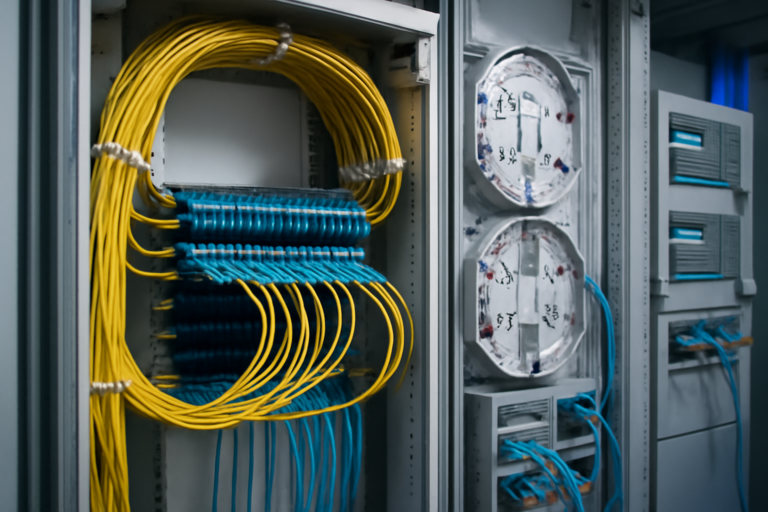
Data center front modules High Density: Maximum port density for German data centers

German data centers are under enormous cost pressure: space costs of 300-800 euros per square meter per month force operators to maximize efficiency. At the same time, the demands on server capacities and network speeds are increasing exponentially. The solution lies in intelligent data center front module high-density systems, which enable up to 96 LC ports per height unit and thus create the basis for future-proof, scalable data center infrastructures.
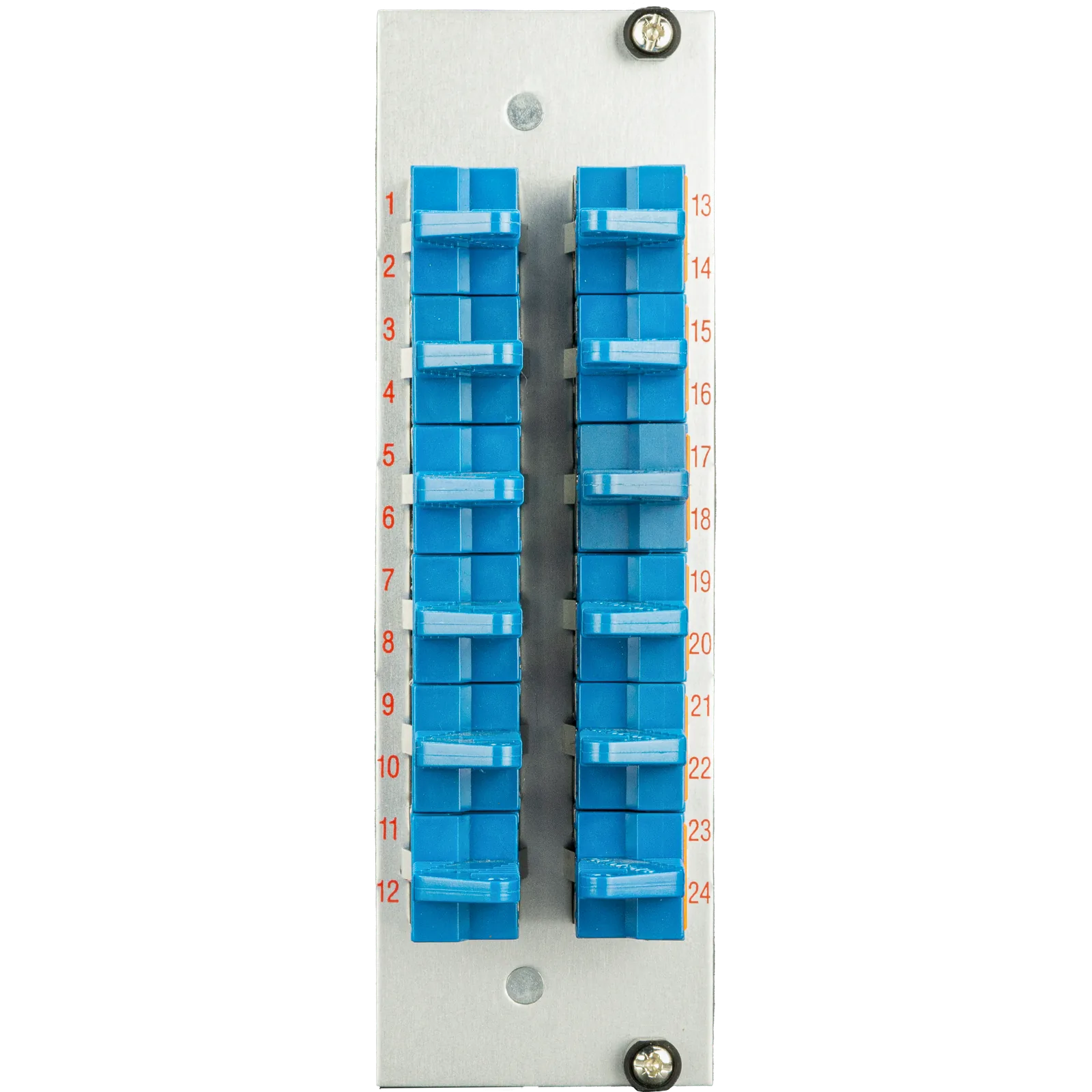
Data center front modules High Density technologies revolutionize traditional cabling approaches and enable data center providers to make the best use of their valuable rack resources. While conventional patch panels only offer 24-48 connections per height unit, modern data center front modules High Density solutions create up to 96 LC duplex connections in the same space.
The development of high-density data center front modules is not just a trend, but a technological necessity for the growing demands of modern communication networks. Hyperscale data centers, edge computing sites and system integrators alike benefit from this revolutionary technology.
Space crisis in German data centers: Why every height unit counts
The data center landscape in Germany is undergoing unprecedented expansion. Driven by digitalization, cloud computing and artificial intelligence, the amount of space required by German data centers is growing by 15-20% per year. At the same time, however, real estate prices are also rising: In metropolitan areas such as Frankfurt, Munich or Hamburg, data center operators are now paying 600-800 euros per square meter per month for premium data center real estate.
Energy efficiency becomes a question of survival
The German Energy Efficiency Act (EnEfG) further exacerbates the situation. From July 2026, new data centers must achieve a maximum Power Usage Effectiveness (PUE) of 1.2. Existing facilities have until 2027 to meet this value. Compact data center front modules High Density solutions not only reduce space requirements, but also significantly improve air circulation and therefore energy efficiency.
Scaling meets physical limits
Modern server generations offer more and more computing power per height unit, but at the same time require more network connections. A typical AI server with 8 GPUs requires 4-8 fiber optic connections for optimum performance. With 42 height units per rack and increasingly dense server populations, extreme demands are placed on the cabling infrastructure.
The traditional solution – larger data centers – is reaching its limits in German conurbations. Building land is scarce and approval procedures take years. The only sustainable answer lies in optimizing rack space efficiency through innovative data center front modules with high density technologies.
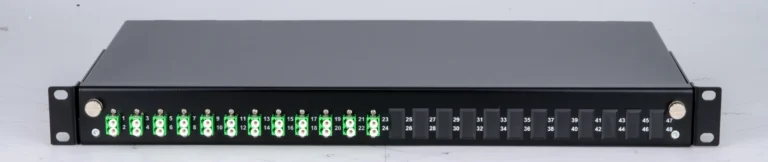
SlimConnect 1U systems represent this new generation of compact solutions and offer maximum flexibility in a minimum of space.
Understanding high-density concepts: From LC to MDC connectors
LC connectors: The current standard
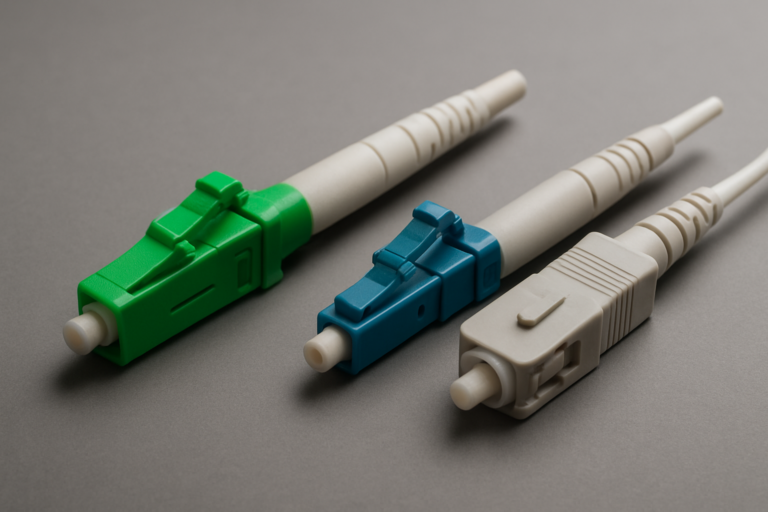
LC (Lucent Connector) connectors have established themselves as the de facto standard in modern data center front module high density applications. With their 1.25 mm ferrule, LC connectors are significantly more compact than older SC or ST variants (2.5 mm ferrule) and therefore enable higher port densities. A standard LC duplex connector requires approximately the same front area as an RJ45 Ethernet port, which simplifies the migration from copper to fiber optic infrastructures.
Port density evolution: from standard to ultra high density
The development of the data center front modules High Density port densities in 19-inch systems shows the rapid technological evolution:
Density development of modern front modules:
- Standard Density (SD): 24-48 LC ports per height unit
- High Density (HD): 72-96 LC ports per height unit
- Ultra High Density (UHD): 96-144 LC ports per height unit
- Mega High Density (MHD): 144+ LC ports per height unit
These increases are made possible by innovative enclosure designs, optimized cable routing and new generations of connectors in data center front modules High Density solutions.
MDC: The next generation of connectors
The Miniature Duplex Connector (MDC) represents the latest development in data center front module high density technology. With its compact design, MDC enables up to three times the port density of LC connectors. An MDC4x system can realize four connections in the footprint of a single LC duplex connector.
Modular fiber optic solutions with MDC compatibility are already preparing data centers for this next generation of technology.
Modular vs. fixed front modules: Flexibility as a competitive advantage
Modular architectures: future-proof through flexibility
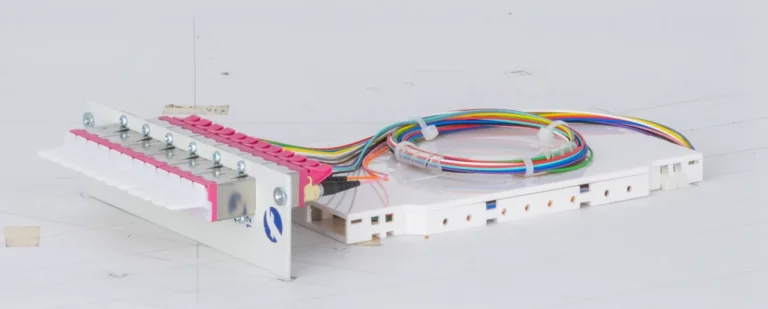
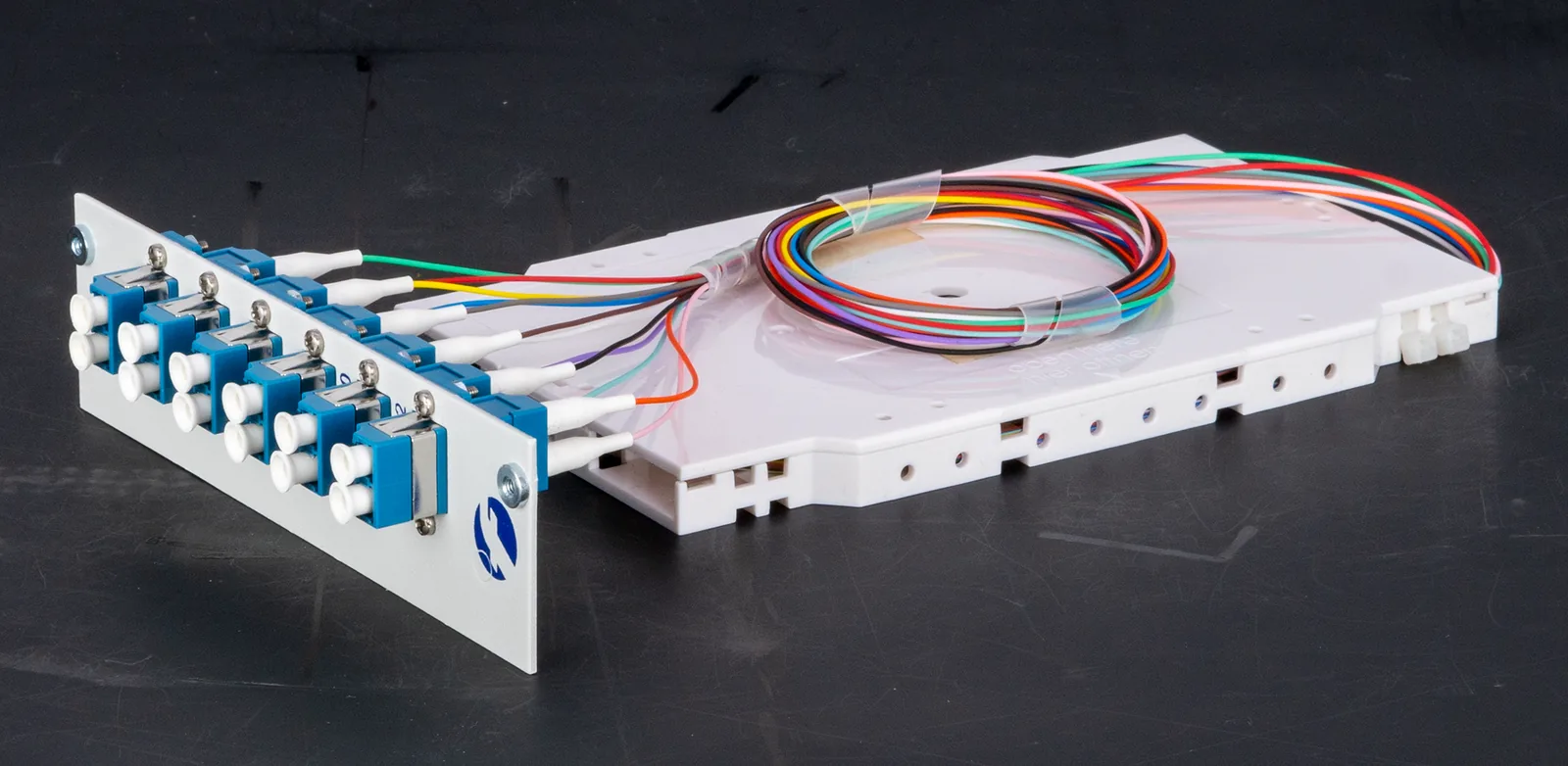
Modular data center front modules High density systems are based on interchangeable components that support different connector types, port densities and application scenarios. The SlimConnect system exemplifies this approach: a 1U basic housing can be equipped with LC, SC, MPO or future connector modules depending on requirements.
Hot-swap capabilities: Operation without interruption
Critical data center applications do not tolerate unplanned downtime. Modular data center front modules High Density systems allow individual components to be replaced without interrupting operations. This is particularly important for 24/7 environments such as cloud providers or financial service providers, where every minute of downtime can result in six-figure costs.
Mixed-media integration: fiber optics and copper combined
Modern data centers use hybrid architectures: fiber optics for high-speed connections between switches and servers, copper for management networks and out-of-band access. Intelligent data center front modules High Density Systems enable the integration of both media in a single housing, which saves space and reduces cabling complexity.
Upgrade scenarios: From 10G to 400G and beyond
Network evolution follows a predictable pattern: 10G→25G→100G→400G→800G. Modular data center front modules High Density systems enable seamless technology migrations by replacing the adapter modules while retaining the backend infrastructure. A system installed today for 10G applications can support 400G connections tomorrow by simply changing modules.
VarioConnect 3U/4U systems offer scalability for the most demanding upgrade scenarios.
Application scenarios in detail: Where front modules make the difference
Top-of-rack switches: Optimized server connection
Top-of-rack (ToR) switching is the de facto standard in modern data centers. Each server rack contains one or more switches that connect all rack-internal servers and provide uplinks to spine switches. Data center front modules High Density solutions are ideal for ToR scenarios: Compact 1U design saves valuable rack space, while high port density (up to 96 LC ports) also supports dense server populations.
Spine-Leaf architectures: Core-Switch cabling
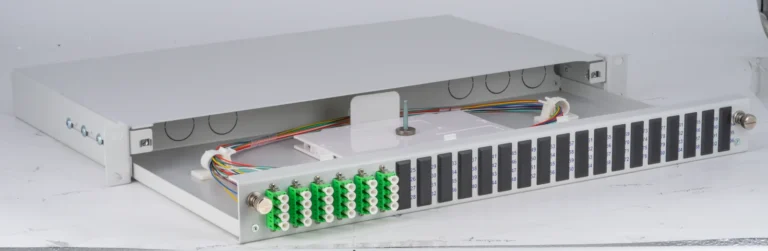
Spine-leaf topologies have replaced traditional three-tier architectures in modern data centers. Spine switches require hundreds of connections to leaf switches – an ideal application for data center front module high density solutions. VarioConnect systems in 3U or 4U versions provide the necessary capacity and flexibility for complex spine layer implementations.
Storage networks: Fibre Channel High-Performance
Data centers use separate Storage Area Networks (SANs) for critical databases and applications. Fibre Channel networks with 16G, 32G or 64G require specialized data center front modules High Density solutions with optimized signal integrity. Modular systems enable the integration of FC-specific components in parallel with Ethernet infrastructures.
Edge computing: compact infrastructures
Edge data centers typically have 1-5 racks and extreme space restrictions. This is where the value of compact data center front module high density solutions becomes particularly clear: a SlimConnect system can provide the connectivity in 1U that traditional solutions would need 2-3U for.
Colocation provider: Maximum customer density
Colocation providers need to monetize their space optimally. Data center front modules High Density Solutions in Meet-Me-Rooms enable more customer connections per rack, which directly increases profitability. Special DN-ODF systems achieve up to 5,250 LC ports per square meter – three times the density of conventional 19-inch systems.
Future-proof planning: 400G/800G and very small form factor integration
400G/800G Preparation: Infrastructure scaling
Network evolution is accelerating: while 100G is still standard, 400G connections are already being widely implemented and 800G systems are being launched. Future-proof data center front modules High Density Systems must anticipate this development. Modular systems offer clear advantages here: New speeds often require different connector types or port densities, which can be realized by changing modules without changing the infrastructure.
Very Small Form Factor: SN, CS, MDC Integration
The industry is continuously developing more compact connectors for the highest data center front modules High Density port densities:
New connector generations:
- SN (Small Network): Significantly more compact than LC
- CS (Connector Small): Optimized for high-speed applications
- MDC (Miniature Duplex Connector): Up to four times LC density
Intelligent data center front modules High density systems must be able to integrate these new standards seamlessly. VarioConnect platforms offer the necessary flexibility thanks to interchangeable adapter modules.
Parallel Optics: MPO-based high-speed systems
400G and 800G applications increasingly use parallel optics with MPO connectors (12, 16 or 24 fibers). These systems require special data center front module high density solutions with optimized MPO handling and breakout functionalities. Modern systems allow both direct MPO connections and breakout to LC connectors for flexibility.
Splice modules with MPO integration support these demanding high-speed applications.
Automated Infrastructure Management: Digital Asset Tracking
Future data centers will be fully digitalized. Intelligent Infrastructure Management (IIM) systems will track every single connection in real time. Data center front modules High density solutions must be able to integrate sensors, RFID tags or other tracking technologies. Modular architectures again offer advantages here through the subsequent integration of additional components.
Product integration & best practices: German engineering quality
SlimConnect: Compact efficiency for Edge and ToR applications
The SlimConnect system represents the essence of German engineering: maximum functionality in minimum space. In just 1U, SlimConnect enables up to 96 LC duplex connections – a data center front module high density port density that was unthinkable just a few years ago. The modular architecture allows flexible configuration depending on the application: LC for standard Ethernet, MPO for parallel optics or mixed media configurations.
VarioConnect: Scalable solutions for complex infrastructures
The VarioConnect system in 3U/4U design offers the necessary scalability for demanding data center applications. Complex breakout configurations, mixed-speed environments and future 800G applications will find the ideal data center front module high-density platform here. The system supports both traditional LC connectors and the latest VSFF connectors for maximum future-proofing.
Modular system: flexibility as a competitive advantage
The combination of SlimConnect and VarioConnect forms a complete modular data center front module high density ecosystem. Edge locations use compact SlimConnect systems, while central data centers rely on scalable VarioConnect platforms. This standardization reduces inventory, simplifies training and ensures consistent performance across all locations.
5-year guarantee: Confidence through German quality
In an industry where 2-year warranties are standard, the 5-year warranty sends a clear signal of quality for data center front module high density solutions. This is particularly relevant for data centers with 10-15 year infrastructure cycles. German manufacturing quality and European production not only ensure maximum reliability, but also short delivery routes and a reduced CO₂ footprint.
Cost analysis: CAPEX vs. OPEX considerations
Investment costs and amortization
Data center front modules High Density Systems have higher initial investments (CAPEX), but offer significant operating cost savings (OPEX). Studies show: A modular system typically pays for itself after 2-3 technology cycles by avoiding complete replacements. With German labor costs of 60-80 euros per hour for data center technicians, the savings are particularly clear.
ROI factors for German data centers
Quantifiable advantages of data center front modules High Density:
- Space saving: 50-70% fewer rack height units required
- Energy savings: 20-30% better cooling efficiency thanks to optimized air flows
- Maintenance costs: 40% less service time thanks to modular architecture
- Scalability: 60% lower upgrade costs through module replacement
TCO analysis over 10 years
A typical TCO analysis for data center front modules High Density over 10 years shows:
- Year 1-2: Higher CAPEX due to premium components
- Year 3-5: Break-even through space and energy savings
- Year 6-10: 25-35% lower total costs through maintenance and upgrade benefits
Thermal management: heat dissipation in a compact design
Airflow optimization
Although passive fiber optic components themselves do not generate heat, data center front modules High Density solutions have a significant impact on airflow in racks. Sophisticated front module designs take airflow patterns into account and use perforated housings or special cooling channels for optimum thermal performance.
Fiber guidance with extreme density
High port densities in data center front modules High density systems pose complex technical challenges. The minimum bending radius of optical fibers (typically 10x cable diameter) must be maintained even in a compact arrangement. Modern front modules use special cable routing geometries, stepped arrangements and bend-insensitive fibers to meet these requirements.
Industry-specific applications
System integrators
System integrators benefit from standardized data center front modules High Density solutions through:
- Reduced project planning time
- Standardized installation and maintenance procedures
- Scalable solutions for different project sizes
- Long-term availability of spare parts
Educational institutions
Educational institutions with limited IT budgets use data center front modules High Density for:
- Maximum performance with minimum space costs
- Future-proof investments with upgrade options
- Simple maintenance by facility management teams
- Energy-efficient solutions for sustainability goals
Industrial data centers
Industrial applications require particularly robust data center front modules High Density solutions:
- Extended temperature resistance
- Vibration-resistant construction
- EMC shielding for interference-free operation
- Dust and moisture-protected versions
Integration into existing infrastructures
Retrofit strategies
Modern data center front modules High Density systems must be able to be seamlessly integrated into existing data center infrastructures. Standardized 19-inch form factors, compatibility with common rack systems and flexible cable routing options enable upgrades without extensive conversions. This is particularly important in Germany, where many data centers are operated in repurposed industrial buildings with special requirements.
Migration without downtime
Critical data center applications require non-disruptive migration to data center front modules high density solutions. Hot-swappable modules and redundant connection architectures enable step-by-step upgrades during ongoing operations.
Recommendations for data center planners
Immediate steps
The transformation to data center front modules high density infrastructures requires strategic planning:
- Audit of existing cabling infrastructures for optimization potential
- Evaluation of current port densities and identification of bottlenecks
- Evaluation of modular front module systems for upcoming upgrade cycles
Medium-term strategies
- Implementation of high-density solutions in new rack installations
- Standardization on modular platforms for simplified maintenance
- Integration of automated infrastructure management for digital asset tracking
Long-term vision
- Development of a modular infrastructure strategy for all locations
- Preparation for 800G/1.6T technologies with future-proof systems
- Implementation of sustainable circular economy principles
Sustainability: Sustainability and circular economy
Data center front modules High Density solutions support sustainability goals through:
- Reduced material consumption due to higher packing densities
- Longer service life thanks to modular upgrade options
- Energy efficiency through optimized air flows
- Recyclability thanks to single-origin materials
Modular front module systems support circular economy principles: Instead of disposing of complete systems, individual modules can be recycled or reused. The 5-year guarantee from German premium manufacturers underlines the longevity and reduces electronic waste.
Conclusion and outlook
Data center front modules High density solutions are not just a trend, but a technological necessity for the growing requirements of modern communication networks. The future of data center cabling lies in intelligent, modular front module systems that combine maximum port density with unparalleled flexibility.
Fiber Products’ SlimConnect and VarioConnect systems, with their proven German quality, 5-year warranty and modular architecture, provide the ideal foundation for future-proof data center front module high density infrastructures. Continuous innovation in connector technology and the increasing demands of 400G/800G networks make high-density solutions indispensable.
Invest now in modular technologies that both solve today’s challenges and support future developments. The combination of space savings, energy efficiency and future-proofing makes Data Center Front Modules High Density the strategic choice for successful data center operations.
Visit our online store for high-quality splice modules and modular fiber optic solutions. You can find more technical articles in our blog.
Contact us to jointly develop the optimum data center front module high-density solution for your data center and benefit from maximum port density with minimum rack space.
Request a Consultation
Our experts will advise you on modular fiber optic solutions for your specific application — fast, personal and non-binding.