Disaster Response Fibre Optic Networks – Resilient Systems for BBK and THW
Disaster response fibre optic networks, BBK network infrastructure, and THW communications require failsafe architectures with Redundant Networks for Emergency Services and modular splice systems that guarantee 99.99% availability even during cable breaks or natural disasters. Current developments in German emergency management show clearly that conventional copper networks no longer meet these demands. Modern fibre optic infrastructure delivers up to 16.6 Petabit/s transmission capacity, providing the bandwidth essential for time-critical operational coordination.
Across the DACH region, government agencies are investing heavily in resilient fibre networks, supported by the TKG Amendment Act 2026 and a €2.7 billion THW infrastructure programme. These investments enable the development of redundant communication pathways along critical infrastructure corridors.
Technical Requirements for BBK and THW Fibre Networks
Technical specifications for disaster response fibre optic systems differ fundamentally from standard office cabling. Government networks must withstand extreme conditions while delivering maximum availability.
- Redundant ring architecture with automatic failover in < 50ms
- Vibration-resistant connectors to IEC 61754-15
- Temperature rating -40°C to +85°C
- IP65 protection rating for outdoor installations
- Attenuation < 0.25 dB per connection
BBK network infrastructure additionally requires seamless integration with existing BOS radio networks. Modern splice modules enable parallel deployment of fibre and radio infrastructure within a single system.
Redundant Ring Architectures for Maximum Resilience
The cooperation between the THW Foundation and OneFiber exemplifies how modern disaster response networks are constructed. The 27,000 kilometre fibre optic network along German rail corridors provides 5,500 access points for THW units.
| Network Architecture | Availability | Failover Time | Application |
|---|---|---|---|
| Single Ring | 99.9% | < 50ms | Local THW stations |
| Dual Ring | 99.99% | < 20ms | BBK command centres |
| Mesh Network | 99.999% | < 10ms | Critical infrastructure |
When cable cuts occur from excavation or natural disasters, the system automatically switches to the alternate pathway. THW communications remain continuously operational.
Modular Splice Systems for Flexible Deployment Scenarios
Fibre optic system requirements in disaster response vary widely. From mobile command centres to permanent operations centres, diverse scenarios must be supported. Modular splice systems offer decisive advantages over rigid solutions.
- Scalability from 12 to 288 fibres per system
- Tool-free module exchange in under 60 seconds
- Pre-terminated modules reduce installation time
- Compatibility with all standard connector types (LC, SC, E2000, MPO)
- Integrated splice cassettes with 24 individual splices
Fiber Products Quality Commitment: As an official Diamond Partner and manufacturer, we produce modular splice systems in Europe. Benefit from Swiss precision and 5 years’ guarantee on all our systems.
Standards-Compliant Installation per VDE and DIN
The new VDE Guideline 0800-730, effective February 2026, significantly simplifies fibre installation in government buildings. For BBK and THW, this means standardised installation procedures with guaranteed quality.
The standard defines precise specifications for bend radius, tensile load, and attenuation values. Splice modules must comply with IEC 61756-1 for optical interfaces and EN 50173-1 for structured cabling. When selecting components, attention must be paid to CPR fire classification – at minimum Dca for government facilities.
Integration with Existing BOS Infrastructure
Connecting fibre optic networks with digital BOS radio systems presents specific architectural challenges. Disaster response fibre networks must interface seamlessly with TETRA base stations and mobile command vehicles.
| Interface | Protocol | Bandwidth | Latency |
|---|---|---|---|
| BOS Base Station | E1/STM-1 | 2–155 Mbit/s | < 5ms |
| Dispatch Centre | Ethernet | 1–10 Gbit/s | < 1ms |
| Mobile Units | LTE/5G | 100 Mbit/s | < 20ms |
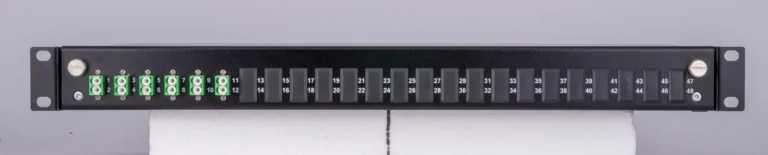
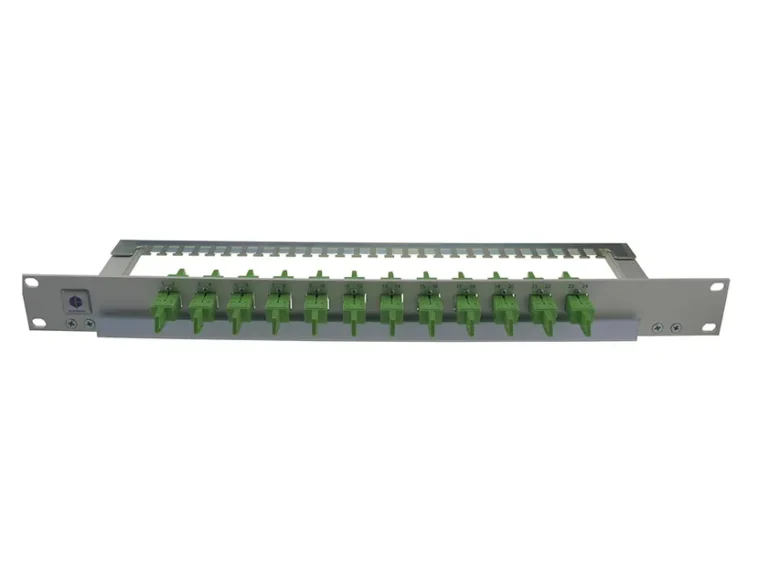
Modern splice boxes with 96 fibres in 1U enable space-efficient integration into existing server racks. High fibre density is particularly advantageous in confined technical rooms.
Power Failure Protection through Uninterruptible Power Supply
A critical aspect of THW communications is maintaining operations during power outages. Fibre optic systems require active components but consume significantly less power than copper infrastructure.
- Passive fibre spans with no power consumption up to 40 kilometres
- Active components consuming < 5 Watts per port
- UPS backup for minimum 72 hours
- Emergency generators with automatic switchover
- Redundant power supplies via separate feed points
The combination of energy-efficient components and redundant power supplies ensures uninterrupted operation even during extended public grid failures.
Real-World Example: Flood Response with Mobile Fibre Solutions
During flood response operations, the superiority of disaster response fibre networks becomes particularly evident. While copper cables are compromised by moisture, fibre optics remain fully functional.
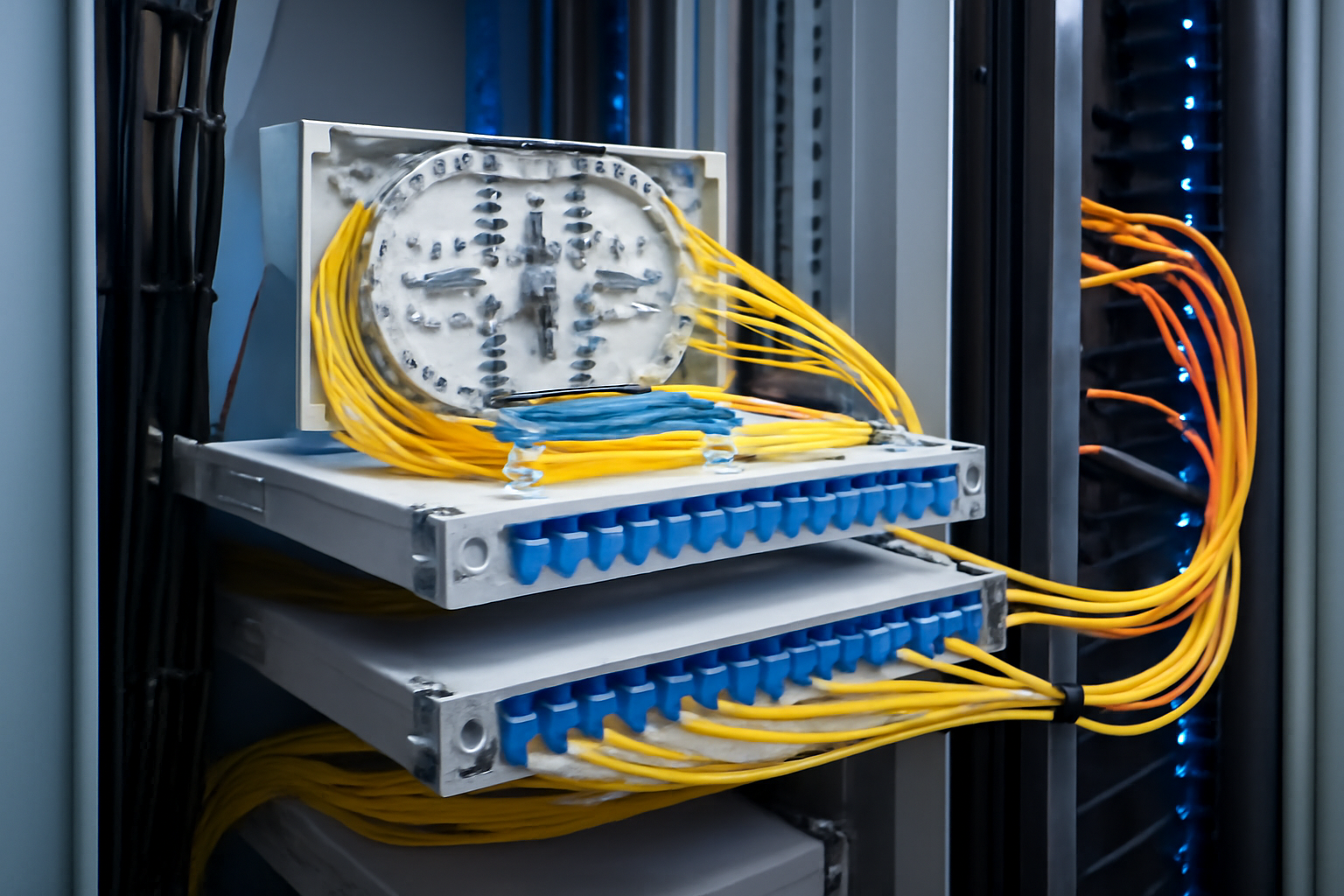
Mobile splice boxes in IP65 rating can be positioned directly in the operational area. Pre-terminated patch cables with E2000 Connectors for Emergency Services enable connection to mobile command vehicles within a short time. Robust connectors withstand severe vibration and mechanical stress.
Cost-Effectiveness through Modular System Architecture
Investment in modular fibre systems for BBK networks and THW delivers payback through lower operating costs and enhanced flexibility. Compared to traditional solutions, substantial savings potential exists.
- Installation time reduction
- Maintenance cost reduction through 5-year warranty
- Minimised downtime via rapid module exchange
- Future-proofing through scalability to 400 Gbit/s
- Simplified inventory management via standardised modules
A SlimConnect 1U system with 96 fibres requires only one-quarter the space of conventional solutions. This saves not only rack space but also reduces cooling costs.
Future Perspectives for Government Networks
THW communications and BBK network development will be shaped significantly by emerging technologies. With planned upgrades to 400 Gbit/s per wavelength, capacity reserves are created for future requirements.
The TKG Amendment Act 2026 streamlines nationwide fibre rollout through simplified approval procedures. For emergency management agencies, this means faster implementation of critical infrastructure projects. Integration of AI-driven monitoring systems and autonomous drones requires bandwidth that only modern fibre networks can deliver.
Quality Assurance and Certification
Disaster response fibre systems are subject to special quality requirements. All components must undergo comprehensive testing and hold appropriate certifications.
| Test | Standard | Limit | Frequency |
|---|---|---|---|
| Attenuation Measurement | IEC 61280-4 | < 0.3 dB/km | 100% of fibres |
| OTDR Measurement | alt: “IEC 61746” | neu: “Calibrated OTDR equipment” (Standard-Spalte der OTDR-Zeile; alternativ neu: “Calibrated measuring equipment”) | < 0.1 dB event | At commissioning |
| Vibration Resistance | IEC 61300-2 | 10–500 Hz | Sample basis |
As a manufacturer with Diamond Partner status, we ensure continuous quality control from production through installation. Our splice modules undergo rigorous testing to European standards.
Best Practices for Implementation
Successful implementation of fibre projects in disaster response requires systematic planning. Based on experience from over 200 government projects, the following success factors have emerged.
- Early engagement of all stakeholders (BBK, THW, IT departments)
- Detailed inventory of existing infrastructure
- Redundancy concept with minimum two independent route paths
- Standardisation on maximum three connector types
- Documentation of all connections in digital cable management system
- Training of maintenance personnel on new systems
Selection of modular systems such as VarioConnect 3U enables subsequent expansions without operational interruption. This is particularly advantageous with growing disaster response requirements.
FAQ: Common Questions on Fibre in Disaster Response
What advantages does fibre offer over copper for BBK and THW?
Fibre provides unlimited bandwidth, complete immunity from electromagnetic interference, and transmission distances to 40 kilometres without amplification. During disasters, fibres remain fully operational even with water ingress.
How quickly can mobile fibre connections be deployed operationally?
With pre-terminated modules and patch cables, a mobile connection is operational within a short time. Modern connector systems enable tool-free installation even in difficult conditions.
Which connector types suit harsh field conditions?
E2000 connectors with integral shutter and IP65 rating are recommended for field operations. They offer maximum vibration resistance and attenuation below 0.1 dB.
How is power supply ensured during extended outages?
Modern fibre systems require only 5 Watts per port. With UPS systems and emergency generators, operation can be maintained for 72 hours without external power.
What capacities should be planned for future-proof BBK networks?
Design for minimum 100 Gbit/s backbone with headroom for 400 Gbit/s. Each site should have at least 48 fibres available, with 50% held in reserve.
How does integration with existing BOS radio networks occur?
Media converters transform BOS radio signals into optical signals. Latency remains below 5 milliseconds, sufficient for real-time communications.
Investment in resilient fibre networks is essential for modern emergency management agencies. With the right system partner and high-quality components, infrastructure can be built to meet even the most demanding requirements. Learn more about our specialised government solutions and benefit from our 5-year warranty on all systems.
Request a Quote
Do you have questions about our fibre solutions? Our expert team will advise you – free and with no obligation.