Government Data Centre Fibre Optic Networks – Secure Data Infrastructure for Public Authorities
Government Data Centre Fibre Optic Networks – Secure Data Infrastructure for Public Authorities
Government datacenter fibre optics, public data centre, and Government Datacenter optical fibre systems form the backbone of digital administration across the DACH region, with modern fibre infrastructure delivering up to 100 Gbit/s transmission rates and physical eavesdropping protection that meet the critical requirements of public institutions. The Federal Government is accelerating fibre rollout to public data centres through the TKG Amendment Act 2026 and the national data centre strategy – Brandenburg alone has already achieved a 62.7% fibre deployment rate for public infrastructure.
Why fibre optics is essential for government data centres
The physical security of fibre optic cables makes them the first choice for sensitive government data. Unlike copper cables, optical fibre cannot be tapped electromagnetically – any eavesdropping attempt results in measurable signal loss. This inherent security, combined with attenuation values below 0.35 dB/km on singlemode fibres, enables eavesdropping-proof connections over long distances.
Public data centres benefit from the enormous bandwidth capacity of modern fibre technology. While copper cables reach their limits at 10 Gbit/s, singlemode fibres easily transmit 400 Gbit/s and beyond. This scalability is critical for growing data volumes from e-government services, digital document management, and AI-driven administrative processes.
- Complete immunity to electromagnetic interference (EMI)
- Latency below 5 microseconds per kilometre
- Transmission distances up to 80 km without signal amplification
- Service life exceeding 25 years with proper installation
- No ground loops or equipotential bonding required
Technical requirements for Government Datacenter fibre optic systems
Public data centres are subject to strict security and availability requirements under BSI IT Baseline Protection and ISO 27001. The fibre infrastructure must ensure the highest redundancy – typically through physically separate routing and N+1 redundancy on all critical components.
| Requirement | Government Data Centre Specification | Standard |
|---|---|---|
| Availability | 99.99% (Tier 3) | EN 50600-2-2 |
| Attenuation budget | < 3.5 dB per span | IEC 61280-4-1 |
| Connector type | LC-APC, E2000-APC | IEC 61754-15/-20 |
| Fibre type | OS2 Singlemode 9/125 | ITU-T G.652.D |
| Port density | Min. 48 fibres/1U | DIN EN 50173-1 |
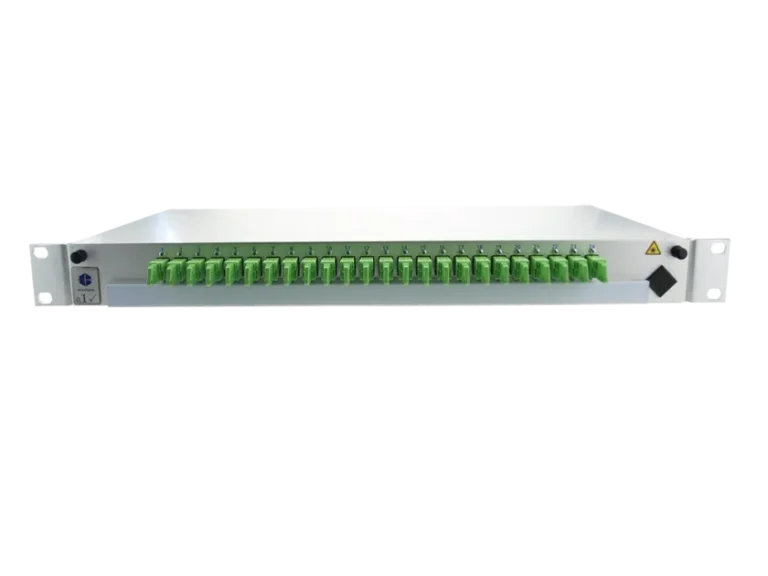
The modular design of modern splice systems allows up to 96 fibres to be accommodated in a single rack unit – a decisive advantage in the often cramped server rooms of public authorities. Pre-configured modules also reduce installation time compared to traditional individual fibre cabling.
Security considerations in government data centre fibre optics
The German Data Centre Association emphasises: “Modern digital administration requires strong and reliable data centre infrastructure”. This begins with physical security of fibre routes. Micro-duct systems with individual fibre management prevent undetected manipulation, while fusion-spliced joints per DIN VDE 0888-100 provide additional protection.
- Alarm monitoring through real-time OTDR measurements
- Encryption at the physical layer (Layer 1) possible
- No electromagnetic signal radiation
- Fire safety class B2ca or higher for indoor cables
- Documentation per DKE/AK 412.6.8 for complete traceability
Fiber Products Quality Promise: As an official Diamond Partner and manufacturer, we produce modular splice systems in Europe. Benefit from Swiss precision and in-house manufacturing.
Standards compliance and certifications for public data centres
Government data centres must meet stringent standards that exceed commercial specifications. The EN 50600 series defines minimum requirements for availability and security. Fibre optic components must additionally comply with IEC 61300-3-35 for mechanical durability and IEC 60793-2-50 for optical properties.
Adherence to attenuation limits per IEC 61280-4-1 is particularly critical. Each connector may exhibit a maximum 0.5 dB attenuation, while fusion splices must not exceed 0.15 dB. These strict requirements demand high-quality components and precise installation techniques.
| Component | Max. Attenuation | Return Loss |
|---|---|---|
| LC-APC connector | 0.25 dB | > 60 dB |
| E2000-APC | 0.20 dB | > 65 dB |
| Fusion splice | 0.05 dB | n/a |
| MPO/MTP-12 | 0.35 dB | > 35 dB |
Redundancy and fault tolerance in Government Datacenter fibre systems
The availability requirements of public data centres allow a maximum of 52 minutes of downtime per year at Tier 3 classification. This requires fully redundant fibre routes with automatic switchover on faults. Modern Optical Line Protection (OLP) systems switch to the backup route within 50 milliseconds.
Municipal utilities such as DNS:NET in Brandenburg are already implementing redundant backbone structures for public authorities. The physically separate routes run along different paths and technical rooms to eliminate single points of failure. For critical connections, wavelength division multiplexing (WDM) is additionally used to carry multiple independent data streams over a single fibre.
- Automatic switchover in under 50 ms
- Separate routing with minimum 500 m separation
- Redundant power supply for active components
- Monitoring all routes via SNMP v3
- Documentation per TIA-606-C standard
Scalable architectures for growing government requirements
The digital transformation of public administration leads to exponentially growing data volumes. E-records, video conferencing systems, and AI-driven analytics tools drive bandwidth demand. Modular fibre optic systems like VarioConnect 3U enable gradual expansion from initially 48 to up to 288 fibres without operational interruption.
The Federal Government is funding expansion with billion-euro programmes. The Underserved Areas Support Programme specifically supports fibre rollout to public authority locations. Municipal data centres also benefit from synergies with FTTH deployment – the same infrastructure serves both administration and citizens.
Practical implementation: from planning to installation
Implementing a fibre infrastructure for public authorities requires systematic planning. First comes the needs assessment: what bandwidths are required? How many users must be connected? What security requirements apply? Based on these parameters, the planning engineer dimensions the required fibre count with typically 30% spare capacity.
- Step 1: Needs assessment and capacity planning per DIN EN 50173-1
- Step 2: Route planning with redundant paths
- Step 3: Selection of appropriate fibre types (OS2 for singlemode)
- Step 4: Installation of modular splice systems in 19″ racks
- Step 5: Acceptance testing per IEC 61280-4-1
- Step 6: Documentation per TIA-606-C
Pre-configured splice modules significantly reduce installation time. Instead of splicing individual fibres on site, finished modules with 12, 24, or 48 pre-terminated fibres are deployed. This not only lowers installation costs, but also minimises installation errors.
Energy efficiency and sustainability in public data centres
Fibre optic technology significantly contributes to the energy efficiency of data centres. Optical transmission requires energy efficiency advantages than equivalent copper connections at 10 Gbit/s. At higher speeds, the advantage becomes even more pronounced – 100 Gbit/s over copper would require ten times the energy.
The new EU Energy Efficiency Directive requires public data centres to achieve a PUE value below 1.3 by 2030. Fibre optic cabling supports this goal through reduced heat generation and lower cooling demand. Additionally, higher port density enables more compact designs with optimised air flow.
Future-proofing through modern fibre technology
Investment in high-quality fibre infrastructure pays long-term dividends. While copper cables require modernisation every 5–7 years, optical fibres remain technically current for over 25 years. Bandwidth upgrades occur through replacement of active components – the passive infrastructure remains in place.
New transmission methods such as Coherent Optics already enable 800 Gbit/s over a single fibre today. Public authorities investing now in modern OS2 singlemode fibres are equipped for the next technology generations. The modular design also allows flexible adaptation to future requirements.
Frequently asked questions about government data centre fibre optics
Which fibre types are suitable for Government Datacenter fibre systems?
For public data centres, only OS2 singlemode fibres per ITU-T G.652.D are recommended. These offer the best future-proofing with transmission rates up to 400 Gbit/s and ranges exceeding 40 km without amplification.
How many fibres should a public data centre have as minimum?
The minimum provision is 48 fibres per rack, though 96 fibres with 30% reserve is recommended. Modular systems enable gradual expansion as needed.
Which connector types are optimal for government IT?
LC-APC and E2000-APC connectors offer the best combination of packing density and signal quality. E2000 is particularly suited for security-critical applications due to integrated dust caps.
What is the cost of fibre cabling for a government data centre?
Investment costs range from €500–800 per fibre including installation and documentation. Modular systems reduce overall costs through faster installation.
How is the fibre infrastructure maintained?
Annual OTDR measurements verify attenuation values. If limits are met, no further maintenance is required. Connector cleaning is performed as needed with specialised fibre wipes.
Can existing multimode fibres continue to be used?
OM3/OM4 multimode fibres are suitable for short runs up to 550 m at 10 Gbit/s. For future-proof installations, singlemode fibres should be deployed to enable higher bandwidths over greater distances.
Conclusion: fibre optics as the foundation of digital sovereignty
Government datacenter fibre optics, public data centres, and Government Datacenter optical fibre systems form the indispensable foundation of digital administration. With transmission rates of 100 Gbit/s and beyond, physical eavesdropping protection, and a service life exceeding 25 years, modern fibre systems meet all requirements of public institutions.
The combination of modular splice systems, redundant routing, and future-proof singlemode technology ensures the required 99.99% availability. As a manufacturer of high-quality fibre optic solutions, Fiber Products supports public authorities with well-conceived system solutions – from the compact 1U splice module to the scalable VarioConnect system accommodating up to 288 fibres.
Consistent expansion of fibre infrastructure in public data centres is not optional but necessary for Germany’s digital sovereignty. With the right technology and professional planning, public authorities create the foundation for secure, efficient, and future-capable IT services.
Request a quote
Do you have questions about our fibre optic solutions? Our expert team will be happy to advise you – free and without obligation.