Fibre Rollout Stuttgart 2026: Municipal Utilities SWS and FTTH Deployment
Fibre rollout Stuttgart, SWS Fibre, FTTH Stuttgart: Technical requirements and modular splice systems for municipal network expansion 2026
The Fibre Rollout Baden-Württemberg 2026 faces critical technical challenges: Stuttgart Municipal Utilities (SWS) must provide 133,000 households with future-proof fibre-optic infrastructure by 2026 while efficiently deploying modular splice systems offering up to 96 fibres in 1U. The current expansion phase in Baden-Württemberg’s state capital demonstrates the technical standards and system components required for successful municipal FTTH Deployment Bavaria 2026.
Municipal utilities face the challenge of not only provisioning raw network infrastructure but also implementing scalable distribution systems. The combination of subsidised expansion projects worth 3.4 million euros for Stuttgart-Rotenberg and self-funded expansion across 17 city districts requires standardised splice solutions.
Technical framework for Stuttgart Municipal Utilities’ FTTH rollout
Stuttgart Municipal Utilities deploy a consistent single-mode fibre architecture compliant with ITU-T G.652.D for trunk routes and ITU-T G.657.A2 for building cabling in their fibre rollout Stuttgart, SWS fibre, FTTH Stuttgart programme. These bend-insensitive fibres enable bend radii of up to 10 mm without significant attenuation increase.
- Attenuation coefficient at 1310 nm: maximum 0.36 dB/km
- Attenuation coefficient at 1550 nm: maximum 0.23 dB/km
- Chromatic dispersion: < 18 ps/(nm·km) at 1550 nm
- Zero-dispersion wavelength: 1300–1324 nm
The network architecture is based on a two-tier model with main distribution frames (MDF) and street cabinets (SC). Each street cabinet typically terminates 48 to 96 fibres, using modular splice cassettes compliant with DIN EN 50173-1.
Modular splice systems for municipal network operators
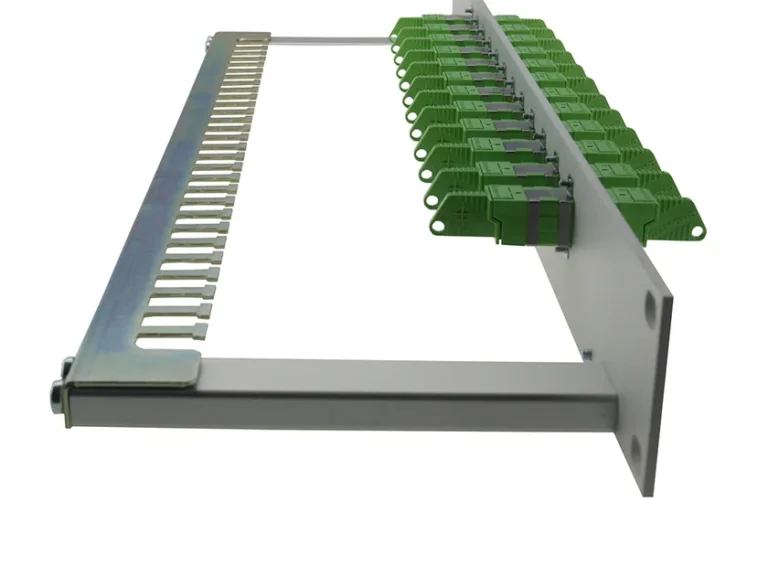
Modular splice systems are essential for efficient fibre-optic infrastructure rollout. SWS Stuttgart deploys 19-inch systems with flexible configuration, enabling port density of up to 96 LC-duplex ports in 1U.
| System type | Height units | Max. fibre capacity | Connector types | Application |
|---|---|---|---|---|
| SlimConnect | 1U | 96 fibres | LC, SC, E2000 | Street cabinets |
| VarioConnect | 3U | 288 fibres | LC, SC, E2000, ST | Main distribution frames |
| VarioConnect | 3U | 288 fibres | LC, SC, E2000, MPO | Technical centres |
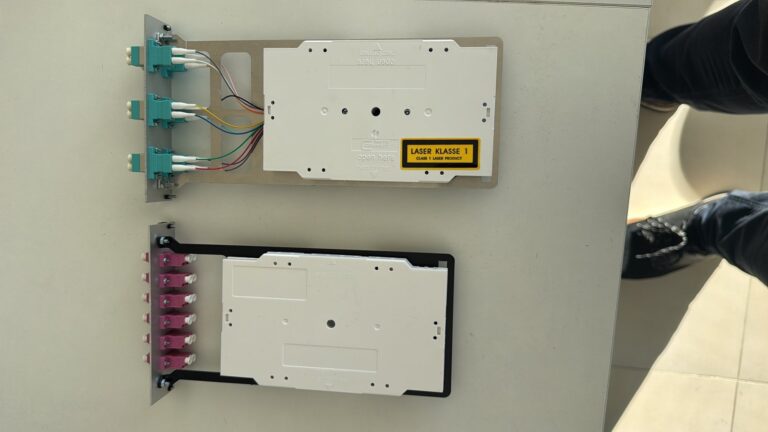
Splice cassettes are certified to IEC 61756-1 and guarantee splice loss of < 0.1 dB for fusion splices. Each cassette accommodates 12 or 24 splice protection holders and incorporates integrated slack fibre storage.
Connector systems and standards compliance in municipal FTTH networks
The fibre rollout Stuttgart, SWS fibre, FTTH Stuttgart programme employs various connector systems meeting different requirements. The E2000 standard per IEC 61754-15 provides optimal protection in municipal distribution cabinets through integral dust shutter and bayonet coupling.
Connector selection follows technical criteria:
- E2000/APC: Return loss > 65 dB, for main distribution frames
- LC/APC: Compact form factor, insertion loss < 0.25 dB
- SC/APC: Robust design for outdoor cabinets
- MPO/MTP: 12-fibre connector for backbone links
Fiber Products quality commitment: As an official Diamond Partner and manufacturer, we produce modular splice systems in Europe. Benefit from Swiss precision and in-house manufacturing.
Network planning and fibre capacity for Stuttgart 2026
Technical planning for FTTH rollout requires precise calculation of required fibre capacities. Stuttgart plans 125 kilometres of new fibre-optic cable and 69 network distribution points by end of 2026. On average, each distribution point will serve 1,944 households.
| City district | Planned household connections | Required fibres | Distribution locations |
|---|---|---|---|
| Stuttgart city centre | 12,500 | 384 | 8 |
| Stuttgart West | 9,800 | 288 | 6 |
| Bad Cannstatt | 15,200 | 480 | 10 |
| Vaihingen | 11,300 | 384 | 7 |
Quality requirements and measurement technology for municipal fibre networks
Quality assurance in the fibre rollout Stuttgart, SWS fibre, FTTH Stuttgart programme is based on defined measurement protocols per IEC 61280-4-1. Every installed section is measured using optical time-domain reflectometry (OTDR) at 1310 nm and 1550 nm.
Acceptance criteria for municipal networks include:
- Section attenuation: < 0.4 dB/km including all splice points
- Connector loss: < 0.5 dB per connection
- Return loss: > 45 dB for PC finish, > 60 dB for APC
- Macrobend loss: < 0.1 dB at R = 15 mm
Splicing technique and installation efficiency in urban environments
Splicing work in urban Stuttgart requires particular efficiency. Modern fusion splicers with core alignment achieve splice times of under 7 seconds with typical loss of 0.02 dB. For the planned 69 distribution locations, approximately 33,120 individual splices will be performed.
Pre-terminated splice cassettes significantly reduce installation time. A complete 96-fibre distribution frame can be installed and documented in a short time. The Splice Box 1U SlimConnect enables double packing density compared to conventional systems.
Cost-effectiveness of modular systems for municipal utilities
The fibre rollout Stuttgart, SWS fibre, FTTH Stuttgart programme benefits from modular design cost-efficiency. Initial investment is noticeably reduced because only actually required modules are installed. Later expansions proceed without service interruption.
- Reduced inventory through standardised modules
- Simplified maintenance via replaceable components
- Scaling from 12 to 288 fibres without system replacement
- Unified documentation per TIA-606-C
Fiber Products’ fibre-optic solutions for municipal utilities provide the required flexibility for municipal network operators. As Diamond Partner, we guarantee 5 years warranty on all splice systems.
Network documentation and operational management
Structured documentation per DIN EN 50174 is essential for sustainable operation of municipal fibre networks. Stuttgart implements digital documentation systems with GIS integration for managing over 125 kilometres of cable routes.
Each splice point is recorded with the following parameters:
- GPS coordinates with < 1 metre accuracy
- Attenuation values at 1310 nm and 1550 nm
- Fibre type and manufacturing date
- Splice date and technician name
- OTDR measurement curves as PDF report
Future-proofing and technology migration
The fibre rollout Stuttgart, SWS fibre, FTTH Stuttgart programme accounts for upcoming technology generations. Installed single-mode fibres readily support XGS-PON with 10 Gbit/s symmetrical and are prepared for NG-PON2 with 40 Gbit/s.
Modular splice systems enable straightforward migration through:
- Interchangeable connector modules for new standards
- Reserve capacity of at least 30 percent
- Compatibility with WDM technology for wavelength division multiplexing
- Preparation for 400G Ethernet in backbone
Frequently asked questions on FTTH rollout for municipal utilities
Which splice systems are suitable for municipal distribution cabinets?
For municipal applications, 19-inch systems to IEC 60297 are widely used; that series defines the dimensions of the 482,6 mm (19 in) family — front panels, subracks, chassis, racks and cabinets — but sets no depth limit. Usable depth, fibre count per height unit and the environmental rating of outdoor cabinets must be taken from the individual product datasheet.
How many fibres should be planned per household?
Technical guidelines recommend 2 fibres per housing unit plus 25 percent reserve. For multi-unit residential buildings with 12 units, 30 fibres should be provisioned.
Which connector types are optimal for outdoor distribution cabinets?
The E2000 connector with integrated dust shutter and IP65 rating when closed provides optimal protection. Alternatively, SC/APC connectors with separate dust caps are suitable.
How is quality assurance performed for mass splicing?
A fusion splicer reports an estimated loss for each splice with a timestamp — useful for catching an outlier on the spot, but an estimate derived from the arc image, not a measurement. The acceptance test is the attenuation and optical return loss measurement of each installed section: IEC 61280-4-2 covers single-mode installed cable plant, IEC 61280-4-1 the multimode case. OTDR traces document the result per section.
Which standards apply to municipal fibre networks?
Key standards are EN 50173-1 for generic (structured) cabling and the EN 50174 series for installation, with Part 3 covering routes outside buildings. Optical fibre cables follow DIN EN IEC 60794 (VDE 0888); in-building FTTH distribution additionally follows EN 50700.
How long does installation of a 96-fibre distribution frame take?
With pre-terminated modules and trained personnel, complete installation including splicing and documentation requires a comparatively short time per distribution frame.
Interested in modular fibre-optic solutions?
Fiber Products GmbH – official DIAMOND SA Partner. Made in EU, 5 years warranty.