NATO Standard Fibre Optic Connectors – Technical Requirements Overview
The NATO fibre optic standard defines highly specific requirements for military optical fibre connections, with NATO connectors ensuring particular robustness and reliability under extreme operational conditions. These military optical fibre standards are based on stringent specifications for attenuation values, mechanical durability and electromagnetic compatibility. Defence ministries and defence contractors in the DACH region must strictly adhere to STANAG 4354 and MIL-DTL-38999 specifications when procuring fibre optic systems.
Implementing NATO-compliant fibre optic solutions requires specialised connectors that meet both civil standards such as IEC 61754 and military additional requirements. German authorities and security organisations are increasingly adopting these robust systems for critical infrastructure.
Foundations of NATO Fibre Optic Standards and STANAG Norms
NATO Standardization Agreements (STANAG) establish precise technical parameters for military communication systems. STANAG 4354 specifically defines requirements for tactical fibre optic systems. This standard includes specifications for attenuation values of maximum 0.5 dB per connector and return loss of at least 45 dB for single-mode fibres.
Military and civil requirements differ mainly in mechanical and environmental qualification rather than in tighter optical limits. DIAMOND’s own range shows the trade-off: the E-2000 (IEC 61754-15) is specified at typ. 0.1 dB / max. 0.3 dB insertion loss with 500 mating cycles and −40 to +85 °C; the ruggedised HE-2000 (IEC 61754-35) at typ. 0.15 dB / max. 0.40 dB, 500 cycles and −55 to +85 °C; and the AVIM (IEC 61754-3) at typ. 0.2 dB / max. 0.5 dB with 50 mating cycles and an optional extended range of −55 to +150 °C. Ruggedising a connector generally costs optical headroom, it does not add it.
- Vibration resistance per MIL-STD-810G Method 514.6
- Shock resistance up to 100g acceleration
- IP68 protection rating for underwater operations to 20 metres depth
- EMC shielding per MIL-STD-461F
- Salt spray resistance per MIL-STD-810G Method 509.5
Technical Specifications of Military Optical Fibre Connectors
NATO-compliant fibre optic connectors differ fundamentally from civil variants. Housings are manufactured from corrosion-resistant stainless steel 316L or Grade 5 titanium, whilst ferrules are produced from specialised ceramic alloys. These materials guarantee dimensional stability under extreme temperature fluctuations.
Note that comparison tables circulating for “NATO vs. civil” connector specifications are not traceable to any published standard. Take the values for a specific connector from its manufacturer datasheet, and the contractual requirements from the tender documents.
The connectors utilise specialised locking mechanisms with triple safety locking. These bayonet or screw couplings prevent unintended disconnection under vibration whilst ensuring rapid assembly with gloves.
Certification Requirements for NATO Fibre Optic Components
Certification of NATO connectors is performed by accredited test laboratories following a multi-stage procedure. Manufacturers must register their products with the NATO Maintenance and Supply Agency (NAMSA). The certification process includes 18 different test procedures conducted over a minimum period of six months.
- Environmental simulation per MIL-STD-810G (14 test methods)
- Optical power measurements per IEC 61300-3-4
- Mechanical load testing per MIL-DTL-38999
- Chemical resistance to JP-8 fuel and hydraulic fluids
- Electromagnetic compatibility per MIL-STD-461F
- Quality management system per AQAP 2110
German procurement authorities additionally require compliance with the Federal Office for Equipment, Information Technology and Use of the Bundeswehr (BAAINBw). This national additional testing ensures that components are compatible with existing Bundeswehr systems.
Fiber Products Quality Commitment: As an official Diamond Partner and manufacturer, we produce modular splice systems in Europe. Benefit from Swiss precision and in-house manufacturing.
Practical Applications of Military Optical Fibre Standards
NATO fibre optic standards are primarily applied in tactical communication systems, mobile command posts and strategic command systems. The Bundeswehr uses these robust connections in its SATCOMBw terminals and the Hercules network. Modern combat vehicles such as the Puma armoured personnel carrier utilise internal fibre optic networks with data rates up to 10 Gbit/s.
Naval applications present particular challenges. Submarines and frigates require salt-water-resistant connectors with pressure equalisation systems for diving depths up to 600 metres. The German Navy uses specially qualified expanded-beam connectors for this purpose.
- Mobile field camps with 96 fibres on compact drum systems
- Aircraft applications in Eurofighter and A400M with weight-optimised cables
- Border monitoring systems with 40 km transmission distance without amplifiers
- NBC protection systems with decontaminable connectors
Differences Between NATO and Civil Fibre Optic Standards
The fundamental differences between military and civil standards are evident in the prioritisation of reliability over cost-effectiveness. Whilst civil network operators primarily focus on cost reduction per port, NATO systems prioritise failure-free operation. A NATO connector typically costs 15 to 20 times more than a standard LC connector.
| Criterion | NATO Standard | Civil Standard |
|---|---|---|
| Priority | Reliability | Cost-effectiveness |
| Service life | 25 years | 10-15 years |
| Maintenance interval | 5 years | 1-2 years |
| Documentation depth | Complete traceability | Basic documentation |
Procurement Processes and Tenders in the Defence Sector
The procurement of NATO-compliant fibre optic systems is subject to strict procurement regulations. The Federal Office for Equipment, Information Technology and Use of the Bundeswehr conducts annual framework contracts with a total volume exceeding €50 million for optical fibre components. Suppliers must hold a NATO supplier number (NCAGE code).
The procurement process consists of several phases. Initially, a technical qualification assessment is conducted in which manufacturers provide sample pieces. Following successful laboratory testing, field trials under real operational conditions are conducted for at least 12 months.
- Pre-qualification with proof of AQAP 2110 certification
- Security screening of the company per Security Classification Guide
- Technical qualification assessment by WTD 81 in Greding
- Economic assessment with life-cycle cost analysis
- Framework contract with 5 year term and call-off guarantees
Integration into Existing Bundeswehr Infrastructure
Migration of existing copper-based systems to fibre optic technology presents a central challenge. The Tactical Army Command Information System (FüInfoSysH) is being progressively modernised with NATO-compliant optical fibre connections. Interim solutions must ensure interoperability between old and new systems.
Modern combat vehicles feature hybrid cabling systems. The new Puma armoured personnel carrier uses 12 fibre strands for internal data transmission between weapon system, sensors and command system. Data rates reach 10 Gbit/s with latency below 1 microsecond.
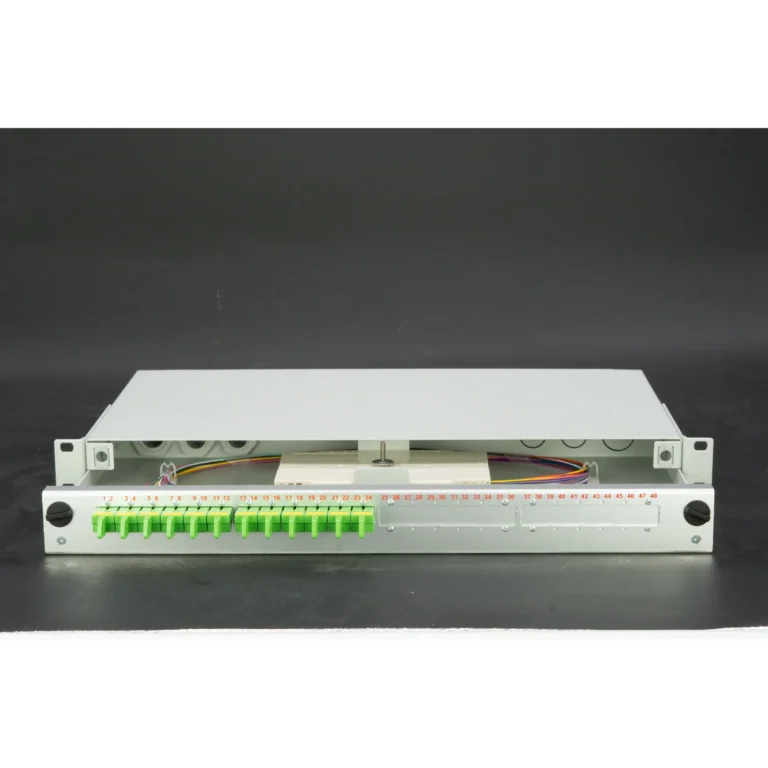
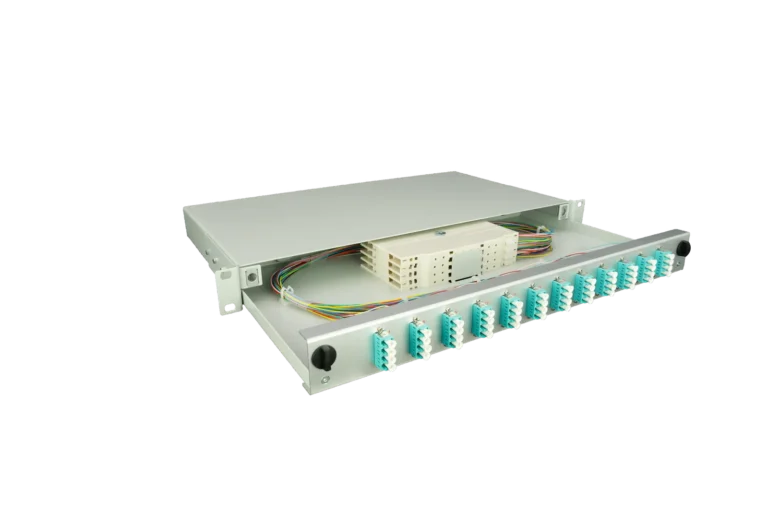
As a manufacturer of modular fibre optic solutions and official Diamond Partner, Fiber Products offers the complete system solution – from splice box to E2000 connector. Our systems meet the highest quality standards for authorities and security organisations.
Maintenance and Service of Military Fibre Optic Systems
Maintenance of NATO fibre optic standards requires specialised personnel and equipment. Technicians require additional qualification per STANAG 4622 for servicing military optical fibre systems. The Bundeswehr trains approximately 200 specialists annually at the Army Technical School in Aachen.
- Cleaning with militarily approved solvents (MIL-PRF-29504)
- Inspection using 400x magnification and automated fault analysis
- Attenuation measurement with calibrated OTDR equipment every 6 months
- Documentation of all service steps in the SASPF system
- Preventive replacement after 3000 mating cycles
Mobile service teams operate from specialised field workshops in ISO containers. These contain splice equipment with battery operation for 500 splices, climate-controlled work areas and complete measurement equipment to military standards.
Future Developments and New NATO Standards
NATO is currently developing STANAG 4795 for next-generation fibre optic systems. This new standard will support data rates up to 400 Gbit/s per fibre and integrate enhanced cybersecurity features. German defence contractors such as Rheinmetall and Hensoldt are already investing in corresponding development projects.
Quantum-encrypted communication over military fibre optics is in the trial phase. The Fraunhofer Institute for Applied Optics is jointly testing systems with the Bundeswehr for quantum key distribution over distances up to 100 kilometres.
Quality Assurance and Testing Procedures to Military Standards
Quality assurance of military optical fibre components follows the AQAP 2110 standard with 100% final inspection. Each individual NATO connector undergoes a 17-stage test sequence before release. Test protocols are archived for 30 years and are fully traceable.
| Test Procedure | Standard | Limit Value | Frequency |
|---|---|---|---|
| Optical continuity | IEC 61300-3-4 | < 0.2 dB | 100% |
| Tensile strength | MIL-DTL-38999 | > 100 N | 10% sample |
| Thermal shock | MIL-STD-810G | -65°C/+125°C | Batch testing |
| Moisture resistance | MIL-STD-810G | 95% RH | Type approval |
Cost Analysis: Military versus Civil Fibre Optic Solutions
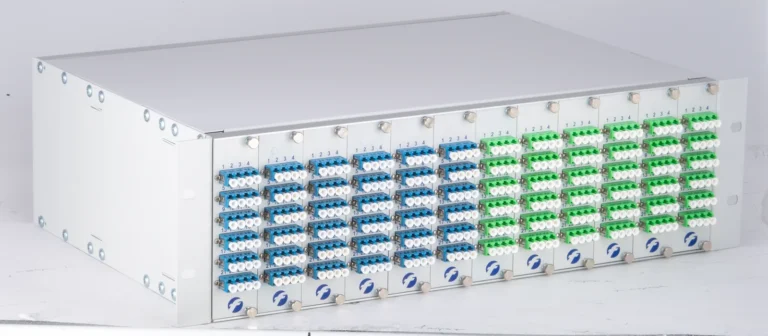
Investment in NATO-compliant fibre optic systems significantly exceeds civil solutions. A fully equipped 19-inch distribution frame with 144 fibres to military standards costs approximately €25,000, whilst the civil equivalent costs €3,000. These additional costs are justified by substantially longer service life and lower failure rates.
Total cost of ownership (TCO) over 20 years reveals a more differentiated picture. Through reduced maintenance intervals and higher reliability, initial investments in critical applications amortise within 8-10 years.
- Acquisition cost: 8-fold higher than civil systems
- Maintenance cost: Noticeably lower through extended intervals
- Failure cost: Substantially reduced through higher reliability
- Spare parts cost: On request
- Disposal cost: Manufacturer take-back obligation
FAQ on NATO Fibre Optic Standards
What are the main differences between NATO and civil fibre optic standards?
Military and NATO procurement differs mainly in mechanical and environmental qualification, not in tighter optical limits — ruggedised designs are usually specified with a higher maximum insertion loss than premium civil connectors. DIAMOND’s own range illustrates it: the E-2000 (IEC 61754-15) at typ. 0.1 dB / max. 0.3 dB, 500 mating cycles, −40 to +85 °C; the ruggedised HE-2000 (IEC 61754-35) at typ. 0.15 dB / max. 0.40 dB, 500 cycles, −55 to +85 °C; and the AVIM (IEC 61754-3) at typ. 0.2 dB / max. 0.5 dB with 50 mating cycles and an optional extended range of −55 to +150 °C. NATO contracts additionally invoke the AQAP quality-assurance requirements with documented traceability — contractual rules, not optical performance limits.
Can civil fibre optic components be used in military applications?
No, NATO-compliant systems may only use certified components. These must pass stringent test procedures per MIL-STD-810G and possess a manufacturer NCAGE number. Civil components do not meet these requirements.
How long does the certification process for NATO connectors take?
The complete certification process takes a minimum of 18 months. This includes 6 months of laboratory testing, 12 months of field trials and administrative processing by NAMSA. Additional national approvals may require a further 6 months.
Which German test facilities are responsible for military fibre optic components?
The Defence Technology Facility 81 (WTD 81) in Greding conducts technical qualification assessments. The Federal Office for Equipment, Information Technology and Use of the Bundeswehr (BAAINBw) is responsible for system integration testing.
Request a Quote
Do you have questions about our fibre optic solutions? Our expert team will be happy to advise you – free and without obligation.