Fibre Rollout Munich 2026: FTTH Infrastructure for SWM and Municipal Utilities
The fibre rollout Munich reaches a historic milestone in 2026: Munich Municipal Utilities (SWM) and its telecommunications subsidiary M-net, together with Deutsche Telekom, supply over 550,000 households with state-of-the-art FTTH Munich technology – a pioneering model for municipal operators across the DACH region. The SWM Glasfaser initiative demonstrates exemplary how other municipal utilities can drive comprehensive broadband rollout through strategic partnerships and modular splice systems whilst simultaneously strengthening their position as digital infrastructure service providers.
Technical Requirements for FTTH Rollout by Municipal Utilities
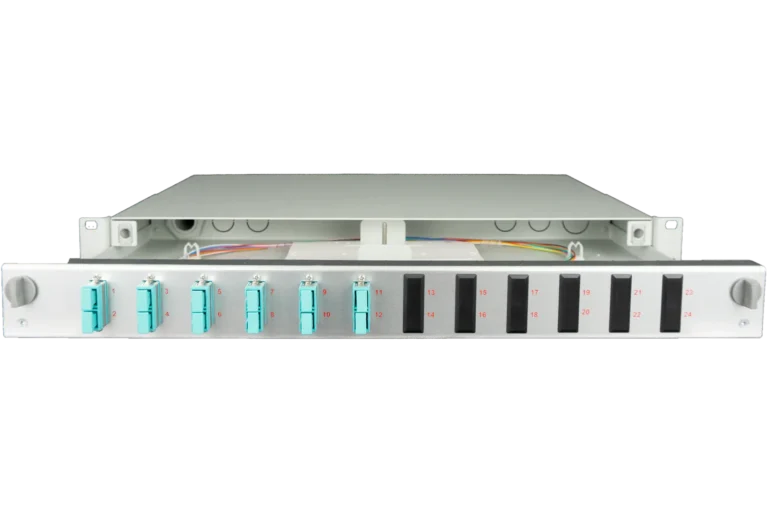
The realisation of fibre rollout Munich places special demands on passive network infrastructure. municipal utilities FTTH projects require high-density splice systems capable of managing up to 96 fibres in just 1U – a packing density that exceeds conventional systems by a factor of two.
- Splice modules with LC-APC and E2000-APC connectors for minimal return loss
- Modular design for flexible expansion as bandwidth demand increases
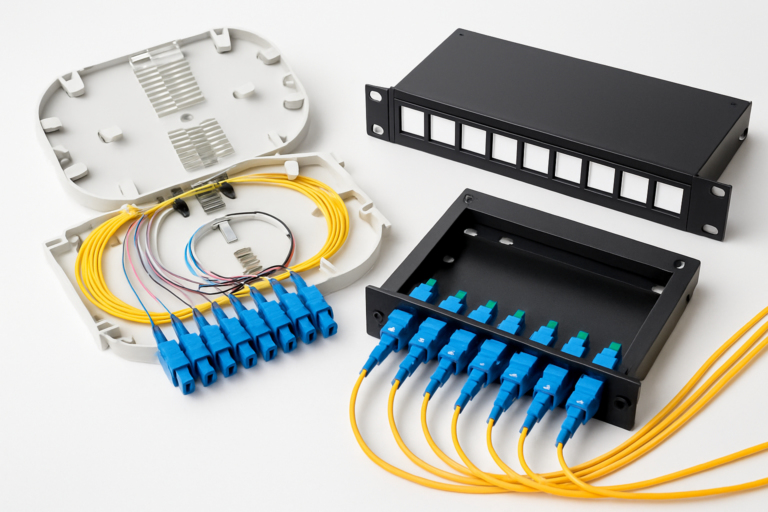
- Pre-terminated cassettes for short installation times per module
- Front-access design for maintenance-friendly patching without module removal
- Documentation systems compliant with DIN EN 50173-1 for legally secure handover
The SWM Glasfaser projects demonstrate that modern splice boxes must meet both technical standards IEC 61754-15 for E2000 connectors and strict fire safety requirements of VDE 0800-730. As an official Diamond partner and manufacturer, Fiber Products provides the complete system solution from a single source – from the splice box 1U to precision-engineered E2000 connectors.
Cooperation Model Munich: Blueprint for Municipal FTTH Networks
The innovative cooperation model in the FTTH Munich project breaks traditional rollout patterns. Rather than parallel duplicate infrastructures, SWM/M-net and Deutsche Telekom share the passive fibre optic infrastructure – each apartment receives a connection box with two separate fibre inputs.
| Network Level | Operator | Technical Specification | Capacity |
|---|---|---|---|
| Backbone | SWM | Single-Mode OS2 | 54 hub points |
| Distribution Network | SWM/M-net | FTTH Point-to-Point | 550,000 connections |
| Building Network | Shared Access | 2-fibre per apartment | 70,000 apartments (Phase 1) |
| Active Equipment | M-net/Telekom | GPON/XGS-PON | 10 Gbit/s symmetric |
This network architecture enables genuine competition at the service level whilst optimising utilisation of passive infrastructure. The SWM Glasfaser strategy relies on open network access, allowing smaller providers to deliver high-quality broadband services.
Splicing Technology and Quality Management in Municipal Fibre Rollout
The successful fibre rollout Munich is based on precision splicing technology with attenuation values below 0.1 dB per connection. Modern fusion splice machines with automatic fibre alignment achieve these values reliably, provided the splice cassettes offer optimal working conditions.
Fiber Products Quality Commitment: As an official Diamond partner and manufacturer, we produce modular splice systems in Europe. Benefit from Swiss precision and in-house manufacturing.
Municipal utilities like SWM increasingly rely on pre-terminated splice modules with factory-fitted pigtails. This design reduces installation error rates to below 0.5 per cent and significantly accelerates commissioning. The modular SlimConnect systems enable packing densities of 96 fibres in 1U – twice as many as conventional solutions.
Economics: Investment Costs and Operating Efficiency
The cost-benefit analysis for the FTTH Munich rollout shows clear cost advantages through economies of scale. At average provisioning costs of €1,250 per building in urban areas, the investment pays back within seven years at a 35 per cent connection rate.
- Reduction of installation time by up to 40 per cent through modular systems
- Lowering maintenance costs through 5-year warranty on splice modules
- Minimisation of downtime through redundant fibre routing
- Simplified documentation compliant with Telecommunications Act and GIA Ordinance
The cooperation between SWM and Deutsche Telekom on the fibre rollout Munich also avoids costly duplicate infrastructures. Experts estimate savings at €30 to 40 million compared to parallel rollout.
Regulatory Framework: GIA Ordinance and VDE Standards
The new EU Gigabit Infrastructure Ordinance (GIA) has significantly accelerated the FTTH Munich rollout since November 2025. Approval procedures are capped at four months maximum, and new buildings face a mandatory fibre provisioning requirement.
| Regulation | Valid from | Key Points for Municipal Utilities |
|---|---|---|
| GIA Ordinance | 11/2025 | 4-month deadline, Digital applications, FTTH requirement for new buildings |
| VDE 0800-730 | 02/2026 | Simplified building installation, Metal conduit instead of fire-rated conduit |
| Telecommunications Act Amendment | 07/2025 | Fibre optic in “overriding public interest” |
Particularly the new VDE 0800-730 revolutionises building installation: fibre optic cables can now be routed in simple metal conduits, reducing installation costs by up to 60 per cent. For SWM Glasfaser projects, this means significant time and cost savings in provisioning the 70,000 apartments of the municipal housing company.
Technical Challenges in Urban FTTH Deployment
The fibre rollout Munich faces specific technical challenges in existing infrastructure. Fully occupied cable shafts, heterogeneous building structures and conservation orders require flexible solutions.
- Microduct technology for diameters under 8mm in existing conduits
- Adhesive fibre installation in stairwells without drilling
- Compact splice boxes with installation depth under 120mm for tight equipment rooms
- Hybrid distributors for parallel copper and fibre operation during migration
The modular VarioConnect systems with their capacity of up to 288 fibres in 3U resolve space problems in existing equipment rooms. Front-side operation enables maintenance work even in confined spaces – a decisive advantage for the FTTH Munich project in historic buildings.
Quality Assurance and Test Equipment for Municipal Network Operators
The SWM Glasfaser standards define strict quality criteria for optical attenuation. Every connector must meet attenuation values below 0.25 dB for APC connectors, documented through OTDR measurements compliant with IEC 61280-4-1.
Modern splice modules already integrate factory-calibrated reference connectors for precise measurements. The Diamond-certified E2000 connectors achieve return losses exceeding 65 dB – a benchmark value guaranteeing interference-free transmission even at highest data rates. This precision makes the difference between a functioning and an excellent FTTH network.
Migration Strategy: Copper to Fibre by 2030
The fibre rollout Munich follows a structured migration strategy. By 2028, 80 per cent of all households are to be connected with FTTH, with copper infrastructure phased out progressively.
- Phase 1 (2026): Provisioning of 70,000 existing apartments
- Phase 2 (2027): Rollout in commercial zones with symmetric 10 Gbit/s
- Phase 3 (2028): Densification in peripheral areas
- Phase 4 (2029-2030): Complete FTTH coverage and copper shutdown
The modular design of splice systems enables demand-driven expansion. Municipal utilities can start with small units and add additional modules as demand grows – without interrupting existing connections.
Best Practices for Municipal Utilities: Lessons from Munich
The successful FTTH Munich rollout provides valuable insights for other municipal operators. The combination of strategic partnership, modular technology and open network architecture creates sustainable business models.
Critical is the selection of high-quality components with long service life. Splice modules with 5-year manufacturer warranty and factory-tested connectors significantly reduce downtime and maintenance costs. The fibre optic solutions for municipal utilities from Fiber Products offer as the only complete supplier in the DACH region the entire system chain from a single source – from the DIN rail-mount box to the high-density 1U splice module.
Future Perspective: XGS-PON and 50G-PON Readiness
The SWM Glasfaser infrastructure is already designed today for future transmission standards. With Single-Mode fibres of category OS2 and APC-polished connectors, the network supports XGS-PON with 10 Gbit/s symmetric without issue and is prepared for forthcoming 50G-PON standards.
The splice modules used offer spare capacity for wavelength division multiplexing (WDM), enabling transmission capacity multiplication without replacing passive infrastructure. This future-proofing justifies the additional investment in premium components and protects municipal utilities’ investments long-term.
FAQ: Frequently Asked Questions on Fibre Rollout for Municipal Utilities
Which splice modules are suitable for municipal FTTH rollout?
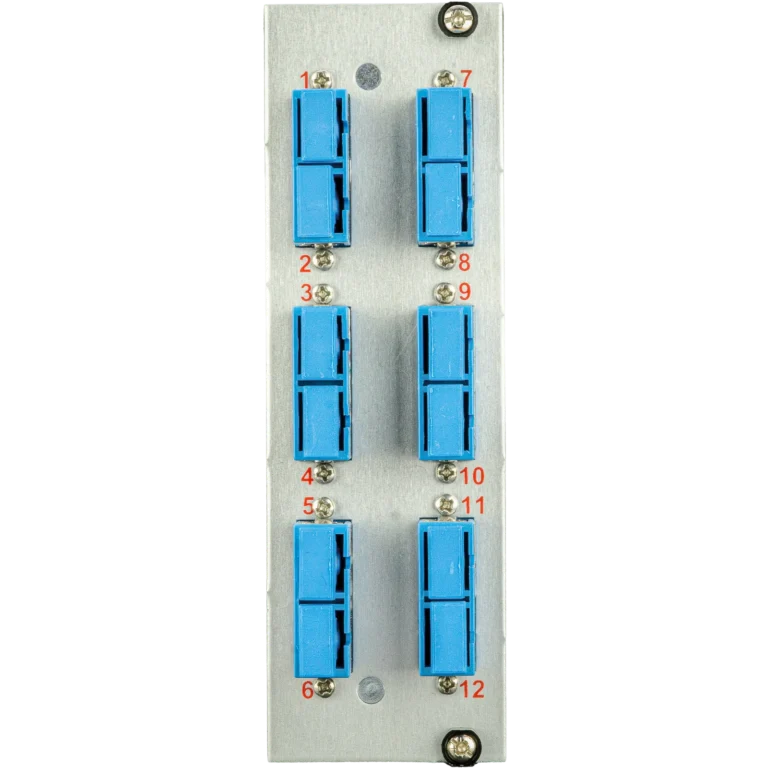
Pre-assembled splice modules for 19-inch subracks are the practical choice. Our modules arrive fully assembled, populated and splice-ready, hold 6 or 12 duplex couplings and a splice cassette for up to 24 crimp splices, and are available with E-2000 (LSH), LC or SC couplings in APC and PC. No standard prescribes a fixed loss limit per connection — DIAMOND specifies the E-2000 at typically 0.1 dB and a maximum of 0.3 dB insertion loss.
How long does installation of a 96-fibre splice box take?
With pre-terminated modules, a trained technician requires only a short time for complete installation including splicing. Factory-terminated pigtails reduce installation time by up to 40 per cent compared to field termination.
Which standards must splice systems for municipal utilities meet?
IEC 61754-15 defines the Type LSH connector interface — the E-2000 family — and DIN EN 50173-1 the generic cabling system. The EU Gigabit Infrastructure Act, Regulation (EU) 2024/1309, governs permit procedures, access to existing physical infrastructure and the coordination of civil works; it sets no documentation requirement for splice systems. What is binding for a given project is what the contracting authority specifies.
Is investment in E2000 connector systems justified over LC?
E2000 connectors offer over 65 dB return loss for highest transmission quality and integrated protective caps. For critical applications and long-distance runs, the superior performance justifies the additional investment of approximately 15–20 per cent.
How much space do modern splice distributors require in equipment rooms?
High-density systems need only 1U (44mm) for 96 fibres. Installation depth is typically 300–400mm. VarioConnect systems achieve up to 288 fibres in 3U – ideal for tight equipment rooms in existing buildings.
What warranty terms are standard for splice modules?
Standard terms are 2–3 years. Premium manufacturers like Fiber Products offer 5-year warranty on their modular splice systems – an important factor in total operating costs for municipal networks.
Interested in Modular Fibre Optic Solutions?
Fiber Products GmbH – Official DIAMOND SA Partner. Made in EU, 5-year warranty.