Fibre Rollout Düsseldorf 2026: Municipal Utilities and FTTH Infrastructure
The fibre rollout Düsseldorf reaches a critical phase in 2026, with Stadtwerke Düsseldorf Glasfaser and other network operators including net.D, Deutsche Telekom and DüsselFibre jointly advancing the FTTH NRW in Münster deployment to supply up to 45,000 households with gigabit-speed connectivity. The state capital coordinates a unique multi-stakeholder model in which municipal and commercial operators work in parallel across defined project areas to achieve comprehensive fibre coverage. With a national fibre deployment rate of 52.8 percent (as of June 2025) and the new EU Gigabit Infrastructure Regulation, technical decision-makers at municipal utilities face new demands for modular splice systems and high-density distribution solutions.
Current Deployment Projects of Stadtwerke Düsseldorf
The company net.D, in which the City of Düsseldorf and Stadtwerke Düsseldorf Glasfaser hold stakes, will deploy a total of 86 kilometres of fibre optic cable from July 2025 through summer 2026 in the districts of Pempelfort, Derendorf and Golzheim. This infrastructure enables the supply of 4,600 buildings with direct FTTH connections, using modern splice technology and high-density distribution systems. Technical implementation is achieved via underground micro-conduit systems into which fibre optic cables with a minimum of four fibres are blown in using compressed air technology.
- Deployment of 86 km fibre optic cable by summer 2026
- Coverage of 45,000 households across three districts
- Implementation of FTTH technology with gigabit-speed capacity
- Deployment of modular splice systems for flexible network architectures
- Coordination through the City’s Digital Infrastructure Service Centre
The municipal utilities rely on a future-proof network architecture with passive optical networks (PON) that support both GPON and XGS-PON. This technology enables symmetrical bandwidths of up to 10 gigabit and can be upgraded without replacing the fibre optic infrastructure if required.
Technical Requirements for FTTH Infrastructure in North Rhine-Westphalia
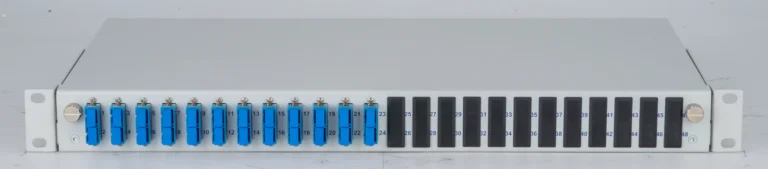
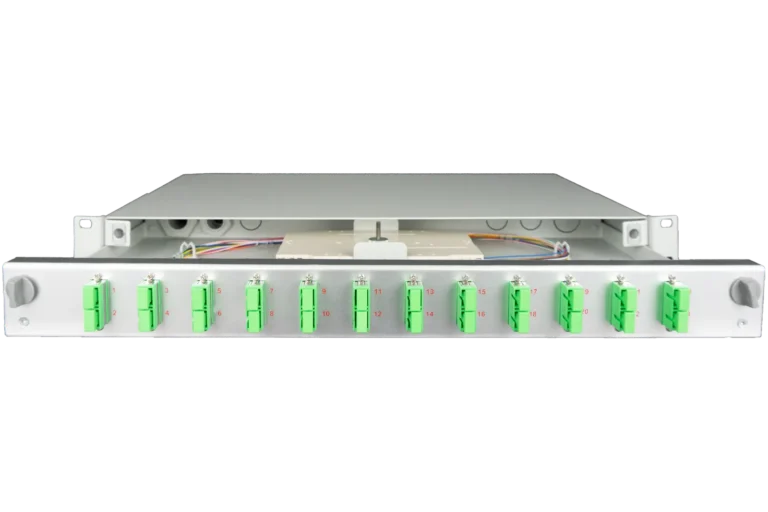
The FTTH NRW deployment places specific demands on the splice technology and distribution systems used. Modern splice boxes must be capable of managing up to 96 fibres in just one rack unit (1U) to achieve the required port density at urban distribution points. The standard IEC 61754-15 defines the requirements for optical connectors, while IEC 61300-3-35 prescribes attenuation values of a maximum of 0.25 dB for splice connections.
| Technical Parameter | Municipal Utility Requirement | Standard Specification |
|---|---|---|
| Fibre density per 1U | Minimum 48 fibres | Up to 96 fibres possible |
| Splice attenuation | < 0.15 dB typical | < 0.25 dB (IEC 61300-3-35) |
| Connector types | LC, SC, E2000 | IEC 61754 series |
| External protection class | IP65 minimum | IEC 60529 |
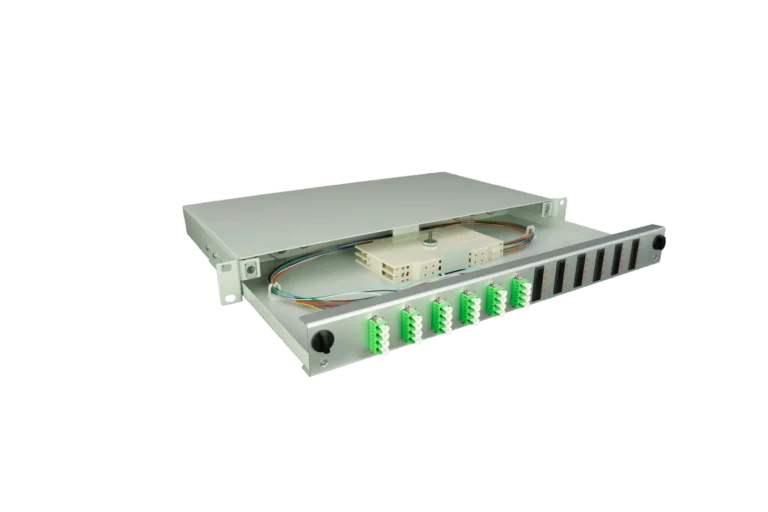
Implementation is achieved via modular splice systems that enable flexible adaptation to growing network requirements. Pre-configured splice cassettes reduce on-site installation time and minimise installation error risk.
Cooperation Models Between Municipal Utilities and Network Operators
The fibre rollout Düsseldorf is based on an innovative cooperation model in which municipal and private stakeholders pool their resources. Municipal utilities function as infrastructure partners and provide their conduit systems, power supply points and local expertise. In return, they gain access to modern fibre optic networks and can develop their own business models in the area of digital public services.
Fiber Products Quality Promise: As an official Diamond partner and manufacturer, we produce modular splice systems in Europe. Benefit from Swiss precision and in-house manufacturing.
Technical coordination is performed through central network distribution points (PoP – Points of Presence), where high-density splice modules establish the connection between backbone networks and distribution networks. These distribution points require splice systems with at least 288 fibres on 3U to guarantee the necessary scalability for future network expansion phases.
- Shared use of civil works capacity in North Rhine-Westphalia
- Coordinated construction measures to minimise street excavation
- Technical standardisation across all network operators
- Central documentation in municipal geodatabases
- Uniform quality standards for splicing work
Regulatory Framework for Municipal Utilities 2026
The TKG Amendment Act 2025 defines fibre rollout as a matter of overriding public interest, which significantly accelerates approval procedures for Stadtwerke Düsseldorf Glasfaser projects. The EU Gigabit Infrastructure Regulation (GIA), effective since November 2025, also requires all network operators to coordinate construction work and establishes uniform technical standards for in-building networks.
For municipal utilities, this concretely means they have access to existing physical infrastructure of other utilities when laying new fibre optic cable. The Federal Network Agency monitors compliance with these requirements and ensures non-discriminatory network access. At the same time, municipal utilities must open their own infrastructure for shared use, which requires standardised handover points with standardised splice modules.
PON Technology and Network Architecture for Municipal Networks
The implementation of Passive Optical Network (PON) technologies enables municipal utilities to cost-effectively expand their supply areas. GPON systems with 2.5 Gbit/s downstream and 1.2 Gbit/s upstream form the basic supply, while XGS-PON with 10 Gbit/s symmetrical is available for business customers and critical infrastructure. Both technologies coexist on the same fibre optic infrastructure via wavelength division multiplexing (WDM).
| PON Technology | Bandwidth | Range | Splitter Ratio |
|---|---|---|---|
| GPON | 2.5/1.2 Gbit/s | 20 km | 1:64 |
| XGS-PON | 10/10 Gbit/s | 20 km | 1:64 |
| NG-PON2 | 40/40 Gbit/s | 40 km | 1:256 |
Distribution is achieved via optical splitters in street-side distribution cabinets equipped with weatherproof splice enclosures with IP65 protection class. Modern splice modules enable management of up to 96 fibres in just 44.45 mm mounting height, increasing packing density compared to conventional systems.
Splice Technology and Distribution Systems for FTTH Deployment
The quality of splice connections largely determines the performance of the entire FTTH NRW network. Modern fusion splice machines achieve attenuation values of typically below 0.05 dB for singlemode fibres, with automatic fibre alignment performed via active core centring. The splice time per fibre on modern machines is less than 7 seconds, which provides substantial time savings in mass splicing operations.
- Use of ribbon splice technology for up to 12 fibres simultaneously
- Pre-configured pigtails with factory-tested connectors
- Modular splice cassettes for 24 single splices or 96 ribbon splices
- Colour coding per DIN VDE 0888-1 for unambiguous fibre assignment
- Integrated attenuation measurement with OTDR logging
Splice modules must offer maximum flexibility: from accommodating various connector types (LC, SC, E2000, MPO) to integration into 19-inch racks through to installation in external distribution cabinets. As a manufacturer of modular fibre optic solutions, Fiber Products delivers the complete system solution – from the splice box to the E2000 connector in Swiss precision quality with 5 years’ warranty.
Investment Planning and Subsidies for Municipal Utilities
The fibre rollout Düsseldorf requires substantial investment, and FTTH trends for municipal operators. The Federal Gigabit Grant 2.0 supports deployment in economically unviable areas with up to 50 percent of eligible costs. In addition, the North Rhine-Westphalia state government provides its own funding for municipal broadband expansion.
Investment costs for FTTH networks typically range from €1,500 to €2,500 per household connection, depending on settlement density and existing infrastructure. By deploying modular splice systems and pre-configured components, installation costs can be reduced noticeably. Amortisation periods for municipal networks range between 15 and 20 years, with the technical lifespan of fibre optic infrastructure extending beyond 40 years.
Quality Assurance and Documentation in Municipal Fibre Networks
Documentation and quality assurance play a central role in building sustainable Stadtwerke Düsseldorf Glasfaser infrastructures. Every splice connection must be logged in accordance with IEC 61300-3-35 and recorded in a digital network cadastre. OTDR measurements (Optical Time Domain Reflectometry) document attenuation values across the entire fibre path and enable precise localisation of faults.
Modern splice modules feature integrated documentation systems with QR codes or RFID tags that enable unambiguous identification of each fibre. Digital network documentation includes route paths, splice point locations, splice plans and attenuation protocols, made available through cloud-based systems to all authorised technicians.
FAQ: Technical Questions on Fibre Deployment for Municipal Utilities
Which splice modules are suitable for municipal FTTH deployment?
Modular 19-inch systems with sliding splice cassettes are the practical choice; the port density you need follows from the fibre count of the route, not from a fixed figure per rack unit. Modules should accept the connector interfaces the project specifies — LC, SC and E-2000, each standardised in its own part of the IEC 61754 series. IEC 61756-1 is a general and guidance standard for fibre management system interfaces, including criteria for the minimum bending radius of stored fibres; it prescribes neither densities nor connector types.
What are typical splice attenuation values in FTTH networks?
With proper installation, fusion splice attenuation for singlemode fibres is typically about 0.08 dB. ITU-T G.671 permits a maximum of 0.30 dB for actively aligned fusion splices and 0.50 dB for mechanical splices. The total ODN loss budget for a GPON FTTH link is 10-25 dB (Class B, ITU-T G.984.2).
What fibre density is optimal for urban distribution points?
Urban distribution points should be capable of managing at least 96 fibres on 1U or 288 fibres on 3U. This enables the supply of 24 to 72 households per distribution point when using 1:32 PON splitters and provides adequate capacity for business customers.
How is migration from copper to fibre performed at municipal utilities?
Migration occurs on an area-by-area basis once at least 80 percent fibre coverage is achieved. Municipal utilities install parallel fibre infrastructure, migrate customers progressively and can decommission copper lines after a typical transition period of 18 months. The Federal Network Agency oversees this process.
Which PON technology should municipal utilities implement in 2026?
Municipal utilities should adopt hybrid systems supporting both GPON and XGS-PON. GPON with 2.5 Gbit/s for residential customers and XGS-PON with 10 Gbit/s symmetrical for business customers on the same infrastructure enable optimal utilisation and future-proofing.
How do modular splice systems ensure network availability?
Modular splice systems allow individual cassettes to be replaced without service interruption to adjacent fibres. Hot-swap capability of modules and redundant fibre routing guarantee availability of over 99.95 percent. Pre-configured replacement modules reduce downtime considerably.
Outlook: Fibre Infrastructure Düsseldorf 2027 and Beyond
The fibre rollout Düsseldorf is expected to achieve coverage of over 75 percent of all households by 2027. Stadtwerke Düsseldorf Glasfaser projects are developing into a model for other municipal utilities in North Rhine-Westphalia. With planned copper decommissioning from 2030 onwards and increasing bandwidth demands from AI applications and IoT, the importance of high-quality splice infrastructure will continue to grow.
Technical evolution is already advancing towards 25G-PON and 50G-PON systems that can be deployed on existing fibre infrastructure. The key to future-proofing is selecting modular, scalable splice systems capable of flexibly managing various connector types and fibre densities. With the right technical foundation, municipal utilities build today the digital infrastructure for the next 40 years.
Interested in modular fibre optic solutions?
Fiber Products GmbH – official DIAMOND SA partner. Made in EU, 5 years’ warranty.