Military Fibre Optic: German Armed Forces Network Infrastructure with E2000 Connectors
Military fibre optic and tactical fibre optic communication form the technical backbone of modern defence systems with data rates up to 100 Gbit/s and return loss values exceeding 60 dB at E2000-APC connector interfaces. The German Armed Forces rely on robust fibre optic cables to VG 95218-30 Type 1 standard, which withstand being run over by tracked vehicles and simultaneously provide eavesdropping-proof communication through electromagnetic immunity.
As the centrepiece of digital transformation for the military, fibre optic infrastructure enables seamless networking of command centres, satellite ground stations and mobile units. Standardisation on E2000 connectors with automatic protective cap and push-pull locking ensures rapid field deployment under extreme conditions.
Technical Fundamentals of German Armed Forces Fibre Optic Networks
Military fibre optic technology differs fundamentally from civilian installations through heightened requirements for mechanical durability, temperature resistance and electromagnetic compatibility. Whilst civilian networks are typically installed in protected environments, Fibre Optic Military Networks – Requirements for Defence Communications must withstand temperatures from -40°C to +85°C and mechanical loads up to 4000 N/10cm.
- Metal-armoured fibre optic cables with stainless steel tubing for maximum fibre protection
- Rodent protection via stainless steel wire armouring to military standards
- Tensile strength up to 5000 N in tactical deployment cables
- Bending resilience with minimum bend radius 15× cable diameter
- Flame-retardant outer sheaths to IEC 60332-3
The German Armed Forces primarily use single-mode fibres to ITU-T G.652.D for long-distance links and OM4 multi-mode fibres for short distances in command centres. This combination enables transmission ranges from a few metres to over 100 kilometres without signal amplification.
E2000 Connectors in Military Applications
The E2000 connector has become the standard interface in European defence networks. With its 1.25 mm ferrule and integrated protective cap, it provides optimal protection against contamination and laser radiation – critical factors in field deployment.
| Characteristic | E2000-PC | E2000-APC |
|---|---|---|
| Return Loss | > 50 dB | > 60 dB |
| Insertion Loss | < 0.25 dB | < 0.30 dB |
| Polish Angle | 0° | 8° |
| Colour Code | Blue/Black | Green |
| Application | Standard Data Transmission | High-Frequency Systems |
The automatic protective cap of the E2000 retracts automatically when mating and immediately protects the ferrule upon disconnection. This design prevents eye damage from Class 3B lasers and reduces downtime from contaminated connectors by up to 75 per cent.
Tactical Fibre Optic Communication in Field Operations
Military fibre optic systems must function under the most extreme conditions. Tactical fibre optic cables are therefore manufactured to VG 95218 standard and undergo comprehensive testing procedures. The cables withstand being run over by a Leopard 2 main battle tank weighing 62 tonnes without loss of function.
Mobile command centres use pre-terminated fibre optic systems with 12 to 144 fibres per cable. Deployment is via specialised cable drums with 500 to 2000 metre lengths, which can be deployed quickly.
- Quick-coupling systems for installation times under 30 seconds
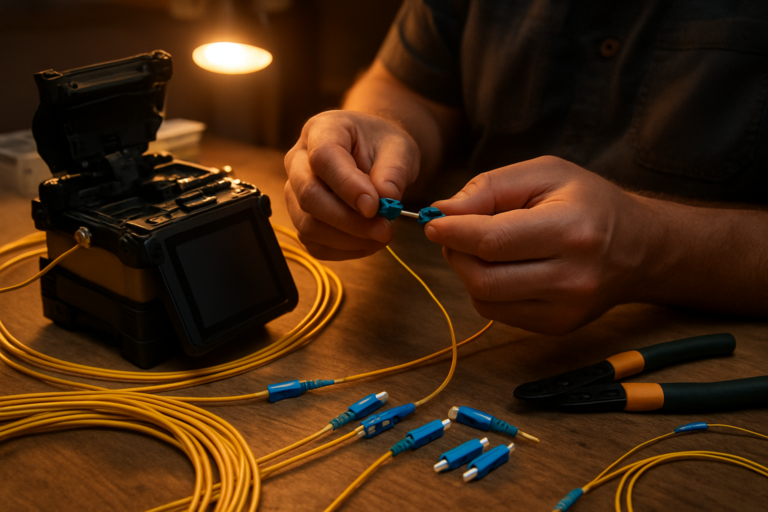
- Field-capable splice equipment with battery runtime for over 200 splice operations
- Rugged transport cases to IP67 for connectors
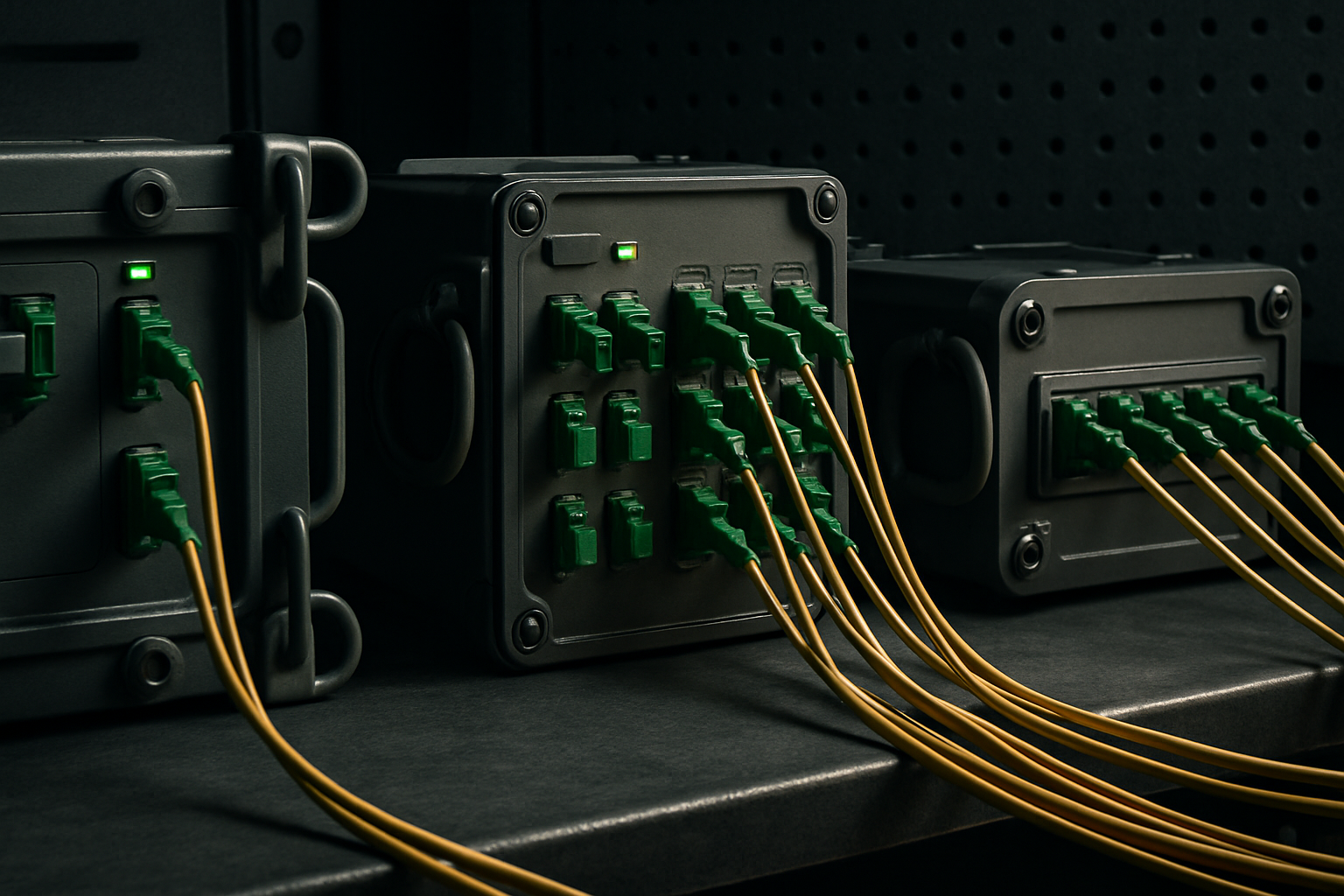
- Tactical distribution boxes with 24 to 96 ports
- Redundant routing for fault-tolerant communication
Fiber Products Quality Promise: As an official Diamond Partner and manufacturer, we produce modular splice systems in Europe. Benefit from Swiss precision and in-house manufacturing.
Satellite Communication and Terrestrial Fibre Optic Connectivity
The German Armed Forces satellite communication system SATCOMBw is based on high-capacity fibre optic ground station connections. With investments of 1.4 billion euros, an infrastructure is being created that enables data rates of multiple terabits per second between satellites and terrestrial networks.
The Heinrich Hertz satellite launched in 2023 requires ground stations with 10 Gbit/s Ethernet connectivity over single-mode fibre. The planned European constellation IRIS² with 290 satellites will impose even higher demands on fibre optic infrastructure from 2031 onwards.
| System | Satellites | Data Rate | Fibre Optic Connectivity |
|---|---|---|---|
| SATCOMBw | 2 COMSATBw | 500 Mbit/s | 10 GbE Single-Mode |
| Heinrich Hertz | 1 Test Satellite | 1 Gbit/s | 10 GbE Single-Mode |
| IRIS² (planned) | 290 MEO/LEO | 100 Gbit/s | 100 GbE Single-Mode |
Standards and Certification of Military Fibre Optic Systems
Standardisation of military fibre optic components follows German defence standards (VG) and NATO standards (STANAG). The primary standard VG 95218-30 defines requirements for tactical fibre optic cables regarding mechanical, thermal and chemical resistance.
Additionally, VG 95343 governs heat-shrink components for fibre optic splice points. These must cover temperature ranges from -55°C to +125°C and guarantee a service life of at least 20 years. Certification is carried out by the Wehrtechnische Dienststelle 91 (Defence Technology Service 91) in Meppen.
- VG 95218-30 Type 1: Metal-armoured tactical fibre optic cables
- VG 95343: Heat-shrink components for splice protection
- STANAG 4207: NATO standard for military fibre optic systems
- MIL-DTL-38999: Circular connectors for fibre optic hybrid cables
- IEC 61754-15: E2000 connector interface
Integration into Existing German Armed Forces Infrastructure
Migration from copper to fibre optic technology at German Armed Forces installations requires special transition concepts. Military fibre optic and tactical fibre optic communication must integrate seamlessly with legacy systems. For this, media converters are employed that translate 10/100/1000 Mbit/s Ethernet to fibre optic.
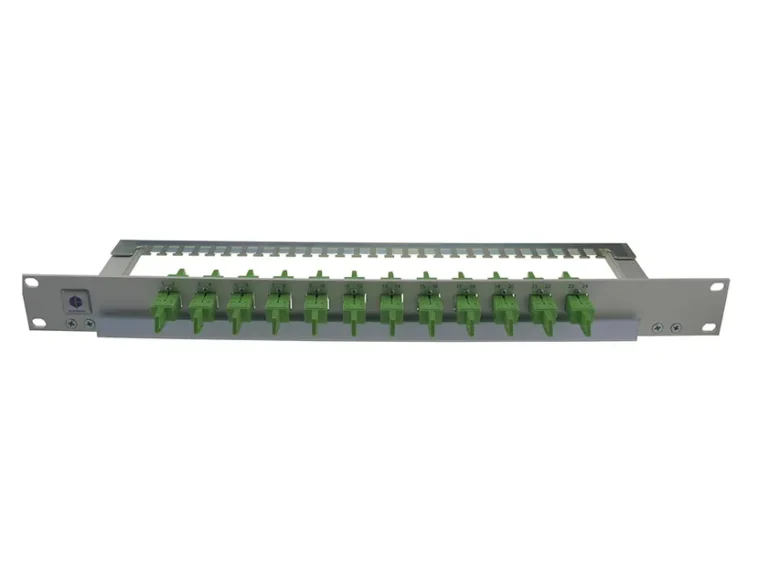
In barracks and command centres, modular 19-inch splice systems with 1HU to 4HU height are installed. These accommodate up to 288 fibres and enable structured cabling to EN 50173. Patch panels use E2000 couplers in simplex or duplex configuration.
For in-building cabling at network level 4 (NE4), the German Armed Forces use pre-terminated fibre optic cables with 4 to 48 fibres. Installation takes place in cable trays to VDE 0800-730, with minimum bend radii of 30 mm being observed.
Cybersecurity and Eavesdropping Protection via Fibre Optic
Fibre optic technology provides inherent security advantages over copper-based systems. Transmission occurs via light pulses without electromagnetic radiation, preventing TEMPEST attacks. Eavesdropping attempts via fibre bending generate measurable attenuation changes of > 0.5 dB, detected immediately.
- No electromagnetic radiation – 100% TEMPEST-secure
- Tampering detection via OTDR monitoring
- Fibre-level encryption using quantum cryptography
- Physical security via microbend sensors
- Redundant routing with automatic failover
The German Armed Forces additionally implement end-to-end encryption to BSI TR-02102 with key lengths of at least 256-bit AES. The combination of physical fibre optic security and cryptography ensures maximum protection for classified information.
Future Perspectives for Military Fibre Optic Networks
Development of German Armed Forces fibre optic infrastructure focuses on higher data rates and improved mobility. New single-mode fibres to ITU-T G.657.A2 enable smaller bend radii of just 7.5 mm, allowing more compact tactical systems.
Future military networks will support 400 Gbit/s Ethernet over individual fibres. Integration of MPO/MTP connectors with 12, 24 or 72 fibres enables faster field deployment. In parallel, industry is developing more robust cable designs with aramid reinforcement and self-healing coatings.
As an official Diamond Partner, Fiber Products accompanies this development with modular splice systems already designed for future requirements today. The SlimConnect 1HU systems offer up to 96 fibres in one rack unit, achieving double the packing density of conventional solutions.
Practical Implementation in German Armed Forces Projects
Implementation of tactical fibre optic communication follows standardised project phases. Following needs analysis and route planning, material selection proceeds in accordance with VG standards. Installation by certified technicians includes cable deployment, splicing and metrological acceptance testing.
| Project Phase | Duration | Key Activities |
|---|---|---|
| Planning | 4–8 weeks | Route design, material specification |
| Procurement | 6–12 weeks | Tender, award, delivery |
| Installation | 2–4 weeks | Cable deployment, splicing, assembly |
| Acceptance | 1 week | OTDR measurement, documentation |
| Documentation | 1 week | As-built drawings, test records |
Metrological acceptance testing is performed with calibrated OTDR instruments at wavelengths of 1310 nm and 1550 nm for single-mode and 850 nm and 1300 nm for multi-mode. Maximum permissible span attenuation is 0.35 dB/km at 1310 nm.
Maintenance and Servicing of Military Fibre Optic Networks
Availability of military communication networks must achieve 99.999 per cent uptime. This requires preventive maintenance concepts with regular inspections and measurements. Mobile service teams conduct quarterly visual inspections and annual OTDR reference measurements.
- Quarterly visual inspection of all accessible components
- Half-yearly cleaning of E2000 connectors
- Annual OTDR measurement with trend analysis
- Permanent monitoring of critical links via RFTS
- Emergency stock of repair kits and spare modules
For rapid repairs, Military Communication Networks – Splice Techniques Under Extreme Conditions and pre-terminated repair cables are on standby. Mean time to repair (MTTR) is maximum 4 hours for critical links. Government and military facilities benefit from our 5-year warranty on all splice systems.
FAQ on Military Fibre Optic and German Armed Forces Networks
What advantages does fibre optic offer over copper cables in military deployment?
Fibre optic cables are completely immune to electromagnetic interference and eavesdropping attempts. They offer 1000-fold higher bandwidth at 80 per cent lower weight compared to copper cables. Transmission range without amplification is up to 100 kilometres.
Why are E-2000 connectors used in security-sensitive networks?
E-2000 connectors are chosen for security-sensitive networks because of their protection concept: a spring-loaded metal shutter closes automatically over the ferrule end face whenever the connector is unmated, shielding it from dust and blocking laser radiation. The push-pull coupling defined by the IEC 61754-15 interface mates without tools. DIAMOND specifies return loss of at least 50 dB for PC and at least 70 dB for APC versions, with 500 mating cycles and an operating range of −40 °C to +85 °C.
How robust are tactical fibre optic cables?
Military fibre optic cables to VG 95218-30 standard withstand being run over by main battle tanks, temperatures from -40°C to +85°C and tensile forces up to 5000 Newtons. Stainless steel armouring additionally protects against rodents and mechanical damage.
What data rates are possible over military fibre optic networks?
Current systems support 100 Gbit/s over single-mode fibres. Future implementations will enable 400 Gbit/s and beyond. Multi-mode systems achieve 40 Gbit/s over distances up to 150 metres.
How are military fibre optic components certified?
Certification follows German VG standards administered by Wehrtechnische Dienststelle 91 (Defence Technology Service 91). NATO partners recognise these standards. STANAG standards additionally apply for international operations.
What service life do military fibre optic systems provide?
With proper installation, service life is at least 25 years. Fibres themselves do not degrade. Connectors withstand over 1000 mating cycles. Cable jackets are specified for 20 years outdoor deployment.
Interested in Modular Fibre Optic Solutions?
Fiber Products GmbH – official DIAMOND SA Partner. Made in EU, 5 years’ warranty.