Smart City fiber optic backbone: IoT integration with modular distribution systems for smart city infrastructures

The future of smart cities starts with the right fiber optic infrastructure
Modern cities are rapidly developing into networked, intelligent organisms that rely on comprehensive digital infrastructures. The smart city fiber optic backbone forms the technical backbone for all IoT applications, sensor networks and digital services that make up a modern city infrastructure. From intelligent traffic control and environmental monitoring to digital citizen services – all smart city components require reliable, high-performance fiber optic connections.
The challenge lies not only in the technical implementation, but also in future-proof planning: IoT integration Fiber optic systems must be installed today, but remain flexible for new technologies and growing requirements over decades. Cities invest in infrastructures with a 20-30 year lifespan, while digital technologies evolve every 3-5 years.
Modular fiber architectures solve this conflict between long-term infrastructure investment and dynamic technology evolution. They allow cities to gradually invest in smart city technologies while protecting their existing fiber investments. The right smart city fiber backbone grows with the city’s needs instead of limiting them with technical constraints.
Requirements for modern smart city fiber optic backbones
Scalability for growing IoT landscapes
Smart cities often start with individual pilot projects – an intelligent parking guidance system here, environmental sensors there. However, successful projects quickly lead to city-wide rollouts with thousands of networked devices. The smart city fiber optic backbone must be able to support this scaling from a few sensors to comprehensive IoT ecosystems.
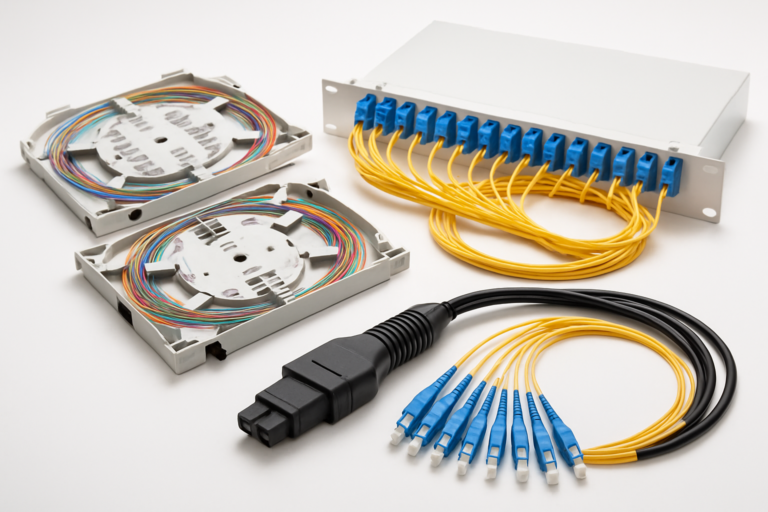
Traditional, fixed-sized fiber optic installations quickly reach their limits with this dynamic development. Modular systems such as the VarioConnect 3U/4U system make it possible to start with small configurations and gradually expand to high-density installations with hundreds of connections.
IoT fiber integration requires special attention for edge computing sites where local data processing takes place. These sites require both backbone connectivity and local distribution capacity for connected sensors and actuators.
Reliability for critical city functions
Intelligent traffic control, emergency communications and critical infrastructure rely on the smart city fiber optic backbone. Outages have a direct impact on citizen safety and city operations. This requires not only high-quality components, but also redundant architectures and service-friendly maintenance concepts.
The extendable modules in modular splice systems enable maintenance work to be carried out without interrupting critical services. While one module is being serviced, neighboring systems remain fully functional – a decisive advantage for 24/7 critical smart city applications.
For particularly critical locations such as traffic control centers or emergency centers, fiber optic solutions for data centers offer the necessary redundancy and performance for uninterrupted operation.
Cost efficiency for municipal budgets
Cities need to achieve maximum impact with limited budgets. The smart city fiber optic backbone must not only be technically excellent, but also economically viable. This requires intelligent investment strategies that enable gradual implementation and at the same time exploit economies of scale.
Modular IoT integration Fiber optic solutions support phased investments: Cities can start with the most important use cases and expand the network according to available budgets. The 5-year warranty on all fiber components reduces long-term operating costs and makes investments predictable.
Core components of a modular Smart City fiber optic architecture
Central backbone nodes with high-density systems
At the heart of every smart city fiber optic backbone are central distribution points that coordinate hundreds of fiber optic connections to different areas of the city. These locations – often in data centers or central technology buildings – require maximum port density with a clear organization at the same time.
VarioConnect 4U systems offer the required capacity for central nodes and enable flexible configuration depending on the configuration thanks to modular assembly. Even with complex configurations, the systematic fiber routing maintains the clarity required for professional cable management.
Central locations must also be able to integrate different fiber optic technologies: from classic singlemode connections for long distances to multimode systems for local high-speed connections. Modular front modules enable the integration of different connector types in one system.
Decentralized distribution points for neighbourhood networks
Smart cities are often organized in intelligent districts that operate local services such as sharing systems, district parking or local environmental monitoring. These areas require decentralized distribution points that connect the smart city fibre optic backbone with local IoT networks.
SlimConnect 1U systems are ideal for such decentralized locations: compact enough for small technical rooms, but powerful enough for demanding local networks. The high port density of up to 96 fibers on 1U enables comprehensive local networking without oversized equipment rooms.
Decentralized locations benefit in particular from the service-friendly design: local technicians can carry out maintenance work without having to call in specialists for every small change. This reduces operating costs and increases the speed of response to local problems.
Edge computing locations for local data processing
Modern IoT integration Fiber optic architectures are increasingly moving data processing to the edge of the network to reduce latency and save bandwidth. Edge computing sites require both high-performance backbone connectivity and flexible local distribution capacity.
These locations often combine data center requirements with local IoT integration. Modular systems make it possible to implement both high-performance server connections and low-bandwidth sensor connections in an integrated architecture.
Edge locations are often integrated into existing urban infrastructures – from substations to transport hubs. The compact design of modular fiber optic systems facilitates integration in limited spaces.
IoT integration and sensor network connection
Massive IoT connectivity for sensor networks
Smart cities continuously collect data on air quality, traffic flows, energy consumption and citizens’ needs. These sensor networks require reliable but cost-effective connectivity to the smart city fiber optic backbone. Not every sensor needs dedicated fiber connectivity, but aggregation points need to efficiently bundle hundreds or thousands of sensor signals.
Fiber optic IoT integration often takes place via hierarchical network architectures: local collection points aggregate sensor data and transmit it via fiber optics to the central smart city fiber optic backbone. This architecture reduces costs and increases system reliability at the same time.
Modular BasicConnect front modules allow flexible configuration of aggregation points depending on local sensor density. From a few connections for sparsely populated areas to high-density configurations for sensor-intensive areas.
Real-time capable connections for critical applications
Intelligent traffic control, emergency systems and industrial automation require real-time capabilities that only more direct fiber connections to the smart city fiber backbone can provide. These applications do not tolerate delays caused by multiple aggregation levels.
Such critical connections require dedicated fiber optic paths with guaranteed latency times and bandwidths. The modular architecture makes it possible to implement both standard IoT connections and premium services in the same infrastructure.
Fiber optic modules for transport companies show how mission-critical applications can be reliably connected to the Smart City fiber optic backbone without compromising flexibility for other applications.
Integration of 5G small cells and WLAN access points
The smart city fiber optic backbone must also support wireless communication technologies. 5G small cells for urban coverage and Wi-Fi access points for public internet coverage require powerful fiber optic backhaul connections.
These applications have high bandwidth requirements and strict latency budgets. IoT integration Fiber optic systems must support both low-bandwidth sensors and high-performance communication infrastructure in a unified architecture.
The flexibility of modular systems makes it possible to implement different service levels in the same physical infrastructure: from simple sensor connectivity to gigabit backhaul for 5G stations.
Application scenarios for smart city infrastructures
Intelligent traffic control and mobility
Modern traffic management systems collect real-time data from thousands of sensors, cameras and vehicles in order to optimize traffic flows and reduce congestion. The smart city fiber optic backbone must reliably transmit these data streams to the central traffic control center and at the same time send control signals to intelligent traffic lights and traffic signs.
Particularly critical are intersections and traffic junctions where multiple sensors, cameras and control devices need to be coordinated. Fiber optic modules for transport operators provide the necessary reliability for such mission-critical installations.
The IoT integration of fiber optics also enables innovative mobility services such as intelligent parking guidance systems that guide citizens to free parking spaces in real time, or sharing systems for e-bikes and e-scooters that ensure optimal distribution of vehicles.
Environmental monitoring and sustainability
Smart cities use comprehensive sensor networks to monitor air quality, noise pollution, energy consumption and water quality. This environmental data flows via the smart city fiber optic backbone into central analysis systems that identify trends and coordinate countermeasures.
Environmental sensors are often installed in locations that are difficult to access – from rooftops to manhole covers. IoT integration fiber optics must ensure robust, low-maintenance connections to such locations. Modular systems enable cost-effective aggregation points that bundle multiple sensors and connect them to the backbone via a few fiber optic connections.
Sustainability monitoring often requires decades of data collection for trend analyses. The 5-year guarantee on modular fiber optic systems supports such long-term monitoring programs with predictable operating costs.
Digital citizen services and e-government
Modern city administrations are increasingly offering digital services for citizens – from online applications to interactive information systems in public buildings. These services require reliable fiber optic connections of all municipal locations to the Smart City fiber optic backbone.
Fiber optic solutions for educational institutions show how public facilities can be efficiently connected to modern fiber optic backbones. Schools, libraries and community centers become digital service points for citizens.
The IoT integration of fiber optics also enables innovative citizen services such as intelligent lighting in parks that is based on usage patterns, or digital information boards at bus stops that display real-time information on connections and delays.
Security and emergency management
City-wide video surveillance, emergency call systems and first responder coordination depend on reliable communication via the smart city fiber optic backbone. These safety-critical applications do not tolerate outages and often require redundant connections.
The extendable modules in modular splice systems enable maintenance work to be carried out without interrupting critical security systems. This is particularly important for cameras at traffic junctions or emergency call points in parks.
IoT integration Fiber optic systems must also support emergency communication for first responders. This requires priority handling for critical data streams and backup connections in the event of infrastructure failures.
Planning approaches for future-proof smart city infrastructures
Phased implementation and scaling
Successful smart city projects start with focused pilot projects and gradually scale up to city-wide implementations. The smart city fiber optic backbone must support this evolutionary development without devaluing early investments.
Modular architectures make it possible to start with limited budgets and expand the system in line with successful pilot projects. A SlimConnect 1U system can start as a pilot installation and later be expanded to high-density VarioConnect configurations.
Fibre optic IoT integration benefits from standardized modules that can be reused in different project phases. This reduces warehousing and simplifies maintenance across all expansion stages.
Integration with existing urban infrastructure
Smart cities must integrate their digital infrastructure into existing urban systems – from power grids and water pipes to traffic routes. The smart city fiber optic backbone often uses existing infrastructure routes and must therefore be flexibly adaptable to different spatial conditions.
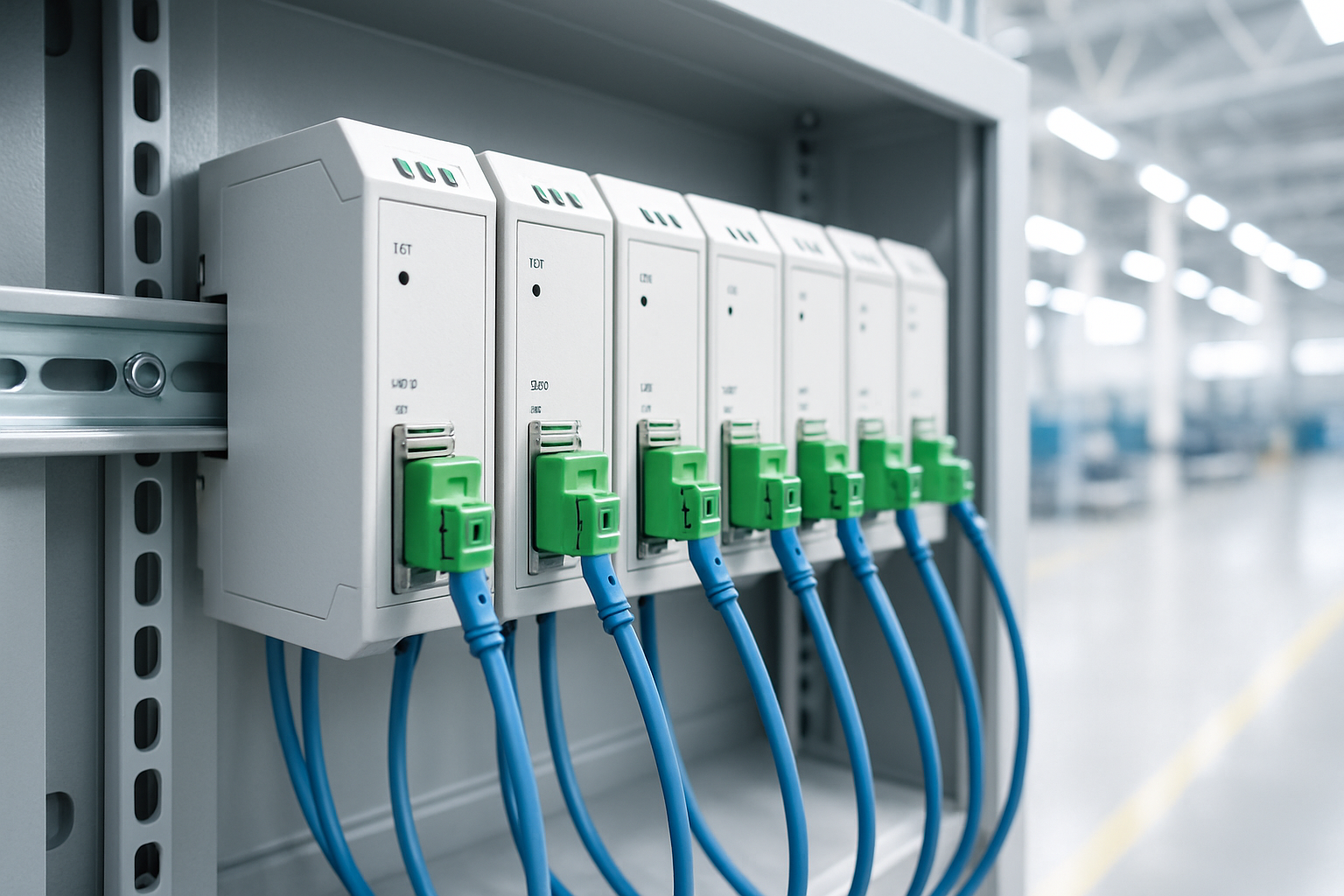
Modular fiber optic systems enable installations in a wide variety of environments: from air-conditioned technical rooms to cramped infrastructure tunnels. The compact design of top-hat rail boxes facilitates integration into existing electrical installations.
IoT integration Fiber optic solutions must also be compatible with legacy systems. Many urban systems are decades old and cannot be replaced in the short term. Modular architectures enable step-by-step modernization without disruptive complete replacements.
Technology roadmap and future security
Smart City infrastructures are operated over 20-30 years, while IoT technologies evolve every 3-5 years. The smart city fiber optic backbone must be able to integrate new technologies without replacing the basic infrastructure.
Modular IoT integration Fiber optic systems support technology evolution through interchangeable components. New connector standards, higher data rates or changed protocols can be integrated by changing modules without having to replace the entire system.
The fiber optic infrastructure itself is inherently future-proof: modern single-mode fibers already support theoretical data rates in the petabit range. Limitations usually arise in the active components and connectors, which can be easily replaced in modular systems.
Economic aspects and financing models
Total cost of ownership for smart city projects
Smart city decisions must take long-term total costs into account, not just initial investments. The smart city fiber optic backbone influences operating costs over decades through maintenance costs, energy consumption and expansion cycles.
Modular IoT integration fiber optic systems reduce long-term costs through service-friendly design and step-by-step expandability. The 5-year warranty on all fiber optic components makes maintenance costs predictable and reduces unforeseeable expenses.
Retractable modules enable eficient maintenance without system downtime, which is particularly valuable for critical smart city services. Reduced downtime means fewer citizen complaints and lower political costs for city administrations.
Funding opportunities and public financing
Smart City projects often benefit from EU, federal and state funding for digitalization and sustainability. The Smart City fiber optic backbone can serve as the basis for various funding programs, from broadband expansion to environmental monitoring.
Modular architectures support funding-compliant project structures by clearly defining different expansion stages. Funding projects can be implemented step by step without fragmenting the overall architecture.
IoT integration Fibre optic projects often qualify for several funding areas at the same time: digitalization, environmental protection, transport transition and citizen services. A well thought-out fibre optic architecture maximizes synergies between different funding programs.
Public-private partnership models
Many smart cities are developing through partnerships between the public sector and private technology providers. The smart city fiber optic backbone must support different business models – from city ownership to service-as-a-service approaches.
Modular systems facilitate PPP models by clearly delineating responsibilities: The city can operate the basic infrastructure, while private partners offer special services on this basis. This reduces risks for all parties involved.
IoT integration fiber optics can also support hybrid financing models in which different urban areas use different financing approaches. Modular architectures enable uniform technical standards despite different operator models.
Integration with existing city networks and legacy systems
Compatibility with existing telecommunications infrastructure
Cities often have established telecommunications infrastructures from different providers and technology generations. The smart city fiber optic backbone must integrate into this heterogeneous landscape without disrupting existing services.
Modular IoT integration Fiber optic systems enable step-by-step migration from legacy systems to modern architectures. Different fiber standards, connector types and protocols can coexist in the same physical infrastructure.
The flexibility of modular front modules facilitates the integration of different provider technologies in a standardized management system. This reduces operational complexity despite technical diversity.
Connection of municipal companies and facilities
Smart cities must integrate all municipal facilities into the smart city fiber optic backbone: from schools and libraries to city administration and municipal utilities. These facilities have very different technical requirements and budget cycles.
Fiber optic solutions for educational institutions are an example of how various public institutions can be efficiently connected to modern backbone systems. Modular systems enable needs-based dimensioning for every facility.
IoT integration Fiber optics must also support the industrial requirements of municipal operations. Public utilities, transport companies and waste disposal companies often require industrial-grade fiber optic solutions with special environmental requirements.
Coordination with energy networks and municipal utilities
Modern smart grids and the smart city fiber optic backbone are developing in parallel and often use shared infrastructure routes. This convergence opens up synergies, but also requires coordinated planning between different urban areas.
Municipal utilities are often natural partners for fiber optic infrastructures as they have extensive routes and technical sites. Modular fiber optic systems can be integrated into existing energy distribution infrastructures.
Fiber optic IoT integration also enables smart grid applications such as intelligent electricity meters, decentralized energy generation and load management. A convergent approach reduces infrastructure costs and increases system synergies.
Maintenance and operation of smart city fiber optic networks
Service-friendly design for urban teams
Municipal IT teams must operate smart city fiber optic backbone systems for decades, often with limited budgets for specialists and training. The fiber optic infrastructure must therefore also be able to be maintained by generalist teams.
Pull-out modules in modular splice systems enable maintenance work without in-depth specialist fiber optic knowledge. Clear labeling and intuitive handling reduce the risk of errors during routine maintenance.
IoT integration Fiber optic systems benefit from systematic fiber routing, which maintains clarity even in complex configurations. This facilitates fault diagnosis and reduces repair times in the event of faults.
Monitoring and preventive maintenance
Smart City infrastructures can use modern monitoring technologies to continuously monitor the Smart City fiber optic backbone and detect problems at an early stage. This enables preventive maintenance instead of reactive repairs.
Modular systems support granular monitoring: problems can be localized to individual modules without affecting the entire system. This simplifies fault diagnosis and enables targeted component replacement.
The fiber optic IoT integration can also implement self-monitoring: Intelligent modules report status information via the network and enable proactive maintenance management. This reduces unplanned outages and optimizes maintenance cycles.
Documentation and knowledge management
Smart City projects last for years and involve various teams, service providers and technology partners. Comprehensive documentation of the Smart City fiber optic backbone is essential for long-term successful operation.
Modular architectures facilitate systematic documentation through standardized components and clear interfaces. Changes and enhancements can be documented in a structured manner without fragmenting the overall documentation.
IoT integration Fiber optic systems can also support digital documentation: QR codes on modules link to online documentation, maintenance histories and configuration data. This modernizes traditional paper-based documentation approaches.
Conclusion: The path to the smart city leads via modular fiber optic infrastructures
The transformation to smart cities requires sophisticated, future-proof fiber optic infrastructures that act as a smart city fiber optic backbone for all digital city services. Modular architectures solve the conflict between long-term infrastructure investment and dynamic technology evolution through flexible, expandable systems.
Successful IoT integration Fiber optic projects start with solid technical foundations and gradually develop into comprehensive smart city ecosystems. From intelligent traffic control and environmental monitoring to digital citizen services – all smart city applications benefit from reliable, scalable fiber optic backbones.
Investing in modular Smart City fiber optic backbone systems pays off in the long term through reduced operating costs, increased system flexibility and simplified technology integration. Cities that invest in future-proof fiber optic infrastructures today are laying the foundation for decades of innovative urban development.
IoT integration Fiber optic technologies are constantly evolving, but the physical fiber infrastructure remains stable in the long term. Modular systems make it possible to benefit from technological advances without devaluing basic infrastructure investments.
At Fiber Products, we develop modular fiber optic systems for the highest quality requirements. Our modular systems combine proven technology with innovative features. With a 5-year guarantee and European production to German quality standards, we offer competitive prices and premium quality for professional fiber optic networks.
Discover our complete product range or visit our online store. Talk to us – together we will develop the optimal solution for your smart city project. Contact us for an individual consultation or find out about other specialist topics in our fiber optic knowledge blog.
Related smart city and municipal network resources
- Smart city fiber optic (overview and planning)
- Fiber optic solutions for municipal utilities (FTTH rollout)
- Fiber optic solutions for network operators (scalable modular expansion)
Request a Consultation
Our experts will advise you on modular fiber optic solutions for your specific application — fast, personal and non-binding.