



Fiber Optic Solutions for Industry 4.0
Robust industrial fiber optic solutions for smart factories and automated production: deterministic, TSN-ready networks, EMC-immune DIN-rail systems and highly available redundancy architectures — engineered in Germany, manufactured in Europe.
- EMC-immune by physics, not by shielding
- Protocol-neutral: EtherCAT, PROFINET & TSN
- One 7HP module standard across every system
Where conventional networks hold industrial automation back
Three pain points come up in almost every fiber optic project for industrial applications — and they decide whether a smart factory network stays reliable under real production conditions.
Electromagnetic interference
Welding equipment, frequency converters and large motors flood production halls with electromagnetic noise that disrupts copper links — and ground loops between cabinets add potential-equalization faults on top. Optical fiber is completely immune to EMI and provides galvanic isolation by design, so the interference problem disappears at the physical layer instead of being patched with ever more shielding.
Downtime is not an option
In automated production, a single failed link can stop an entire line — and every minute of standstill has a price tag. High availability needs redundancy that is planned in from the start: ring topologies with automatic failover, dual-homing of critical components and physically separated cable routes. Rigid, non-modular infrastructure makes exactly that hard to retrofit.
Data growth without lock-in
IoT sensors, machine vision and predictive maintenance push data volumes up year after year, from 100 Mbit/s links towards 10 Gbit/s backbones — and with suitable singlemode optics, fiber bridges distances of up to 40 km without repeaters. What you want to avoid is an infrastructure that forces a rip-and-replace upgrade every time requirements grow.
Fiber optic solutions for industrial applications
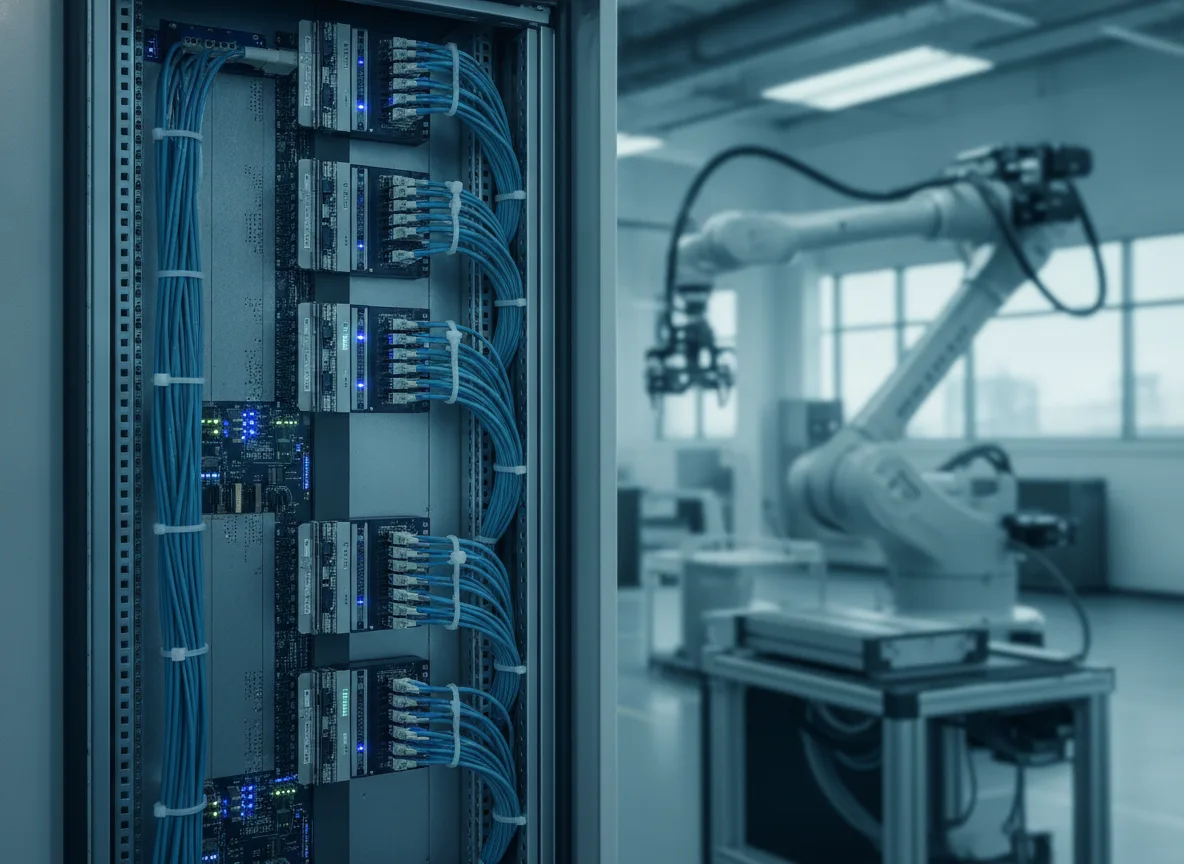
Fiber Products supplies modular product lines built on one 7HP architecture (35.5 mm module width) — from the control cabinet next to the robot cell to the central backbone distribution frame.
One 7HP module concept unites all systems: the uniform module width enables cross-system migration between RailConnect, VarioConnect and SlimConnect. Modules move with your network as it grows — three system lines, one module standard, 100% modular compatible and manufactured in Europe, for maximum investment security through modular future compatibility.
DIN-rail splice boxes
RailConnect fiber boxes for TH35 rails to DIN EN 60715 — straight into standard control cabinets, close to drives and robotics, in controlled indoor environments. Compact cabinet-level fiber counts on the 7HP module architecture.
Discover DIN-rail boxes →VarioConnect 3U ODF system
High-capacity 19-inch backbone distribution for the factory core: high-density, modular 3U capacity that scales without a system change — with LC, SC and E-2000 connectors on interchangeable 7HP modules.
Discover VarioConnect →SlimConnect 1U splice box
High port density for edge sites and IoT gateways in a single height unit (44.45 mm), fully serviceable from the front — on standard 19″ rack mounting.
Discover SlimConnect →Splice modules
The 7HP splice and front modules behind every system — one 35.5 mm module width, interchangeable between DIN rail, 1U edge and 3U/4U backbone, designed for service-friendly maintenance.
Discover splice modules →RailConnect DIN-rail splice boxes
Straight into the control cabinet: RailConnect brings structured fiber management onto the TH35 rail (DIN EN 60715) — next to drives and robotics, with the same 7HP module architecture as every other F4P system.
The factory site — explore it live
Production halls, the EMI-free fiber ring and one network node: scroll and the site rotates with you.
Reliable fiber solutions for smart manufacturing — from one partner
A smart factory network has to outlive several technology cycles. Four reasons industrial automation projects build on F4P and DIAMOND.

In-house European manufacturing
German engineering, manufactured in Europe: our F4P system lines are produced under our own quality control — no anonymous trading stock.
Official DIAMOND partner
As a distribution partner of DIAMOND SA (Switzerland) we complement our range with Swiss precision connectivity — including E-2000 connectors with typically ≤ 0.1 dB insertion loss.
One modular system
The 7HP module standard runs through every product line. Expand, migrate or reconfigure without replacing your installed base — your investment keeps its value.
Personal project consulting
Personal project consulting from our team: we analyze your requirements and develop suitable solution concepts. Project pricing and volume discounts on request.
Plan your industrial fiber optic network online
Configure live in 3D and calculate with real part numbers and prices — before you send a single inquiry.
Loss budget calculator
Check your optical power budget before installation: splices, connectors and fiber length against your transceiver budget — essential when links span large industrial facilities.
Calculate loss budget →DIAMOND configurator
Put together DIAMOND precision components step by step and receive real part numbers for your inquiry or order — no catalog digging required.
Open DIAMOND configurator →Subrack configurator
Build your VarioConnect subrack live in 3D: choose modules, connectors and fiber counts and see real part numbers and prices as you configure.
Configure in 3D →Industrial fiber optic solutions — frequently asked questions
Practical answers on fiber solutions for industrial automation, smart factories and industrial IoT.
Why choose a fiber-optic solution for industrial applications instead of copper?
Optical fiber is completely immune to electromagnetic interference from welding equipment, frequency converters and motors — the dominant noise sources on a factory floor. It also provides galvanic isolation, which prevents ground loops and potential-equalization problems between distributed system components. On top of that, fiber offers the bandwidth headroom for data-intensive applications such as machine vision and predictive maintenance, with data rates from 100 Mbit/s up to 10 Gbit/s. And with suitable singlemode optics, links of up to 40 km without repeaters make it ideal for large industrial facilities.
Which fiber optic components suit smart factories and robotics?
It depends on where in the network the component sits. Close to robots and drives, DIN-rail splice boxes on TH35 rails (DIN EN 60715) integrate directly into standard control cabinets. At edge computing sites and IoT gateways, compact 1U systems deliver high port density in minimal rack space, while 3U/4U ODF systems handle the central backbone distribution. Because passive fiber infrastructure is protocol-neutral, the same components carry EtherCAT, PROFINET, Industrial Ethernet and TSN traffic alike — no vendor lock-in at the physical layer.
How do I optimize fiber optics for industrial IoT and smart manufacturing?
Start with a hierarchical architecture that clearly separates backbone, distribution and access layers — that keeps the network scalable as sensor counts grow. Plan security zones from day one: segmenting operational technology (OT) from information technology (IT) limits the impact of incidents, and continuous monitoring helps detect unusual communication patterns early. For time-critical control traffic, deterministic behavior is achieved with dedicated fiber channels, traffic prioritization and precise network synchronization. A modular fiber platform ties this together, because capacity can be added at any layer without redesigning the whole network.
What redundancy strategies protect critical production lines?
The classic building blocks are ring topologies with automatic failover, which recover quickly from a line interruption, and dual-homing, which connects critical components to two separate switches over separate fiber paths. Physically diverse cable routes eliminate single points of failure — two fibers in the same duct are not true redundancy. Continuous link monitoring adds an early-warning layer, so degrading connections are fixed before they cause downtime. Modular systems make these strategies straightforward to implement and to extend later.
How can I source reliable fiber solutions for smart manufacturing projects?
All our components are orderable online through our shop at fiber-products.de with a transparent pricing structure — from single splice modules to complete distribution systems. For larger projects, you get personal project consulting from our team: we analyze your requirements and develop a suitable solution concept, including detailed network planning and material lists. Project pricing and volume discounts are available on request. Delivery time depends on the project — you receive a binding date with your quote.
Datasheets for download
Everything on this page as a PDF — for tenders, planning and sharing within the project.
19″ subracks
Dimensions, configurations, order numbers and connection technology for the 19″ subracks line.
Open PDF (PDF · 1 page) →1U splice boxes
Dimensions, configurations, order numbers and connection technology for the 1U splice boxes line.
Open PDF (PDF · 7 pages) →Full catalogue
The complete range at a glance — splice boxes, modules, subracks, cable management and the DIAMOND product line.
Open PDF (PDF · 20 pages) →
Successfully implement your Industry 4.0 connectivity
Tell us about your production environment and requirements — you will receive personal project consulting from our team and a concrete solution concept.
Project pricing and volume discounts on request; your delivery date is confirmed as binding in the quote.
Send your project inquiryNon-binding inquiry via our contact form — you will receive personal project consulting from our team.
Related fiber optic solutions
The same modular system technology, tailored to other demanding environments.
Wind power & offshore
Vibration-proof splice boxes and E-2000 connectivity for turbines and wind farm ring networks.
Explore wind power solutions →Data centers
High-density 19″ systems for 400G/800G migration and maximum port density per height unit.
Explore data center solutions →Municipal utilities
From FTTH roll-out to network modernization: system technology for municipal operators.
Explore utility solutions →