Win Fibre Optic Tenders: Tips for Quotes and Civil Works Costing
Win Fibre Optic Tenders: Tips for Quotes and Civil Works Costing
To win fibre optic tenders, you need more than technical competence: precise costing, complete tender documents and a structured bidding process determine success or rejection in the highly competitive FTTH civil works market.
The German fibre market is booming: Deutsche Telekom alone plans 2.5 million new connections annually from 2026, while the new TKG Amendment Act accelerates rollout through simplified permit procedures. For civil works contractors and main contractors, this means enormous opportunities – but only with the right bidding strategy.
As a manufacturer of modular fibre optic solutions and official Diamond Partner, we know the technical requirements from over 500 completed FTTH projects. In this guide, we show you the decisive factors for successful tenders.
Market analysis: Why now is the right time for FTTH projects
The DACH market is experiencing historic rollout growth. The EU Gigabit Infrastructure Act (since November 2025) and the German TKG Amendment 2026 have fundamentally improved the regulatory environment. Notification requirements instead of lengthy permit procedures noticeably reduce project timelines.
- Funding programmes such as the Gigabit Directive 2.0 (April 2024) secure financing
- BayGigabitR and other state programmes create additional incentives
- Municipal tenders are increasing – for example Burgebrach: 30,500m of ducts, 282 house connections
- Copper switch-off at 80% FTTH coverage forces full rollout
Demand currently exceeds available civil works capacity. Companies with optimised costing processes and proven expertise secure the most profitable contracts.
Win fibre optic tenders through precise civil works costing
Fibre optic civil works costs 2026. Detailed costing must distinguish between different installation methods and account for regional characteristics.
| Installation method | Cost per metre | Time required | Typical application |
|---|---|---|---|
| Open trench | €80–150/m | 50–100 m/day | Urban areas, pavements |
| Plough method | €15–30/m | 500–1,000 m/day | Rural routes |
| Horizontal directional drilling | €200–400/m | 20–50 m/day | Crossings, difficult terrain |
| Microduct systems | €25–40/m | 200–400 m/day | Pre-installation, multiple use |
Successful costings also account for restoration costs (30–50% markup for asphalt), disposal costs for excavated material and documentation requirements under funding guidelines.
References and evidence: The entry ticket for major projects
Municipal utilities and public clients demand concrete evidence. Typical requirements have become stricter over the past two years.
- At least 50 house connections (HA) in a comparable project
- Proof of 1,500m duct installation within the last 24 months
- Certified splicers with IEC 61754-15 qualification
- Documented acceptance measurements per VDE Guideline 2026
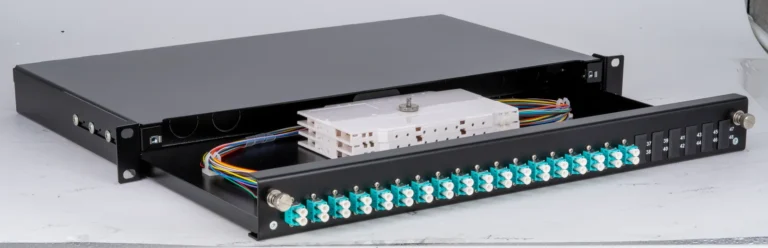
- References for modular systems with up to 96 fibres in 1U
Fiber Products quality pledge: As an official Diamond Partner and manufacturer, we produce modular splice boxes in Europe. Benefit from Swiss precision and in-house manufacturing.
Create FTTH quotes: Costing the technical component correctly
In addition to civil works, passive network infrastructure accounts for approximately 20–30% of total costs. The choice of components determines profitability and future-proofing.
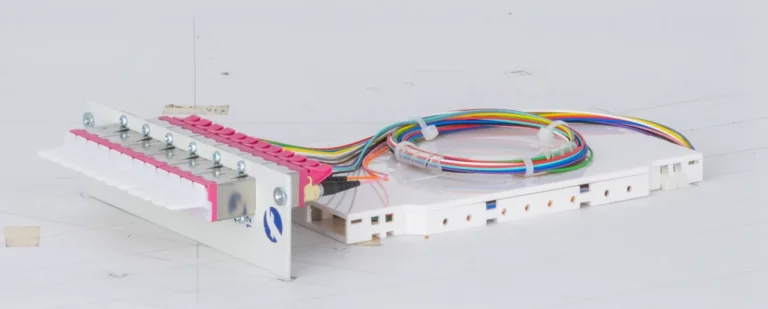
Modern splice boxes with modular design reduce installation time. Investment in high-quality systems pays for itself through lower installation costs and reduced maintenance intervals.
| Component | Standard solution | Modular premium solution | Savings potential |
|---|---|---|---|
| Splice box 48 fibres | 2U, hardwired | 1U SlimConnect | considerable space saving |
| Installation time | 120 minutes | noticeably shorter | considerable time saving |
| Expandability | Full replacement | Modular expansion | lower material costs |
| Warranty | 2 years | 5 years | Lower TCO |
Ensure grant compliance: Understanding Gigabit Directive 2.0
The Gigabit Directive 2.0 from April 2024 defines clear technical requirements. Quotes must explicitly address these to be eligible for funding.
- Microduct installation with 7/10mm diameter for future upgrades
- Use of G.652.D or G.657.A2 fibres
- Documentation of all splices with < 0.25 dB loss
- Georeferenced duct documentation per GIS standard
- Proof of open-access capability of infrastructure
Breaches of these requirements lead to grant clawback. Careful review of tender documents against current funding guidelines is essential.
Win fibre optic tenders: Choosing the right partner
The choice of component suppliers directly affects competitiveness. Selection criteria should go beyond pure purchase price.
Critical factors are delivery capability (warehouse capacity for major projects), on-site technical support and warranty services. Premium manufacturers with own European production offer planning certainty and reduce project risks.
- Made in Europe as an award criterion in public tenders
- Technical support during quote preparation
- Warranty extension to 5 years reduces follow-on costs
Optimise scheduling and resource allocation
Realistic timelines are critical to quote credibility. The new VDE Guideline 2026 defines standard times for various work steps.
Per kilometre of duct installation, plan for: 2–3 civil works teams with 4 people each, 1–2 splicing teams with 2 certified technicians each, and 1 documentation team for complete record-keeping.
Parallelising civil works and cable installation can noticeably reduce total project duration. This requires detailed execution planning with defined milestones.
Risk management in civil works costing
Unforeseen soil conditions and contamination are the most common cost drivers. Professional risk analysis identifies critical route sections in advance.
- Ground-penetrating radar surveys for urban routes
- 15–20% risk contingency for unknown ground conditions
- Contract clauses for additional costs from unexploded ordnance or contamination
- Minimise weather risks through seasonal planning
- Buffer for 5–10% additional duct length in costing
Quality assurance as competitive advantage
Documented quality processes significantly increase tender success rates. Award bodies evaluate demonstrable QA measures positively.
Implementation of an ISO 9001:2015 compliant quality management system is practically mandatory for projects over €500,000. Many tenders additionally require specific fibre optic certifications.
| Certification | Relevance | Validity | Cost |
|---|---|---|---|
| ISO 9001:2015 | Required from €500k | 3 years | €5,000–15,000 |
| Splicer certificate | Required | 2 years | €1,500/person |
| SCC** certificate | Advantageous | 3 years | €8,000–12,000 |
| Waste disposal specialist | Regionally required | 1 year | €3,000–5,000 |
Create FTTH quotes: Sustainability as a differentiator
Sustainability aspects are increasingly important in public tenders. Integration of environmentally responsible methods can make the decisive difference.
- CO₂ accounting for the entire project
- Use of recycled materials in duct systems
- Minimising ground disturbance through HDD
- Using modular systems to reduce electronic waste
- Proof of regional supply chains (< 500km transport)
In particular, the use of modular splice systems with 5 years warranty and interchangeable components is weighted positively in sustainability assessments.
Pricing: The narrow line between competitiveness and profitability
Pricing for FTTH projects requires balancing market rates and necessary margins. Current market analysis shows a price range of €800–1,500 per house connection under standard conditions.
The quote should transparently show these cost blocks: civil works (60–70%), passive infrastructure (20–30%), documentation (5–8%) and warranty reserves (2–3%).
Strategically positioned options for additional services such as extended warranties or maintenance contracts can improve overall margin without raising the base price.
Use digitalisation in the quoting process
Modern costing tools significantly accelerate quote preparation. Specialised software for fibre projects automatically incorporates current standards and regional considerations.
- GIS-based route planning with automatic quantity calculation
- Integration of real-time material prices
- Automatic compliance check against funding guidelines
- Version control for iterative quote optimisation
- Interfaces to tender platforms
Avoid common mistakes in fibre optic tenders
Analysis of failed quotes identifies typical pitfalls. The most common rejection reasons are avoidable.
Incomplete reference evidence leads to rejection in 40% of cases. Missing or outdated certifications disqualify another 25%. Unrealistic timelines without weather buffers are immediately spotted by experienced award bodies.
- Formal errors from missing signatures or stamps
- Use of outdated standards (pre-2024)
- Missing proof of creditworthiness and liquidity
- Unclear service boundaries for subcontractors
- Failure to comply with regional special regulations
FAQ: Win fibre optic tenders and civil works costing
What references are mandatory for municipal FTTH tenders?
At least 50 house connections and 1,500 metres of duct installation within the last 24 months are standard. Additionally, many municipalities require proof of projects with comparable grant handling and documented experience with modular splice systems up to 96 fibres in 1U.
How do I calculate realistic civil works costs for different soil conditions?
Base rates are €80–150/metre for open trench in urban areas. Rock or contaminated soil increases costs to €200–300/metre. Plough method in rural areas is €15–30/metre. Add 15–20% risk contingency for unknown ground conditions.
Which technical standards must an FTTH quote in 2026 necessarily comply with?
There is no fixed set — the tender documents define the binding specification. Commonly referenced are ISO/IEC 11801-1 for premises cabling, the IEC 61754 series for connector interfaces (Part 15 covers the LSH/E-2000 family) and ITU-T L.400 for splices. Splice and link loss limits follow the client’s link power budget, not a universal value, and are verified by field measurement. Regulation (EU) 2024/1309 (Gigabit Infrastructure Act) governs deployment, access and permits — grant compliance is set separately by the funding guidelines.
How important is the choice of component manufacturers for tender success?
Critical – especially with public clients. Made in Europe can account for up to 15% of the evaluation. Manufacturers with 5 years warranty and proven delivery capability significantly increase success. Diamond quality for E2000 connectors is mandatory with many municipal utilities.
What documentation requirements apply to funded FTTH projects?
Complete GIS-compliant duct documentation, splice logs with OTDR measurements for each fibre, photographic documentation of all junction boxes and distribution frames, material certificates per CE/CPR Regulation and monthly progress reports with grant expenditure proof are standard.
How can I differentiate my quotes against major contractors?
Through regional presence, flexible project adaptation and high-quality components. Using modular systems like SlimConnect with 96 fibres in 1U
Request a quote
Have questions about our fibre optic solutions? Our expert team is happy to advise you – free and without obligation.