Hospital fiber optic networks: GDPR-compliant splicing systems for healthcare IT
Modern hospital fiber optic networks form the invisible backbone of digital patient care and must meet the highest standards of data protection and availability. The GDPR poses particular challenges for the technical infrastructure of clinics, as healthcare data is among the most sensitive personal data. High-quality fiber optic splicing systems create the physical basis for secure, failure-resistant network architectures that reliably network modern medical technology while supporting the strictest compliance requirements.
The digitalization of healthcare makes high-performance hospital fibre optic networks a critical infrastructure for patient safety. From imaging and electronic patient records to telemedicine – all modern medical applications require reliable, high-performance data connections that remain stable even during the highest load peaks.
GDPR requirements for hospital infrastructures
The General Data Protection Regulation defines strict technical and organizational measures for handling health data. Clinic fiber optic networks form the physical basis for GDPR-compliant IT systems.
Technical security measures at infrastructure level
GDPR Article 32 requires “technical measures appropriate to the risk” to protect personal data. Hospital fiber optic networks contribute to these safeguards through inherent physical security. Fiber optic transmission is virtually tap-proof, as tapping into light signals is almost impossible without physical access and special equipment.
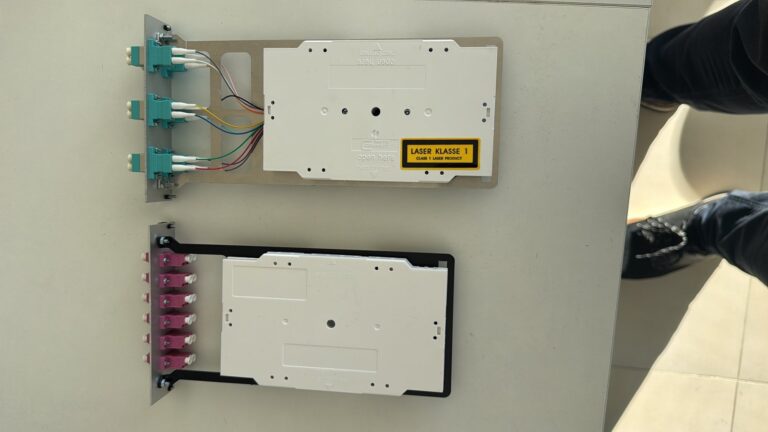
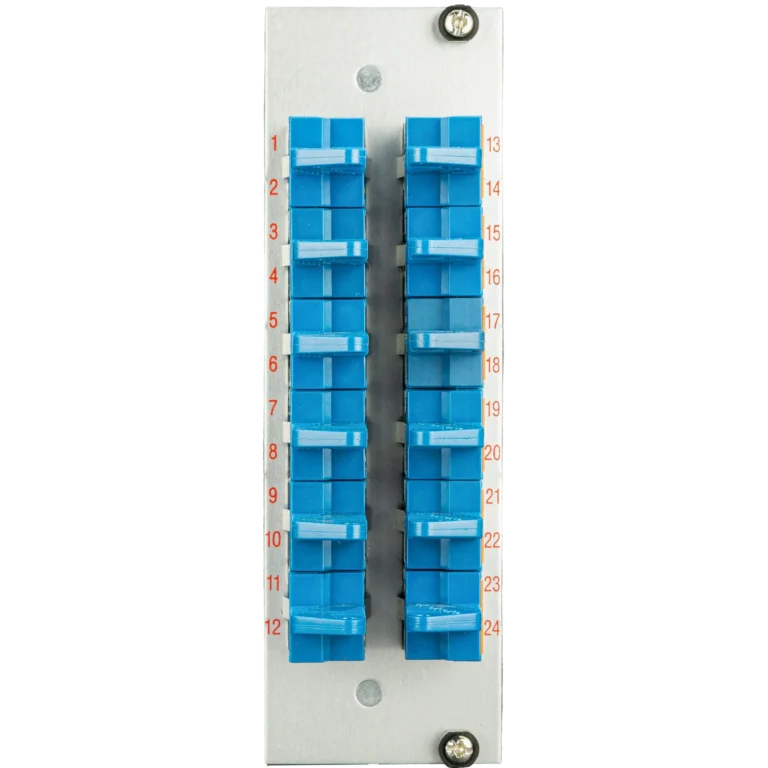
The VarioConnect modular system enables physical network segmentation at infrastructure level. Particularly sensitive areas such as psychiatry or oncology can be connected via dedicated optical fibers that are physically separated from other network areas.
The 5-year guarantee on high-quality European production supports the “guarantee of permanent confidentiality” required by the GDPR. Reliable infrastructure components significantly reduce the risk of security-related failures.
Physical access control and tamper protection
Hospital fibre optic networks must be protected against unauthorized physical access. Distribution points should be located in lockable technical rooms to which only authorized personnel have access.
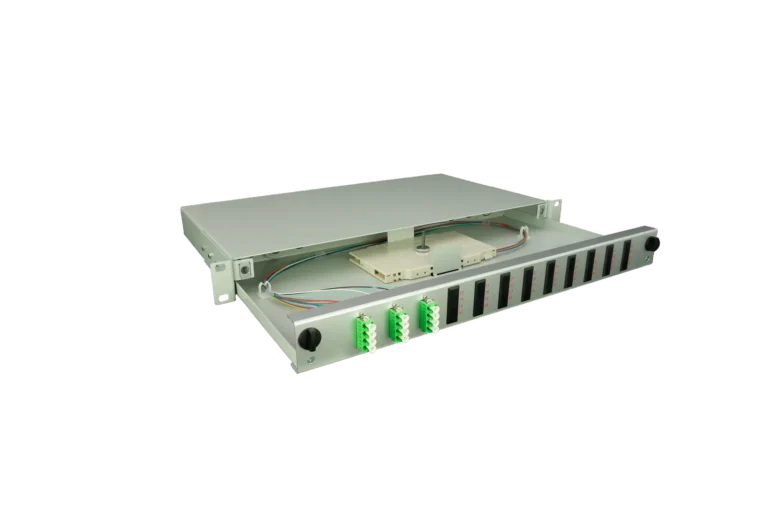
With up to 96 fibers per height unit, the SlimConnect 1U system offers maximum packing density and enables compact installations in secure rooms. The permanently mounted design prevents unintentional connection changes and supports compliance requirements.
Tampering with fiber optic connections is difficult to carry out undetected, as it usually leads to measurable changes in attenuation. Regular optical measurements can therefore serve as an additional safety measure.
Documentation and traceability
GDPR compliance of all data processing systems. Hospital fiber optic networks must therefore be fully documented and each connection must be clearly identifiable.
Standardized labelling systems and asset management support these documentation requirements. Each fiber is given a unique identification that enables it to be traced back to specific applications and data streams.
Medical applications and networking requirements
Hospital fiber optic networks have to network a large number of medical systems, each of which has specific requirements in terms of bandwidth, latency and availability.
Imaging procedures and PACS systems
Picture Archiving and Communication Systems (PACS) are at the heart of modern radiology. High-resolution medical images can be several gigabytes in size and need to be transferred between different locations. Hospital fiber optic networks must provide the appropriate bandwidths without interfering with other critical systems.
CT, MRI and X-ray devices continuously generate large amounts of data. A modern CT device can generate 500-1000 images per series during routine examinations, with each image being several megabytes in size. The transmission of such amounts of data requires gigabit connections or higher.
The VarioConnect 3U and 4U system can support different bandwidth classes in the same infrastructure. Imaging devices receive high-performance connections, while management systems get by with standard gigabit links.
Electronic patient records (EPR)
The widespread introduction of electronic patient records places new demands on hospital fiber optic networks. EHR systems must be quickly and reliably accessible from all workstations, as delays can impair patient care.
Modern EPA systems integrate multimedia content such as photos, videos and audio recordings. This rich content significantly increases bandwidth requirements and makes fiber optics the only economically viable transmission technology.
Cloud-based EPO solutions also require stable, high-performance internet connections. The connection to external data centers must meet the same security and availability standards as internal systems.
Medical device integration and IoT
Modern medical devices are increasingly networked and require a network connection for remote monitoring, software updates and data transfer. From ventilators and infusion pumps to patient monitors – the number of networked devices is growing exponentially.
These medical IoT devices place special demands on hospital fiber optic networks. Many are life-sustaining and must not experience any connection interruptions. At the same time, they must be protected against cyber attacks, which requires appropriate network segmentation.
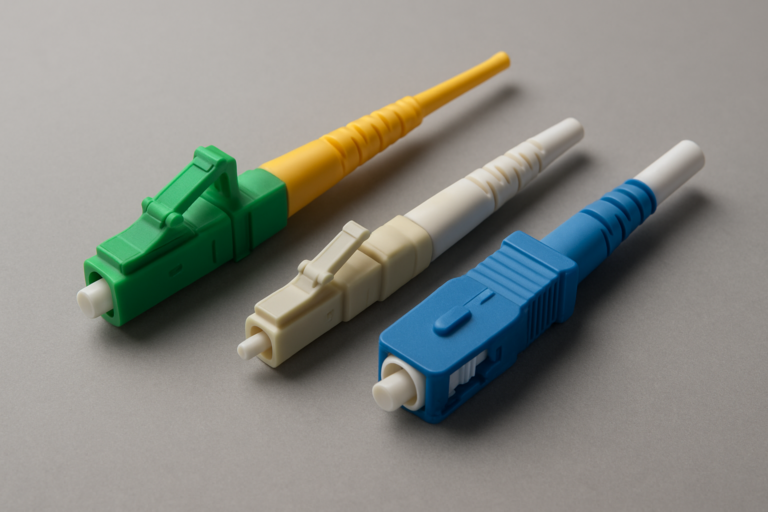
BasicConnect front modules enable flexible integration of different medical devices. Standardized connections can accommodate different device types and can be reconfigured as required without changing the entire infrastructure.
High availability and redundancy concepts
Outages in hospital fiber optic networks can have a direct impact on patient safety. Appropriate redundancy concepts are therefore not only economically but also ethically necessary.
Critical vs. non-critical systems
Not all systems in hospitals have the same criticality. Life-support equipment and emergency systems require maximum redundancy, while administrative systems can get by with standard availability.
Hospital fiber optic networks should support different availability classes. The VarioConnect system can implement ring topologies for critical systems that maintain communication even in the event of cable breaks.
Intensive care units, operating theaters and emergency rooms typically have fully redundant connections via separate cable routes. This ensures communication capability even in the event of major infrastructure damage.
Redundant Internet connections
Today’s clinics need stable internet connections for telemedicine, cloud services and communication with other facilities. Redundant provider connections have therefore become standard.
The integration of several Internet providers in hospital fiber optic networks requires appropriate infrastructure planning. Different providers should be connected via separate cable routes in order to avoid single points of failure.
Load balancing and automatic failover between different Internet connections ensure optimum availability even in the event of provider failures.
Backup systems and disaster recovery
GDPR compliance requires “the ability to quickly restore the availability of and access to personal data in the event of a physical or technical incident”.
Hospital fiber optic networks must be able to connect backup data centers and disaster recovery sites. These connections transport critical patient data and must meet corresponding security and bandwidth requirements.
The modular architecture allows flexible expansion for backup connections without affecting existing systems. Additional fibers can be activated for disaster recovery purposes if required.
Special requirements of various clinical areas
Different areas of a clinic have different requirements for their network infrastructure. Clinic fiber optic networks must take this diversity into account and offer appropriately adapted solutions.
Operating theaters and interventional areas
Operating theaters are the most technically demanding areas of a hospital. Modern operating theaters integrate dozens of networked systems: Anesthesia machines, patient monitors, imaging, navigation systems and documentation systems.
4K endoscopy and 3D imaging generate enormous amounts of data that need to be transmitted in real time. Delays can impair surgical procedures and increase patient risks.
The SlimConnect system offers the necessary bandwidth for such demanding applications. With up to 96 fibers per height unit, even large operating theatres with dozens of rooms can be supplied efficiently.
Intensive care units and monitoring
Intensive care units have particularly high requirements in terms of availability and monitoring. Patient monitors, ventilators and medication pumps must be continuously monitored, often centrally from monitoring stations.
Real-time monitoring requires the lowest latency and highest reliability. Even short connection interruptions can lead to false alarms or missed critical events.
Redundant cabling with automatic failover is standard in intensive care areas. The VarioConnect system can implement such complex redundancy concepts and intercept various failure scenarios.
Outpatient areas and patient admission
Outpatient areas often have fluctuating workloads with corresponding network load peaks. During consultation hours, hundreds of patients can be treated at the same time, while at night only emergencies occur.
WLAN-based systems for mobile documentation require high-performance fiber optic backbones. Tablets and mobile workstations must work reliably anywhere on the hospital premises.
RailConnect top-hat rail boxes are suitable for mobile areas with limited infrastructure requirements. The compact 7TE format can be integrated into existing electrical distribution boards and enables cost-effective fiber optic connections.
Maintenance and service concepts for hospitals
Hospital fiber optic networks must be available around the clock. Maintenance concepts must therefore be particularly well thought out and minimize downtimes.
Service-friendly design
The EasyConnect splice modules enable tool-free maintenance and significantly reduce service times. In hospitals, where every minute counts, critical repairs can be carried out more quickly.
Modular systems enable hot-swap capabilities with corresponding redundancy. Defective modules can be replaced while operations are maintained via backup connections.
Preventive maintenance and monitoring
Continuous monitoring can detect creeping deterioration before it leads to failures. OTDR measurements and performance monitoring identify potential problems at an early stage.
Integration into hospital management systems enables automatic alerting in the event of problems. IT staff can thus react proactively before patient care is compromised.
24/7 support and emergency service
Hospitals need support available around the clock. Infrastructure providers must offer corresponding service level agreements and provide emergency services.
The high-quality European production and 5-year warranty reduce the risk of unplanned downtime. Nevertheless, appropriate spare parts must be kept in stock for critical infrastructures.
Integration with hospital information systems
Hospital fiber optic networks must integrate and coordinate various IT systems. This integration is becoming increasingly complex as new systems are constantly being added.
Hospital Information Systems (HIS)
The hospital information system is the central data platform for all patient-related processes. From admission to treatment to billing – all data converge here.
HIS systems require stable, high-performance connections to all workstations. Failures can paralyze the entire hospital operation and jeopardize patient safety.
The high availability of fiber optic networks supports the reliability requirements of critical HIS systems. Redundant connections ensure operational continuity even in the event of infrastructure problems.
Laboratory Information Systems (LIS)
Laboratory data is time-critical and must be transferred quickly between the laboratory and the wards. Delays can affect treatment decisions and increase patient risks.
Modern laboratory devices are highly automated and continuously generate large amounts of data. Integration into hospital fiber optic networks enables real-time transmission and automatic distribution of findings.
Radiology Information Systems (RIS)
RIS systems coordinate radiological examinations and manage scheduling, execution and reporting. Integration with PACS systems requires corresponding bandwidths.
Teleradiology makes it possible to outsource diagnostic examinations to external specialists. These applications require secure, high-performance Internet connections via the hospital fiber optic networks.
Future trends in hospital IT
Hospital fiber optic networks must be prepared for future technologies. The digitalization of the healthcare sector is continuously accelerating.
Artificial intelligence in medicine
AI-based diagnostics and therapy support are increasingly being used. These systems require extensive data processing and corresponding network capacities.
Deep learning for medical image analysis requires large amounts of data and computing capacity. Cloud-based AI services require stable, high-performance internet connections.
Telemedicine and remote consultations
The coronavirus pandemic has established telemedicine. Video consultations, remote monitoring and digital consultations have now become standard.
High-resolution video transmission for medical consultations requires corresponding bandwidths. 4K video and specialized medical applications can require several gigabits per session.
Internet of Medical Things (IoMT)
The networking of medical devices will continue to increase. From implantable sensors to intelligent medication dispensers – all devices require a network connection.
This proliferation of networked devices places new demands on hospital fiber optic networks. Scalability and flexibility are becoming even more important as the number of networked endpoints grows exponentially.
Compliance and regulatory requirements
In addition to the GDPR, hospital fiber optic networks must also meet other regulatory requirements. Medical device law, radiation protection and industry-specific standards influence infrastructure planning.
Medical Device Regulation (MDR)
Networked medical devices are subject to the MDR and must meet the corresponding safety requirements. The network infrastructure must support these requirements.
Cybersecurity requirements for medical devices require secure network segmentation and corresponding monitoring. Hospital fiber optic networks form the physical basis for such security concepts.
IT Security Act and critical infrastructures
Large hospitals are considered critical infrastructures and are subject to special IT security requirements. Regular security audits and reporting obligations must be fulfilled.
The documentation of the fiber optic infrastructure supports such compliance requirements. Complete asset inventories and network topologies are essential for security audits.
Patient data protection laws of the federal states
In addition to the GDPR, country-specific patient data protection laws apply. These may define additional technical requirements.
The physical security of fiber optics supports these strict data protection requirements. Tap-proof transmission protects sensitive patient data at the infrastructure level.
Conclusion: Fiber optics as the foundation for secure hospital IT
Hospital fiber optic networks are more than just technical infrastructure – they are the foundation for secure, available patient care in the digital age. The inherent security and reliability of fiber optics supports GDPR compliance and creates the basis for innovative medical applications.
Modular splicing systems offer the necessary flexibility for the complex requirements of the healthcare sector. They enable redundant designs for critical systems, support different availability classes and reduce maintenance times thanks to their service-friendly design.
Hospitals that invest in future-proof fiber optic infrastructures today create optimal conditions for the digital transformation of patient care.
At Fiber Products, we develop modular fiber optic systems for the highest quality requirements. Our modular systems combine proven technology with innovative features.
With a 5-year guarantee and European production according to German quality standards, we offer competitive conditions with professional quality for successful fiber optic networks.
Discover our complete product range or visit our online store. Talk to us – together we will develop the optimum solution for your project. Contact us for an individual consultation or find out about other specialist topics in our fiber optic knowledge blog.